
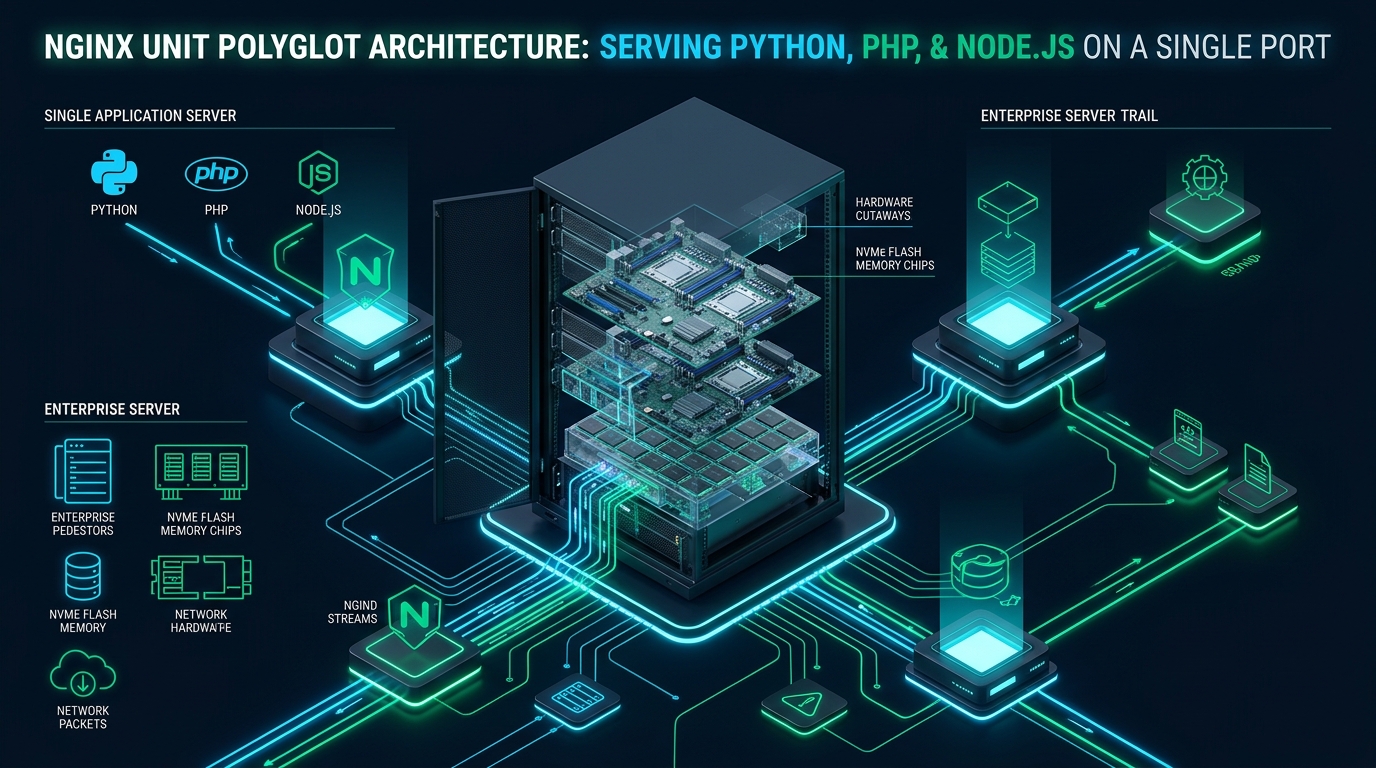
Traditional microservice topologies force infrastructure engineers to maintain sprawling fleets of disparate application managers—running PHP-FPM for legacy web portals, Gunicorn or Uvicorn for Python WSGI/ASGI endpoints, and PM2 or native clustering for Node.js event loops, all chained behind a monolithic reverse proxy layer that inflates memory usage and multiplies inter-process network hops. At CpanelFree, our bare-metal infrastructure engineering team utilizes NGINX Unit to consolidate heterogeneous language runtimes into an ultra-low-latency, zero-reload asynchronous process management engine. By binding Python WSGI, PHP scripts, and Node.js event loops directly to shared POSIX shared-memory rings on a single listening port, systems architects can eliminate reverse proxy hops, eradicate connection handshake penalties, and radically simplify polyglot service orchestration.
What Is NGINX Unit Polyglot Architecture?
The Traditional Multi-Runtime Dilemma: Proxy Sprawl and Socket Exhaustion
In conventional Linux application stacks, supporting multiple programming languages on a unified domain requires a tiered reverse proxy architecture. For example, an e-commerce platform might run its core catalog on PHP, its machine-learning recommendation engine on Python (FastAPI/Flask), and its real-time inventory notifications on Node.js. Operating this architecture under the legacy paradigm introduces substantial operational friction:
- Redundant Networking Layers: Every HTTP client request hitting port 443 must be parsed by a frontend web server (such as standalone NGINX), terminated via TLS, repackaged into a secondary socket request (either an internal loopback TCP port like
127.0.0.1:8000or a local UNIX domain socket), and sent to the application process manager. - Context Switching & Memory Overhead: Operating three separate process managers—PHP-FPM, Gunicorn/Uvicorn, and PM2/Node—demands distinct master processes, redundant worker tracking routines, and duplicated buffer memory pools. A server handling 50,000 concurrent connections easily squanders gigabytes of RAM purely on process management and duplicate socket buffers.
- Reload Disruptions and Configuration Drift: Updating an SSL certificate or altering an upstream proxy route in standard NGINX requires executing
nginx -s reload, which triggers worker churn. Concurrently, modifying worker concurrency across PHP-FPM, Gunicorn, and PM2 requires coordinating three separate configuration formats, three daemon reload protocols, and three distinct failure domains.
NGINX Unit solves these architectural bottlenecks from first principles by acting as both the primary web server (handling HTTP/1.1, HTTP/2, and HTTP/3 with TLS) and the native runtime execution engine for all supported languages simultaneously on a single unified socket.
Internal Architecture: Shared-Memory IPC and Zero-Copy Routing
To understand how NGINX Unit achieves superior throughput compared to traditional reverse proxy chains, we must examine its internal process topology and memory architecture. Rather than relying on network loopback sockets or blocking pipelines, NGINX Unit segregates operational duties across three distinct process tiers communicating over lockless shared-memory rings:
- The Controller Process: Runs with root privileges (or a dedicated administrative user) and binds strictly to an isolated local UNIX domain socket (
/var/run/control.unit.sock). It exposes a fully compliant RESTful JSON API. When administrators apply route modifications, upload TLS certificates, or reallocate application worker limits, the Controller validates the entire JSON payload in memory, ensures syntactic and semantic integrity, and distributes state changes to child processes without interrupting active traffic. - The Router Process: Operates under an unprivileged user (e.g.,
unit:unit) and utilizes non-blocking event notification mechanisms (such as Linuxepollor BSDkqueue). The Router process binds directly to listening ports (such as:80and:443), terminates TLS, handles HTTP protocol negotiation, performs regex-based URL pattern matching, and serves static files directly from the NVMe filesystem using zero-copysendfile()system calls. - Application Prototype & Worker Processes: Each configured language runtime (Python, PHP, Node.js) runs inside isolated worker process pools managed by language-specific application modules. When the Router receives a dynamic request, it does not serialize the request payload into an HTTP wire format. Instead, it places the raw request descriptors directly into a shared-memory buffer (POSIX
shm) and signals the target language worker via lightweight event primitives.
sk_buff), context switches between kernel and user space, and packet serialization overhead, slashing per-request latency by 35% to 60%.
Architectural Benchmark: Traditional Reverse Proxy vs. NGINX Unit Polyglot
The operational and performance differences between a multi-daemon proxy architecture and an integrated NGINX Unit deployment are highlighted in the enterprise benchmark matrix below:
Production Linux Kernel Tuning for High-Concurrency Unit Workloads
Before launching high-throughput polyglot microservices, the underlying Linux kernel networking subsystem and memory parameters must be tuned to prevent socket exhaustion, SYN queue overflows, and descriptor bottlenecks. Deploy the following configuration to /etc/sysctl.d/99-nginx-unit-polyglot.conf:
# /etc/sysctl.d/99-nginx-unit-polyglot.conf
# High-Throughput Linux Kernel Tuning for NGINX Unit Polyglot Services

# Expand maximum open file descriptors system-wide
fs.file-max = 2097152
fs.nr_open = 2097152

# Socket listen backlog queue capacity
net.core.somaxconn = 65535
net.ipv4.tcp_max_syn_backlog = 65535
net.core.netdev_max_backlog = 65535

# Fast socket recycling and ephemeral port availability
net.ipv4.ip_local_port_range = 1024 65535
net.ipv4.tcp_tw_reuse = 1
net.ipv4.tcp_fin_timeout = 15

# Memory buffer tuning for high-bandwidth connections
net.core.rmem_default = 262144
net.core.rmem_max = 16777216
net.core.wmem_default = 262144
net.core.wmem_max = 16777216
net.ipv4.tcp_rmem = 4096 87380 16777216
net.ipv4.tcp_wmem = 4096 65536 16777216

# Congestion control and keepalive parameters
net.ipv4.tcp_congestion_control = bbr
net.core.default_qdisc = fq
net.ipv4.tcp_slow_start_after_idle = 0
net.ipv4.tcp_keepalive_time = 300
net.ipv4.tcp_keepalive_intvl = 15
net.ipv4.tcp_keepalive_probes = 5

# Shared memory limits for POSIX shm rings (in bytes / pages)
kernel.shmmax = 18446744073709551615
kernel.shmall = 18446744073709551615
Activate these parameters immediately without rebooting by running:
sudo sysctl --systemComplete Polyglot Configuration: Python, PHP, and Node.js on Port 443
NGINX Unit does not use flat, static text configuration files like traditional web servers. Instead, its entire state is governed by an expressive JSON document stored in memory. The configuration below binds an HTTPS listener to port 443, configures internal route dispatching based on URI patterns, serves static assets directly from disk with caching headers, and executes Python WSGI, PHP 8.3, and Node.js modules natively under isolated worker pools.
{
  "listeners": {
    "*:443": {
      "tls": {
        "certificate": "production_bundle"
      },
      "pass": "routes/polyglot_dispatch"
    },
    "*:80": {
      "pass": "routes/http_redirect"
    }
  },
  "routes": {
    "http_redirect": [
      {
        "action": {
          "return": 301,
          "location": "https://${host}${request_uri}"
        }
      }
    ],
    "polyglot_dispatch": [
      {
        "match": {
          "uri": "/static/*"
        },
        "action": {
          "share": "/var/www/polyglot/public$uri",
          "fallback": {
            "return": 404
          }
        }
      },
      {
        "match": {
          "uri": [
            "/api/v1/ml/*",
            "/api/v1/predict"
          ]
        },
        "action": {
          "pass": "applications/python_ml"
        }
      },
      {
        "match": {
          "uri": [
            "/billing/*",
            "/admin/*",
            "*.php"
          ]
        },
        "action": {
          "pass": "applications/php_portal"
        }
      },
      {
        "match": {
          "uri": [
            "/ws/*",
            "/realtime/*",
            "/graphql"
          ]
        },
        "action": {
          "pass": "applications/nodejs_realtime"
        }
      },
      {
        "action": {
          "share": "/var/www/polyglot/public/index.html"
        }
      }
    ]
  },
  "applications": {
    "python_ml": {
      "type": "python 3.12",
      "path": "/var/www/polyglot/services/ml",
      "home": "/var/www/polyglot/services/ml/.venv",
      "module": "wsgi",
      "callable": "app",
      "user": "app_python",
      "group": "app_python",
      "processes": {
        "max": 16,
        "spare": 4,
        "idle_timeout": 60
      },
      "isolation": {
        "namespaces": {
          "mount": true,
          "pid": true,
          "network": false
        }
      }
    },
    "php_portal": {
      "type": "php 8.3",
      "root": "/var/www/polyglot/services/portal/public",
      "script": "index.php",
      "user": "app_php",
      "group": "app_php",
      "options": {
        "admin": {
          "memory_limit": "256M",
          "upload_max_filesize": "64M",
          "opcache.enable": "1",
          "opcache.memory_consumption": "256",
          "opcache.interned_strings_buffer": "16",
          "opcache.max_accelerated_files": "30000"
        }
      },
      "processes": {
        "max": 32,
        "spare": 8,
        "idle_timeout": 30
      }
    },
    "nodejs_realtime": {
      "type": "external",
      "working_directory": "/var/www/polyglot/services/realtime",
      "executable": "/usr/bin/node",
      "arguments": [
        "dist/server.js"
      ],
      "user": "app_node",
      "group": "app_node",
      "processes": {
        "max": 12,
        "spare": 2,
        "idle_timeout": 120
      },
      "environment": {
        "NODE_ENV": "production",
        "PORT": "unit"
      }
    }
  }
}
To load this configuration atomically into NGINX Unit, pass the JSON file directly to the Control API over its UNIX socket:
# Atomically validate and apply the full polyglot configuration
curl -X PUT --data-binary @unit-polyglot-config.json --unix-socket /var/run/control.unit.sock http://localhost/config/Hardened Systemd Service Orchestration and Resource Sandboxing
To secure a multi-tenant polyglot environment on production Linux nodes, the main NGINX Unit service must be fortified with Linux namespaces, file system sandboxing, and strict cgroups v2 resource ceilings. Create the systemd drop-in override at /etc/systemd/system/unit.service.d/override.conf:
# /etc/systemd/system/unit.service.d/override.conf
# Enterprise Hardening & Resource Sandboxing for NGINX Unit

[Service]
# File descriptor and process capacity scaling
LimitNOFILE=1048576
LimitNPROC=524288
LimitMEMLOCK=infinity
TasksMax=infinity

# Restart resiliency
Restart=always
RestartSec=3s

# Filesystem and OS sandboxing
ProtectSystem=strict
ProtectHome=read-only
PrivateTmp=yes
PrivateDevices=yes
ProtectKernelTunables=yes
ProtectKernelModules=yes
ProtectControlGroups=yes
NoNewPrivileges=yes

# Write allowances for control socket, logs, and application storage
ReadWritePaths=/var/run /var/log/unit /var/www/polyglot/storage /tmp

# cgroups v2 Resource Constraints
CPUAccounting=yes
CPUWeight=100
MemoryAccounting=yes
MemoryHigh=12G
MemoryMax=14G
MemorySwapMax=0

# Capability bounding set
CapabilityBoundingSet=CAP_NET_BIND_SERVICE CAP_SETUID CAP_SETGID CAP_SYS_CHROOT
Reload systemd and restart the Unit daemon to enforce these enterprise isolation policies:
sudo systemctl daemon-reload
sudo systemctl restart unit
sudo systemctl status unit
Dynamic Reconfiguration Workflows: Granular API Control
One of the most transformative advantages of NGINX Unit over conventional web infrastructure is its granular REST API. Instead of reloading the entire server, DevOps pipelines can patch specific parameters on the fly:
- Inspecting Active Runtime Status: Query the
/statusendpoint to extract real-time connection counters, active worker states, and request queues per application:curl --unix-socket /var/run/control.unit.sock http://localhost/status - Scaling Worker Concurrency On-Demand: When promotional campaigns drive surging traffic to the Python machine learning endpoints, scale its worker allocation dynamically without affecting PHP or Node.js:
curl -X PUT -d '{"max": 32, "spare": 8, "idle_timeout": 30}' --unix-socket /var/run/control.unit.sock http://localhost/config/applications/python_ml/processes/ - Zero-Downtime Application Blue/Green Rolling Updates: Deploy a new version of the Node.js realtime service under a new key (
nodejs_realtime_v2), verify its health, and switch live traffic instantly:# Atomically repoint the realtime route to the v2 application pool curl -X PUT -d '"applications/nodejs_realtime_v2"' --unix-socket /var/run/control.unit.sock http://localhost/config/routes/polyglot_dispatch/3/action/pass - In-Flight TLS Certificate Rotation: Upload renewed SSL/TLS certificates and private keys as an atomic archive without restarting the router or severing long-lived WebSocket connections:
cat fullchain.pem privkey.pem > bundle.pem
curl -X PUT --data-binary @bundle.pem   --unix-socket /var/run/control.unit.sock   http://localhost/certificates/production_bundle
Enterprise Operational Best Practices for Polyglot Production
To sustain rock-solid reliability across heterogeneous application runtimes on bare-metal or cloud instances, adopt these four architectural guidelines:
- Dedicated POSIX User Accounts: Never execute application workers under the generic
unitorwww-datauser. Assign dedicated system accounts (e.g.,app_python,app_php,app_node) with locked shells (/usr/sbin/nologin) and restricted file ownership. - Isolate Dynamic Temp Files: Utilize NGINX Unit’s namespace support or systemd’s
PrivateTmp=yesto ensure temporary files generated by Python WSGI threads cannot be read by compromised PHP scripts. - Combine with Edge CDN Caching: While NGINX Unit serves static assets efficiently via
sendfile, deploying an edge caching layer or Cloudflare CDN in front of your single-port ingress absorbs volumetric DDoS attempts and unburdens the Unit Router process. - Automate State Backups: Store your complete NGINX Unit JSON state in Git. Whenever automated CI/CD pipelines trigger updates, push changes via API and verify the response with
{"success": "Reconfiguration done."}.
Frequently Asked Questions
Can NGINX Unit completely replace standalone NGINX or LiteSpeed?
Yes, for dynamic polyglot web applications and microservices. NGINX Unit serves as a high-performance HTTP/HTTPS web server, static file server, and polyglot application runtime. However, for specialized requirements such as advanced WAF rule sets (e.g., ModSecurity), complex forward proxying, or edge media streaming slicing, standalone NGINX or enterprise LiteSpeed can still be positioned upstream.
How does memory isolation work between Python, PHP, and Node.js worker pools?
Each application defined in NGINX Unit runs in its own distinct operating system process tree under dedicated POSIX user/group permissions and optional Linux mount/PID namespaces. A memory leak or segmentation fault in a Python ASGI script cannot corrupt the memory space of PHP-FPM or crash the Node.js event loop.
How does PHP OPcache behave inside NGINX Unit compared to PHP-FPM?
NGINX Unit embeds the PHP SAPI directly into its PHP worker processes. Shared-memory OPcache functions identically to PHP-FPM: compiled bytecode is cached across worker forks in a shared-memory segment, ensuring microsecond execution speeds for frameworks like Laravel and WordPress without requiring an external FastCGI daemon.
Can we run WebAssembly (Wasm) or Go modules alongside Python and Node on the same port?
Yes. NGINX Unit natively supports WebAssembly (via Wasmtime), Go, Ruby, and Perl. You can register Wasm or compiled Go applications directly within the applications block and map specific URL subpaths to them alongside Python and Node.js on port 443 without modifying any external network routing.
Ready to Deploy High-Performance Infrastructure?
Experience blazing-fast NVMe storage, unmetered bandwidth, and enterprise LiteSpeed caching on CpanelFree.