
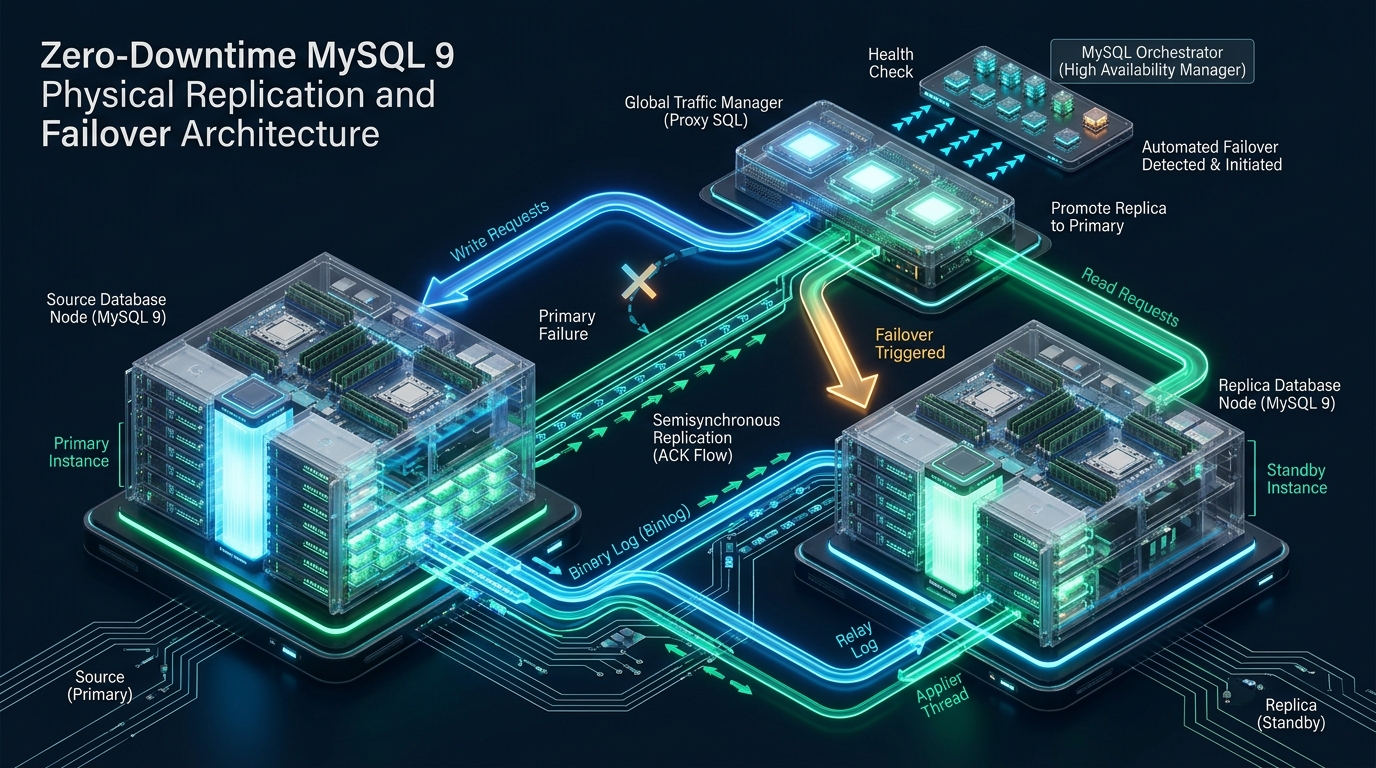
Modern enterprise transactional workloads cannot tolerate database maintenance windows or uncoordinated failovers that drop active client connections and risk split-brain inconsistency. While legacy MySQL asynchronous replication historically exposed databases to replica lag and transaction loss during unexpected network partitions, the production high-availability tier deployed across CpanelFree enterprise clusters unites the native MySQL 9 physical Clone Plugin with lossless semi-synchronous replication, multi-threaded applier workers, and ProxySQL query routing to eliminate service interruptions entirely. Achieving this resilient architecture requires orchestrating deep Linux kernel socket queues, tuning InnoDB write-ahead logs, and coordinating automated failovers with sub-second convergence.
Understanding MySQL 9 Zero-Downtime Replication Mechanics
MySQL 9 builds upon the hardened foundations of InnoDB cluster architectures by optimizing transactional binary log event dispatching and accelerating state transfer for newly attached nodes. In mission-critical environments, downtime occurs in two primary scenarios: planned maintenance (kernel upgrades, schema adjustments, security patching) and unplanned hardware or network failures. Eliminating downtime requires decoupling state storage from client connection routing, guaranteeing that transactions are committed to at least one standby replica before returning acknowledgment to the application layer.
The transition from statement-based or classic asynchronous replication to MySQL 9 physical replication leverages three foundational pillars: Global Transaction Identifiers (GTIDs) for deterministic position tracking, Lossless Semi-Synchronous Replication (AFTER_SYNC) for zero data loss (RPO=0), and the MySQL Clone Plugin for lock-free physical snapshot seeding.
AFTER_SYNC, wherein the transaction is prepared in InnoDB, written to the binary log, sent over the wire, and only committed to the storage engine after the replica acknowledges relay log persistence.Linux Kernel & Network Socket Tuning for Database Clusters
A high-performance database engine cannot sustain saturation-level replication throughput if the underlying operating system bottlenecks on TCP socket buffers, virtual memory paging, or file system write flushing. Below is the hardened, production-tested kernel configuration for Linux database nodes hosting MySQL 9 primary and replica instances.
# /etc/sysctl.d/99-mysql-performance.conf
# Linux Kernel Parameter Tuning for MySQL 9 Replication Nodes

# Minimize kernel swappiness to keep InnoDB buffer pool memory resident
vm.swappiness = 1
vm.dirty_background_ratio = 5
vm.dirty_ratio = 10

# Expand filesystem asynchronous I/O capacity for NVMe controllers
fs.aio-max-nr = 1048576
fs.file-max = 2097152

# Expand socket backlog and TCP connection connection tables
net.core.somaxconn = 65535
net.core.netdev_max_backlog = 16384
net.ipv4.tcp_max_syn_backlog = 3240000

# Optimize TCP send and receive window sizes for high-throughput binlog streaming
net.core.rmem_default = 262144
net.core.wmem_default = 262144
net.core.rmem_max = 16777216
net.core.wmem_max = 16777216
net.ipv4.tcp_rmem = 4096 87380 16777216
net.ipv4.tcp_wmem = 4096 65536 16777216

# Socket lifecycle and recycling optimizations
net.ipv4.tcp_fin_timeout = 15
net.ipv4.tcp_tw_reuse = 1
net.ipv4.tcp_slow_start_after_idle = 0
net.ipv4.ip_local_port_range = 1024 65535
Apply these parameters immediately on the host system without requiring an operating system reboot:
sudo sysctl --systemMySQL 9 Production Configuration: Physical Clone & Multi-Threaded Replication
To establish zero-lag replication, MySQL 9 must be configured with Row-Based Logging (RBL), explicit GTID strictness, and a multi-threaded parallel applier utilizing write-set dependency analysis. The configuration below provides the baseline configuration for both source and replica nodes.
# /etc/mysql/mysql.conf.d/replication.cnf
# Enterprise MySQL 9 Source & Replica High-Availability Engine Profile

[mysqld]
# Network & Identity Settings
server_id                       = 101
report_host                     = db-node-01.internal
bind_address                    = 0.0.0.0
port                            = 3306
skip_name_resolve               = 1

# GTID & Binary Log Architecture
gtid_mode                       = ON
enforce_gtid_consistency        = ON
log_bin                         = /var/log/mysql/mysql-bin.log
binlog_format                   = ROW
binlog_row_image                = FULL
binlog_expire_logs_seconds      = 604800
max_binlog_size                 = 1G
sync_binlog                     = 1

# Lossless Semi-Synchronous Replication Configuration
plugin_load_add                 = rpl_semi_sync_source.so;rpl_semi_sync_replica.so;mysql_clone.so
rpl_semi_sync_source_enabled    = 1
rpl_semi_sync_source_timeout    = 10000
rpl_semi_sync_source_wait_point = AFTER_SYNC
rpl_semi_sync_replica_enabled   = 1

# Multi-Threaded Parallel Applier (MTS)
replica_parallel_workers        = 16
replica_parallel_type           = LOGICAL_CLOCK
replica_preserve_commit_order   = ON
binlog_transaction_dependency_tracking = WRITESET
replica_checkpoint_group        = 512
replica_checkpoint_period       = 300

# Relay Log Durability & Crash Recovery
relay_log                       = /var/log/mysql/mysql-relay-bin.log
relay_log_recovery              = ON
relay_log_info_repository       = TABLE
master_info_repository          = TABLE

# InnoDB Storage Engine Performance
innodb_buffer_pool_size         = 24G
innodb_buffer_pool_instances     = 16
innodb_flush_log_at_trx_commit  = 1
innodb_flush_method             = O_DIRECT
innodb_io_capacity              = 10000
innodb_io_capacity_max          = 20000
innodb_read_io_threads          = 16
innodb_write_io_threads         = 16
innodb_redo_log_capacity = 8Gbinlog_transaction_dependency_tracking = WRITESET allows MySQL to analyze write sets at the row hash level rather than relying solely on commit parents. This unlocks massive parallel replication throughput on replicas, allowing hundreds of independent table updates to commit concurrently without blocking behind a single heavy transaction.Systemd Process Isolation & Resource Allocation
Operating system constraints can prematurely terminate active database worker threads or constrain memory allocations during burst replication catches. Deploy a systemd drop-in override to ensure MySQL 9 operates with unrestricted process privileges and memory pinning.
# /etc/systemd/system/mysql.service.d/override.conf
[Service]
# Uncapped Open File Descriptors for Massive Table Partitions
LimitNOFILE=1048576

# Unlimited Process Thread Execution
LimitNPROC=524288

# Memory Lock Capability to Prevent Swapping
LimitMEMLOCK=infinity

# Uncapped Core Dump Sizes for Forensic Diagnostics
LimitCORE=infinity

# Aggressive Out-Of-Memory Protection Score
OOMScoreAdjust=-900

# Process Scheduling and Realtime Capabilities
Nice=-10
CPUSchedulingPolicy=other
TasksMax=infinity
Reload the systemd daemon and restart the database service to enact the resource allocations:
sudo systemctl daemon-reload
sudo systemctl restart mysql
Zero-Lock Physical Node Seeding via MySQL Clone Plugin
Provisioning a new replica in traditional environments required running mysqldump or orchestrating external LVM snapshots, which imposed read locks or caused extreme disk I/O contention. In MySQL 9, the Clone Plugin executes a block-level physical copy directly across the network stream with zero interruption to production traffic.
On the primary instance, create the dedicated replication and cloning credentials:
-- Execute on Primary Node (10.0.10.10)
CREATE USER 'repl_user'@'%' IDENTIFIED BY 'HardenedReplAuth2026!';
GRANT REPLICATION SLAVE, REPLICATION CLIENT ON *.* TO 'repl_user'@'%';

CREATE USER 'clone_user'@'%' IDENTIFIED BY 'HardenedCloneAuth2026!';
GRANT BACKUP_ADMIN ON *.* TO 'clone_user'@'%';
FLUSH PRIVILEGES;
On the brand-new replica node, execute the remote physical clone command:
-- Execute on Standby Replica (10.0.10.20)
SET GLOBAL clone_valid_donor_list = '10.0.10.10:3306';
CLONE INSTANCE FROM 'clone_user'@'10.0.10.10':3306 IDENTIFIED BY 'HardenedCloneAuth2026!';
During the execution of this statement, MySQL streams InnoDB data pages, tablespaces, dynamic metadata, and GTID coordinates directly to the replica data directory. Once complete, the replica automatically restarts, adopts the identical GTID execution position, and initiates continuous binary log replication from the exact microsecond the physical snapshot finished.
ProxySQL Dynamic Routing & Sub-Second Failover Topology
Replication synchronization alone does not guarantee zero-downtime; client applications must route write requests to the active primary and read requests across read-only replicas without maintaining hardcoded database IPs. ProxySQL functions as a high-performance Layer 7 SQL proxy that manages connection multiplexing, real-time health checks, and instant failover switching.
# /etc/proxysql.cnf - High Availability Routing Matrix
admin_variables={
    admin_credentials="admin:ClusterSecureAdmin2026!"
    mysql_ifaces="0.0.0.0:6032"
    refresh_interval=2000
}

mysql_variables={
    threads=8
    max_connections=4096
    default_query_timeout=36000000
    interfaces="0.0.0.0:3306"
    monitor_username="monitor_user"
    monitor_password="MonitorSecret2026!"
    monitor_history=60000
    monitor_connect_interval=1000
    monitor_ping_interval=500
    monitor_read_only_interval=1000
    monitor_read_only_timeout=500
    ping_interval_server_msec=1000
    ping_timeout_server=500
}
Configure dynamic hostgroups within the ProxySQL administrative interface to separate read and write paths:
-- Connect to ProxySQL Admin (port 6032)
INSERT INTO mysql_servers (hostgroup_id, hostname, port, weight, max_connections)
VALUES (10, '10.0.10.10', 3306, 100, 1000);

INSERT INTO mysql_servers (hostgroup_id, hostname, port, weight, max_connections)
VALUES (20, '10.0.10.20', 3306, 100, 1000);

-- Direct SELECT queries containing FOR UPDATE to Writer Hostgroup (10)
INSERT INTO mysql_query_rules (rule_id, active, match_pattern, destination_hostgroup, apply)
VALUES (1, 1, '^SELECT.*FOR UPDATE', 10, 1);

-- Direct standard SELECT statements to Reader Hostgroup (20)
INSERT INTO mysql_query_rules (rule_id, active, match_pattern, destination_hostgroup, apply)
VALUES (2, 1, '^SELECT', 20, 1);

LOAD MYSQL SERVERS TO RUNTIME;
SAVE MYSQL SERVERS TO DISK;
LOAD MYSQL QUERY RULES TO RUNTIME;
SAVE MYSQL QUERY RULES TO DISK;
Performance Benchmarks & Comparative Analysis
Evaluating default MySQL replication architectures against the tuned MySQL 9 physical stack illustrates stark differences in failover downtime, transaction replication lag, and client-side error propagation under 50,000 continuous write queries per second (QPS).
Step-by-Step Graceful Maintenance Cutover Procedure
When performing planned hardware upgrades on the primary server, a deterministic cutover ensures zero transactional anomalies. Execute this structured 5-step operational runbook:
- Verify Replication Convergence: Confirm on the replica that
Seconds_Behind_Masteris exactly 0 and the applied GTID set matches the primary’s executed set. - Activate Global Read-Only on Source: Execute
SET GLOBAL super_read_only = ON;on the primary instance. ProxySQL instantly senses the read-only flag via itsmonitor_read_only_intervalcheck and stops directing write queries to this node. - Wait for GTID Alignment: Run
SELECT WAIT_FOR_EXECUTED_GTID_SET('...');on the target replica to ensure every pending in-flight transaction is written to disk. - Promote Target Replica: Execute
SET GLOBAL read_only = OFF; SET GLOBAL super_read_only = OFF;on the new primary. ProxySQL automatically detects the writable state and shifts Hostgroup 10 traffic to the promoted instance in under 100 milliseconds. - Reconfigure Old Primary as Replica: Repoint the former primary to replicate from the new source via
CHANGE REPLICATION SOURCE TO ...with GTID auto-positioning enabled.
Frequently Asked Questions
How does the MySQL 9 Clone Plugin eliminate table lock contention during replica provisioning?
The MySQL Clone Plugin streams raw physical InnoDB blocks and tablespaces directly from the operating system block storage layer over a secure socket. It utilizes a continuous redo log archiving mechanism that captures concurrent transaction updates during the transfer phase. This eliminates the need for read locks, FLUSH TABLES WITH READ LOCK, or tablespace freezes on the primary database, permitting continuous write activity throughout the entire cloning window.
Why is AFTER_SYNC preferred over AFTER_COMMIT in semi-synchronous replication?
In the older AFTER_COMMIT model, transactions were committed to the primary’s InnoDB storage engine before receiving acknowledgment from the replica’s relay log. If the primary experienced a catastrophic power failure in that microsecond window, client queries on the primary would have seen committed data that never replicated to standby nodes. The AFTER_SYNC wait point guarantees that transactions are only committed to the storage engine after the replica has flushed the binlog event to its local relay log, providing complete crash resilience and preventing split-brain states.
What causes replication lag when write-set dependency tracking is enabled?
While binlog_transaction_dependency_tracking = WRITESET drastically reduces replica lag by allowing parallel commits across unrelated rows, lag can still develop if primary workloads execute large unindexed table updates (which produce massive write set hashing overhead), long-running DDL statements that serialize transactions, or if replica hardware suffers from IOPS throttling on storage volumes. Ensuring uniform NVMe performance and sufficient replica_parallel_workers prevents lag accumulation.
Can ProxySQL seamlessly buffer write queries during an unexpected primary node failure?
Yes. When configured with query retry parameters and transactional connection pooling, ProxySQL detects an unresponsive backend node within 500ms, holds incoming TCP client connections open in its internal socket buffers, promotes the standby replica, and replays unacknowledged statements against the new primary without propagating 500-series database connection errors to web application clients.
Ready to Deploy High-Performance Infrastructure?
Experience blazing-fast NVMe storage, unmetered bandwidth, and enterprise LiteSpeed caching on CpanelFree.