
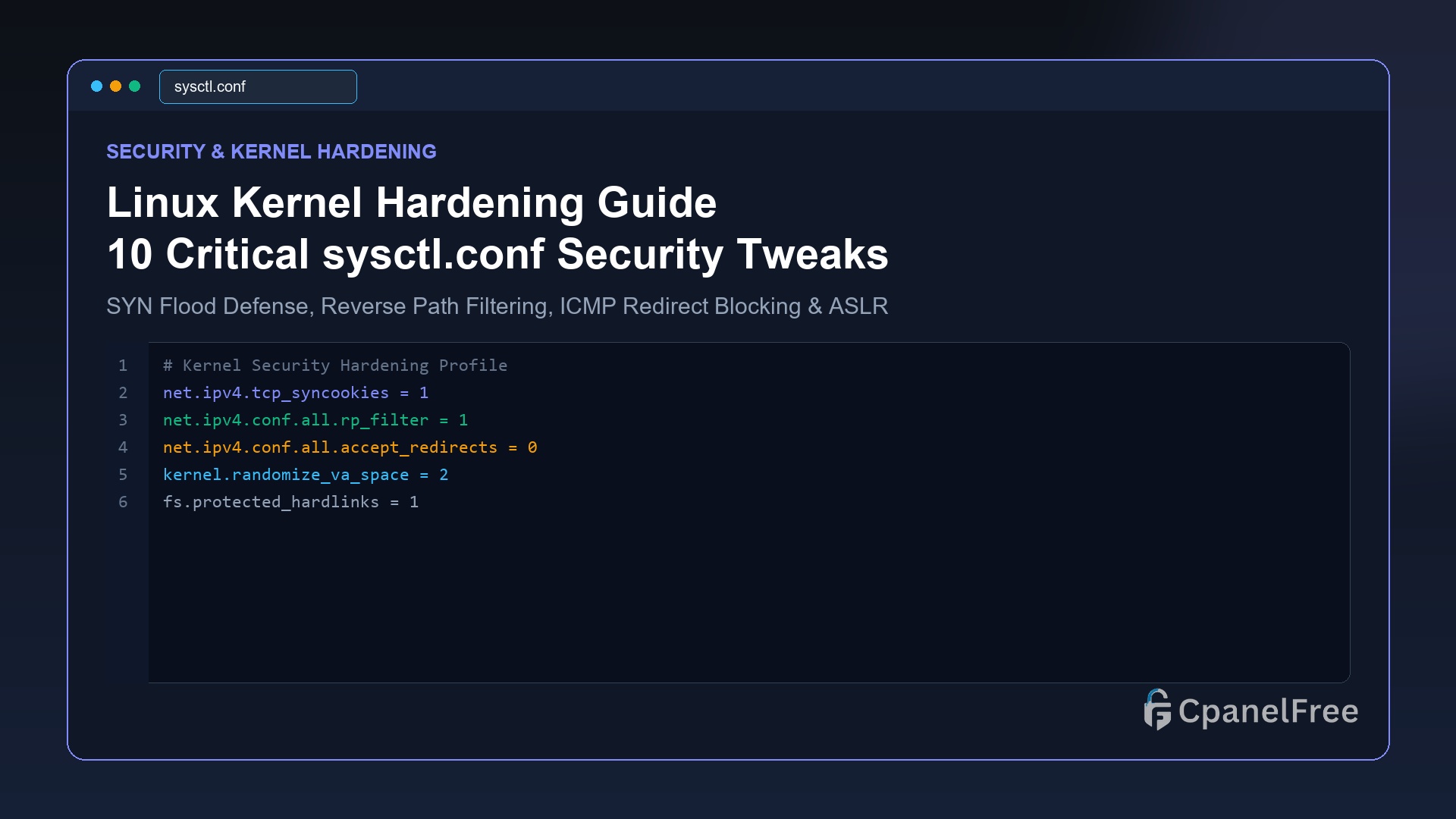
To harden the Linux kernel against network attacks, edit /etc/sysctl.d/99-security.conf. Enable TCP SYN cookies with net.ipv4.tcp_syncookies = 1 to survive SYN floods, enable reverse path filtering with net.ipv4.conf.all.rp_filter = 1 to block IP spoofing, disable ICMP redirects (accept_redirects = 0), and maximize ASLR memory protection with kernel.randomize_va_space = 2. Apply immediately with sudo sysctl --system.
Why Default Linux Kernel Configurations Are Vulnerable
Out of the box, Linux distributions prioritize broad network compatibility over defense-in-depth security. Default kernel settings frequently allow routers to redirect your traffic via ICMP, accept packets with forged source IP addresses, and permit unprivileged users to create symlink pointers to sensitive system files.
When deploying a public-facing cloud VPS, relying solely on firewall rules (like UFW or iptables) is insufficient. If an attacker floods your web server with spoofed TCP SYN packets or exploits a buffer overflow in an application daemon, kernel-level hardening provides an immutable lower-level defensive barrier that intercepts attacks before they consume server memory.
The 10 Critical sysctl.conf Security Tweaks
Create a dedicated security override file in /etc/sysctl.d/. Using modular files in this directory ensures your customizations will not be overwritten by OS distribution updates:
sudo nano /etc/sysctl.d/99-security-hardening.confInsert the following hardened security profile:
# 1. Defend Against TCP SYN Flood Denial-of-Service Attacks
net.ipv4.tcp_syncookies = 1
net.ipv4.tcp_max_syn_backlog = 4096
net.ipv4.tcp_synack_retries = 2

# 2. Block IP Spoofing via Strict Reverse Path Filtering
net.ipv4.conf.all.rp_filter = 1
net.ipv4.conf.default.rp_filter = 1

# 3. Reject ICMP Redirects (Prevent Man-in-the-Middle Routing Attacks)
net.ipv4.conf.all.accept_redirects = 0
net.ipv4.conf.default.accept_redirects = 0
net.ipv6.conf.all.accept_redirects = 0
net.ipv6.conf.default.accept_redirects = 0

# 4. Do Not Send ICMP Redirects (Server is Not a Router)
net.ipv4.conf.all.send_redirects = 0
net.ipv4.conf.default.send_redirects = 0

# 5. Disable Source Routing (Prevent Attackers Dictating Packet Paths)
net.ipv4.conf.all.accept_source_route = 0
net.ipv4.conf.default.accept_source_route = 0
net.ipv6.conf.all.accept_source_route = 0

# 6. Ignore Broadcast ICMP Echo Requests (Mitigate Smurf Amplification)
net.ipv4.icmp_echo_ignore_broadcasts = 1

# 7. Log Martians (Log Impossible / Spoofed Packet Addresses)
net.ipv4.conf.all.log_martians = 1
net.ipv4.conf.default.log_martians = 1

# 8. Ignore Bogus ICMP Error Responses
net.ipv4.icmp_ignore_bogus_error_responses = 1

# 9. Restrict Kernel Pointer Exposure & dmesg to Root
kernel.dmesg_restrict = 1
kernel.kptr_restrict = 2

# 10. Memory Protection: Maximize Address Space Layout Randomization (ASLR)
kernel.randomize_va_space = 2
fs.protected_hardlinks = 1
fs.protected_symlinks = 1
fs.protected_fifos = 2
fs.protected_regular = 2
Step 2: Activating & Testing the Hardened Profile
Load all sysctl profiles from disk and verify they took effect:
# Reload all system sysctl rules
sudo sysctl --system

# Confirm SYN cookies are enabled
sysctl net.ipv4.tcp_syncookies

# Confirm ASLR memory randomization is maximized (returns 2)
sysctl kernel.randomize_va_space
Detailed Security Threat Mitigation Matrix
| Attack Vector | Target Directive | Defensive Mechanism |
|---|---|---|
| TCP SYN Flood | tcp_syncookies = 1 |
Encodes connection state into initial sequence numbers when backlog fills, preventing memory starvation. |
| IP Address Spoofing | rp_filter = 1 |
Verifies that incoming packets arrive on the network interface the kernel would use to reply. Discards spoofed packets. |
| MITM Traffic Hijacking | accept_redirects = 0 |
Prevents malicious rogue routers or compromised neighbors on the LAN from altering server routing tables. |
| Buffer Overflow Exploits | randomize_va_space = 2 |
Randomizes the memory locations of program stacks, data structures, and libraries, making Return-Oriented Programming (ROP) fail. |
Frequently Asked Questions (FAQ)
Can these sysctl hardening rules break normal web hosting traffic?
No. These rules strictly target malicious protocol manipulation (such as source routing and spoofed packets). Legitimate HTTP, HTTPS, SSH, FTP, and DNS traffic operates identically while benefiting from enhanced resilience against denial-of-service floods.
What is a “Martian packet”?
A Martian packet is a network packet that arrives with a source IP address from an unroutable or reserved address block (e.g. 127.0.0.1 arriving from the public internet). Setting log_martians = 1 logs these anomalies directly into /var/log/syslog for intrusion analysis.
🔗 Recommended Related Technical Guides
File Descriptor Limits & Socket Ephemeral Port Exhaustion Tuning
Beyond defensive network parameters, hardening your server’s resilience involves preventing resource starvation when high-traffic web applications open thousands of concurrent socket connections:
# Raise system-wide maximum file descriptor allocation
fs.file-max = 2097152

# Expand ephemeral port range for high-concurrency reverse proxies
net.ipv4.ip_local_port_range = 10240 65535

# Allow reuse of TIME_WAIT sockets for outgoing client connections
net.ipv4.tcp_tw_reuse = 1

# Reduce TIME_WAIT timeout from 60s to 30s to cycle closed sockets faster
net.ipv4.tcp_fin_timeout = 30
Setting tcp_tw_reuse = 1 is critical when Nginx reverse proxies traffic to local backends (like Node.js, PHP-FPM, or Python Gunicorn), preventing the operating system from running out of free TCP socket pairs under heavy load spikes.
Kernel Memory & Privilege Hardening: ptrace & BPF JIT
Modern privilege escalation exploits frequently target process tracing (ptrace) and the in-kernel eBPF Just-In-Time (JIT) compiler. Add these advanced defensive directives to your /etc/sysctl.d/99-security-hardening.conf:
# Restrict ptrace so non-root users cannot spy on or attach to other processes
kernel.yama.ptrace_scope = 2

# Harden eBPF JIT compiler against kernel spray attacks
net.core.bpf_jit_harden = 2

# Restrict unprivileged user namespaces to prevent container breakout exploits
kernel.unprivileged_userns_clone = 0
Applying kernel.yama.ptrace_scope = 2 ensures that only administrative processes with the CAP_SYS_PTRACE capability can debug running binaries, stopping attackers who gain low-privileged shell access from dumping database passwords out of process memory.
Deploy Hardened Cloud Infrastructure on CpanelFree
Protect your web assets with native DDoS mitigation, isolated KVM virtualization, and enterprise hardware security on CpanelFree.