
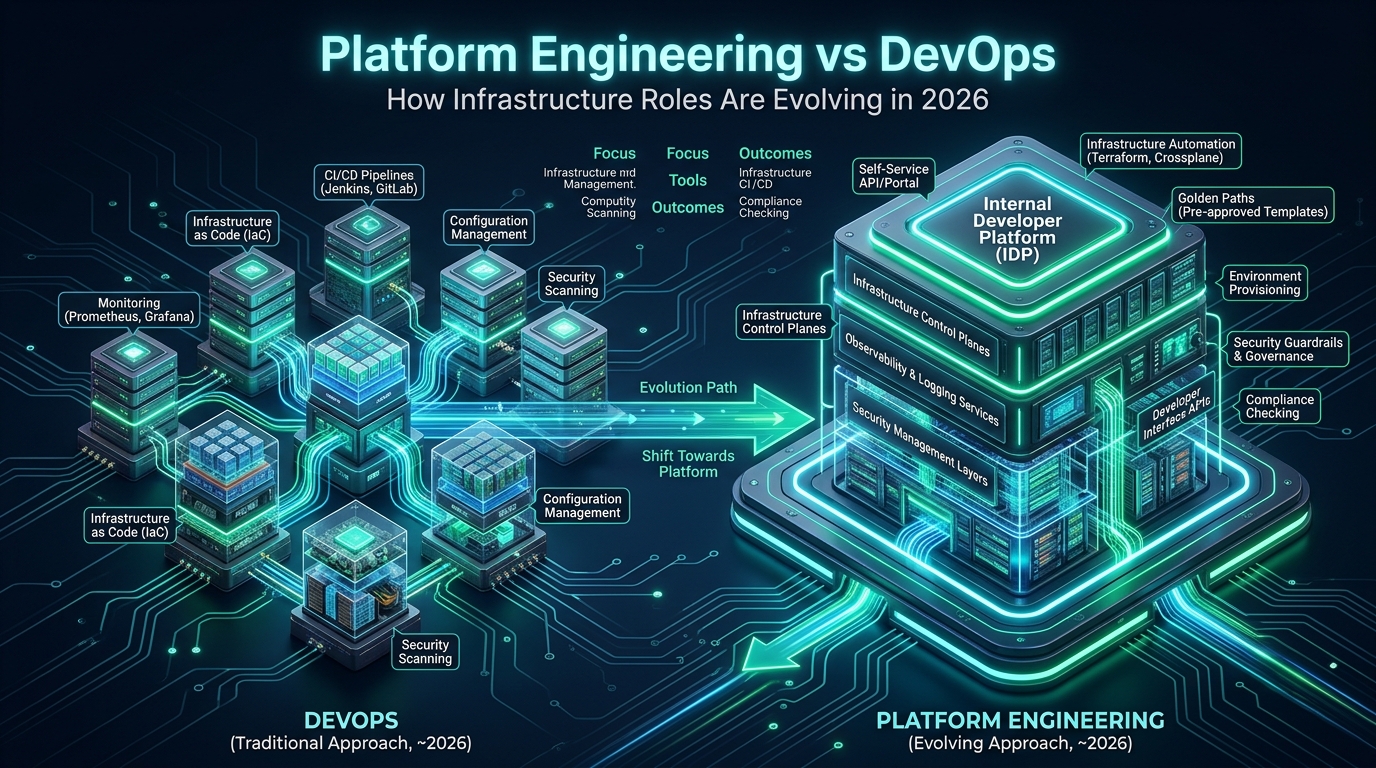
Modern software engineering organizations are wrestling with unprecedented cognitive load: developers now juggle container registries, Helm charts, Kubernetes ingress controllers, IAM policies, and distributed tracing setups instead of shipping customer-facing features. While traditional DevOps promised end-to-end autonomy (“you build it, you run it”), in practice it frequently degenerated into shadow operations teams buried beneath endless ticket queues or overwhelmed application developers coping with leaky infrastructure abstractions. At CpanelFree, we have watched infrastructure teams transition from fractured, ad-hoc CI/CD scripts to centralized, productized control planes that restore developer flow and operational sanity.
Platform Engineering vs DevOps: What Is the Difference in 2026?
Quick Answer: In 2026, DevOps principles (continuous integration, automation, cultural collaboration) are operationalized into Platform Engineering. Rather than forcing application developers to master Kubernetes manifests, Terraform, and cloud networking, platform teams build Internal Developer Platforms (IDPs) that offer self-service golden paths, automated policy enforcement, and reduced cognitive load.
To understand the seismic shift occurring across technical infrastructure in 2026, one must distinguish between a cultural philosophy and an engineering discipline. DevOps emerged in 2009 as a cultural rebellion against the rigid silos separating software developers from system administrators. Its central philosophy was simple yet profound: developers and operations personnel should share responsibility for the entire application lifecycle, from design and coding to deployment and runtime monitoring.
However, as cloud-native architectures expanded into sprawling microservices topologies, multi-region Kubernetes clusters, serverless pipelines, and distributed observability meshes, the promise of “you build it, you run it” collapsed under its own weight. Software developers who previously wrote business logic were suddenly expected to become masters of Helm templates, BGP networking, cloud security baselines, and distributed consensus algorithms. The result was widespread cognitive burnout, inconsistent deployment patterns, and operational paralysis.
Platform Engineering is the enterprise discipline that resolves this systemic breakdown. Instead of treating infrastructure as a collection of ticket requests or burdening every product squad with raw infrastructure plumbing, platform engineering treats the platform itself as a dedicated software product. The platform team acts as a product squad whose primary customers are internal application developers. By designing, building, and operating an Internal Developer Platform (IDP), platform engineers provide curated “Golden Paths”—reusable, pre-architected, compliant, and automated workflows that enable developers to independently provision environments, deploy code, and observe runtimes without touching low-level infrastructure configuration.
Why Traditional DevOps Stalled: The Cognitive Overload Crisis
The root cause behind the industry-wide evolution toward platform engineering is cognitive load theory. In modern engineering organizations, human working memory is a scarce resource. When an application engineer must spend 35% of their weekly capacity debugging Terraform state locks, configuring Cilium eBPF network policies, and reconciling mutual TLS certificates, their capacity to innovate and deliver core business value is degraded.
Several compounding technical factors triggered this operational plateau:
- Leaky Infrastructure Abstractions: Exposing raw Kubernetes YAML or HashiCorp Configuration Language (HCL) to application developers forced them to understand underlying cloud primitives, leading to copy-pasting of insecure manifests across microservices.
- Configuration Drift and Fragmentation: Without standardized platform blueprints, five different product teams within the same enterprise often deploy five divergent CI/CD pipelines, disparate database version configurations, and non-standardized logging agents.
- Security & Compliance Blindspots: Shifting security “left” without automated guardrails placed unrealistic auditing burdens on developers. Vulnerabilities routinely slipped into production through misconfigured S3 buckets, unpatched container bases, or over-privileged IAM roles.
- The Re-emergence of Shadow Ops: In many organizations, developers overwhelmed by infrastructure complexity informally designated a “DevOps person” on their team to handle deployments, accidentally recreating the exact silos and single points of failure that DevOps was created to eliminate.
Comprehensive Architectural Comparison: DevOps vs. Platform Engineering
The following technical comparative matrix outlines the architectural and operational contrasts between traditional DevOps practices and modern 2026 Platform Engineering implementations:
| Dimension / Metric | Traditional DevOps (Silo/Tickets) | Platform Engineering (IDP / 2026) |
|---|---|---|
| Core Paradigm | Cultural philosophy & shared responsibility | Product discipline (Platform as a Product) |
| Developer Interface | Raw CLI, Terraform, Helm manifests, JIRA tickets | Self-service developer portal, declarative API, CLI |
| Cognitive Friction | High (developers manage cloud primitives) | Low (Golden Paths abstract low-level machinery) |
| Provisioning Latency | Hours to days (manual reviews & approvals) | Sub-minute (automated dynamic control plane) |
| Governance & Security | Post-hoc audits & manual static code checks | Policy-as-Code guardrails (OPA/Kyverno) baked in |
| Mean Time to Onboard (MTTO) | 3 to 6 weeks for new engineers | < 1 day via pre-configured scaffolding |
| FinOps & Resource Allocation | Opaque cloud bills, manual untagged auditing | Automated tagging, quota limits, idle resource reclamation |
The 4 Essential Pillars of an Internal Developer Platform (IDP)
An Internal Developer Platform (IDP) is not an off-the-shelf single binary; it is a composite architectural plane consisting of four tightly integrated layers:
- Developer Control Plane & Service Catalog: A centralized portal (such as Spotify Backstage, Port, or internal custom frontends) that provides software templates, architectural scorecards, documentation, and real-time dependency topology mapping.
- Infrastructure Orchestration & Composition: Declarative control planes (such as Crossplane, OpenTofu operators, or Terraform Cloud agents) that translate high-level developer resource requests into secure, validated multi-cloud or on-premises resources.
- Environment Management & Ephemeral Previews: Automated systems that spin up isolated staging and preview environments for every pull request, allowing developers to test against production-like topologies before merging.
- Automated Security & Compliance Guardrails: Policy engines running Open Policy Agent (OPA) or Kyverno that enforce corporate compliance, encrypt data at rest, and audit network traffic transparently without developer intervention.
Architecture Note: Golden Paths must never become “Golden Cages.” Modern platform engineering succeeds when adherence to the platform is voluntary because the paved road is dramatically faster, safer, and easier than manual bespoke provisioning. If an engineering team requires a bespoke distributed database for a unique microsecond-latency workload, the platform must provide an explicit, well-documented escape hatch rather than blocking organizational progress.
Production Configuration: Declarative Control Plane & Linux Node Hardening
To ground these architectural concepts in production reality, let us examine two concrete configurations used by enterprise platform engineering teams in 2026: a declarative Crossplane Composite Resource Definition (XRD) that abstracts a complete microservice stack, followed by enterprise Linux kernel tuning parameters for high-throughput platform worker nodes.
1. Declarative Platform Custom Resource: AppEnvironment API
Instead of requiring developers to write 400 lines of Terraform containing IAM bindings, subnet IDs, and KMS keys, the platform exposes a concise, intent-driven declarative resource:
# /etc/platform/crds/app-environment.yaml
# Production Declarative AppEnvironment Definition (Crossplane / Kubernetes Control Plane)
apiVersion: platform.cpanelfree.internal/v1alpha1
kind: AppEnvironment
metadata:
  name: billing-service-prod
  namespace: team-payments
spec:
  # Intent-driven specification exposed to application developers
  tier: production
  workload:
    image: registry.internal.net/payments/billing-service:v2.14.0
    replicas: 4
    port: 8080
    autoscaling:
      minReplicas: 4
      maxReplicas: 32
      targetCPUUtilizationPercentage: 70
  datastore:
    engine: postgresql
    version: "16.2"
    storageGB: 100
    highAvailability: true
    backupSchedule: "0 2 * * *"
  networking:
    ingressDomain: billing.internal.net
    requireMutualTLS: true
    rateLimitRequestsPerSec: 2500
  observability:
    alertChannel: slack-payments-pager
    traceSampleRate: 0.15
  # Underlying platform composition handles:
  # - VPC peering & private subnets
  # - KMS customer-managed key rotation
  # - Automated DNS registration & Let's Encrypt / Vault mTLS certs
  # - NetworkPolicy egress lock-down
2. Production Linux Kernel Tuning for Platform Worker Nodes (/etc/sysctl.d/99-platform-worker.conf)
Platform engineering hosts hundreds of microservices and container runtimes across dense Linux worker clusters. To eliminate connection throttling, SYN floods, file descriptor exhaustion, and socket memory pressure, deploy this production-grade kernel configuration:
# /etc/sysctl.d/99-platform-worker.conf
# Enterprise Linux 9 / Ubuntu 24.04 LTS Kernel Optimization for Platform Cluster Nodes
# Target: High-Density Container Runtimes (containerd/CRI-O), Ingress Gateways, & Platform Routers

### File Descriptors & Process Capacity ###
fs.file-max = 2097152
fs.inotify.max_user_watches = 524288
fs.inotify.max_user_instances = 8192
kernel.pid_max = 4194304

### Socket Backlogs & Inbound Connection Queueing ###
# Prevent dropped TCP handshakes during high-concurrency traffic bursts
net.core.somaxconn = 65535
net.ipv4.tcp_max_syn_backlog = 32768
net.core.netdev_max_backlog = 32768

### TCP Window Sizing & Buffer Scaling (Autotuning) ###
# Max buffer sizing: 16MB read/write for high-throughput container networking
net.core.rmem_default = 262144
net.core.rmem_max = 16777216
net.core.wmem_default = 262144
net.core.wmem_max = 16777216
net.ipv4.tcp_rmem = 4096 87380 16777216
net.ipv4.tcp_wmem = 4096 65536 16777216

### Modern TCP Congestion Control (BBR) & Queue Disciplines ###
# Fair Queueing packet scheduler with Google BBR congestion control
net.core.default_qdisc = fq
net.ipv4.tcp_congestion_control = bbr

### Ephemeral Port Range & Socket Recycling ###
net.ipv4.ip_local_port_range = 1024 65535
net.ipv4.tcp_tw_reuse = 1
net.ipv4.tcp_fin_timeout = 15

### Netfilter Connection Tracking (Conntrack) Hardening ###
# Eliminate dropped packets in containerized service meshes and NAT ingress
net.netfilter.nf_conntrack_max = 1048576
net.netfilter.nf_conntrack_tcp_timeout_established = 600
net.netfilter.nf_conntrack_tcp_timeout_close_wait = 30

### Virtual Memory & Paging Efficiency ###
# Restrict kernel swapping and prioritize active file page caching
vm.swappiness = 10
vm.dirty_ratio = 15
vm.dirty_background_ratio = 5
vm.max_map_count = 1048576
Apply the kernel parameters immediately without rebooting via:
sudo sysctl --system3. Hardened Systemd Unit for Platform Automation Daemon
Enterprise platform engineering mandates strict process isolation, cgroups v2 resource capping, and security sandboxing for local platform daemons and runner agents:
# /etc/systemd/system/platform-agent.service
[Unit]
Description=Internal Developer Platform Automation Agent
After=network-online.target remote-fs.target
Wants=network-online.target

[Service]
Type=simple
User=platform-runner
Group=platform-runner
WorkingDirectory=/opt/platform-agent
ExecStart=/opt/platform-agent/bin/agent-daemon --config=/etc/platform/config.yaml
Restart=always
RestartSec=5s

# Security Hardening & Sandboxing
NoNewPrivileges=true
ProtectSystem=strict
ProtectHome=true
PrivateTmp=true
PrivateDevices=true
ProtectKernelTunables=true
ProtectControlGroups=true
RestrictAddressFamilies=AF_INET AF_INET6 AF_UNIX
RestrictRealtime=true
CapabilityBoundingSet=CAP_NET_BIND_SERVICE
AmbientCapabilities=CAP_NET_BIND_SERVICE

# Cgroups v2 Resource Governance
MemoryHigh=2G
MemoryMax=3G
CPUQuota=200%
TasksMax=1024

[Install]
WantedBy=multi-user.target
How Engineering Roles Are Evolving in 2026
The rise of platform engineering is fundamentally redefining job titles, daily workflows, and career trajectories across the infrastructure landscape:
- The Systems Administrator → Infrastructure Control Plane Engineer: Traditional SysAdmins are no longer manually imaging bare-metal servers or hand-editing Apache virtual hosts. In 2026, they leverage their deep low-level knowledge of Linux kernels, systemd cgroups, storage subsystems, and BGP routing to build the resilient compute foundations that power internal platforms.
- The DevOps Engineer → Platform Product Manager & Developer Experience (DevEx) Architect: Engineers with the title “DevOps Engineer” are shifting away from being perpetual ticket-responders who debug CI/CD failures. Instead, they act as product managers for internal tooling—interviewing developers, designing friction-free CLI workflows, automating policy enforcement, and measuring developer satisfaction (DevEx).
- Site Reliability Engineers (SREs): Rather than reacting to alerts during on-call firefights, SREs partner directly with platform teams to codify Service Level Objectives (SLOs), automated canary rollouts, and chaos engineering experiments directly into the platform’s deployment templates.
While modern container orchestration and platform engineering solve organizational complexity at scale, foundational hosting performance still hinges on raw hardware velocity, unthrottled I/O throughput, and low kernel latency. If you run mission-critical web applications, high-traffic APIs, or production portals that require bulletproof reliability without complex multi-cloud orchestration overhead, hosting your workloads on MeraHost Enterprise Cloud guarantees enterprise NVMe drives, LiteSpeed Web Server optimization, and a permanent Same Renewal Price guarantee starting at just ₹99/mo.
Frequently Asked Questions (FAQs)
Does Platform Engineering replace DevOps or render it obsolete?
No. Platform engineering does not replace DevOps; rather, it operationalizes and scales DevOps principles. DevOps represents the cultural philosophy of shared responsibility, automation, and continuous delivery. Platform engineering provides the dedicated engineering discipline, team topology, and software products (Internal Developer Platforms) necessary to realize the DevOps vision without burdening developers with excessive infrastructure complexity.
When should an organization invest in building a dedicated platform team?
Generally, organizations with fewer than 20-30 developers can manage infrastructure through shared DevOps practices. However, once an engineering organization scales beyond 40-50 developers across multiple product squads, infrastructure fragmentation, onboarding delays, and cognitive fatigue escalate rapidly. At this threshold, dedicating 3 to 5 engineers to build and maintain an Internal Developer Platform delivers massive compounding returns in deployment velocity, security compliance, and developer retention.
How do engineering leaders measure the ROI of Platform Engineering?
Return on investment (ROI) is evaluated using a combination of DORA metrics and DevEx indicators: Deployment Frequency (DF), Lead Time for Changes (LTFC), Mean Time to Recovery (MTTR), and Change Failure Rate (CFR). In addition, platform teams monitor Mean Time to Onboard (MTTO) for new engineers, self-service adoption percentages (percentage of infrastructure provisioned via Golden Paths vs. manual tickets), and cloud infrastructure cost savings achieved through automated rightsizing and idle resource reclamation.
What open-source tools dominate the 2026 platform engineering ecosystem?
The 2026 open-source platform stack centers around Backstage or Port for the developer portal UI, Crossplane and OpenTofu for cloud infrastructure composition, ArgoCD or Flux for GitOps reconciliation, Kyverno and Open Policy Agent (OPA) for automated policy enforcement, and OpenTelemetry paired with Prometheus and Grafana for standardized observability and metric collection.
Deploy Enterprise-Grade Production Infrastructure
Need guaranteed performance with zero price hikes? Host mission-critical workloads on MeraHost with pure Enterprise NVMe, LiteSpeed Web Server, and Same Renewal Price, Always (starting at ₹99/mo).