
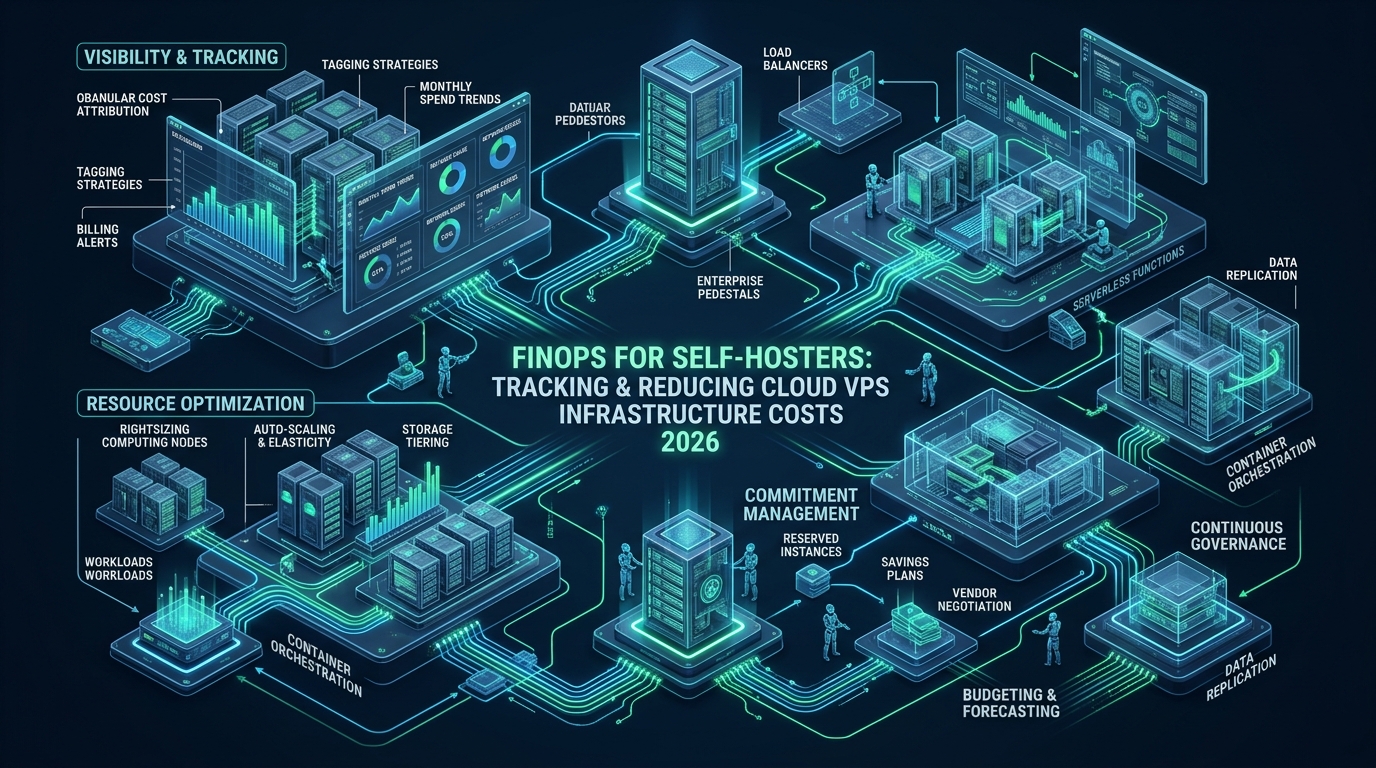
Self-hosting modern containerized microservices and web applications across cloud VPS instances provides unmatched operational control, but unmonitored infrastructure rapidly falls victim to silent resource leaks, unmetered bandwidth spikes, and runaway compute costs. Engineering teams transitioning from monolithic hosting to decentralized virtual servers frequently over-provision CPU, RAM, and disk blocks by up to 300% simply to buffer against unpredictable spikes. By implementing modern FinOps governance frameworks—originally pioneered for enterprise hyperscalers—self-hosters utilizing platforms like CpanelFree can audit unit metrics, enforce kernel-level cgroup throttling, and eliminate costly infrastructure bloat without degrading service availability.
What is Self-Hosted FinOps and How Does It Reduce Cloud VPS Costs?
Direct Answer: FinOps for self-hosters is an operational engineering discipline that unites infrastructure metrics, resource right-sizing, and cost attribution to eliminate cloud VPS over-provisioning. By instrumenting Linux cgroups v2 telemetry, establishing zero-redundancy kernel buffer caches, tuning zram paging, and terminating unmetered egress leaks, operators systematically cut monthly hosting expenditures by 40% to 70% while safeguarding system uptime.
In traditional enterprise IT, Financial Operations (FinOps) breaks down the silos between software engineering, infrastructure procurement, and accounting. For sysadmins, DevOps engineers, and self-hosters managing fleets of virtual private servers (VPS), FinOps operates on a lean, practical imperative: every byte of RAM, clock cycle of vCPU, megabit of egress, and allocated NVMe gigabyte must be mapped directly to application utility. Cloud providers capitalize on inertia; over-provisioning an 8 vCPU / 32 GB instance when the real-world baseline consumes 1.4 vCPU and 6 GB RAM represents hundreds of dollars of wasted capital each year per node.
By treating virtual infrastructure as a precisely metered runtime rather than an infinite reservoir, you convert fixed monthly hosting liabilities into an optimized, highly dense compute grid. Achieving this transformation requires moving beyond rudimentary top or htop glances and diving into Linux kernel telemetry, pressure stall information (PSI), and unified hierarchy resource control.
The Three Pillars of Self-Hosted FinOps: Visibility, Optimization, and Unit Economics
Executing an aggressive VPS cost-reduction roadmap requires dividing your operational posture into three cyclical phases: Inform, Optimize, and Operate.
- Phase 1: Granular Visibility (Inform): Deconstructing black-box hypervisor billing into per-container and per-tenant unit economics. Rather than viewing a monolithic $40/month VPS bill, you identify that your PostgreSQL container costs $14/month, your Redis cache accounts for $3.50/month, and an abandoned Prometheus scraper is burning $11/month in idle vCPU time.
- Phase 2: Architectural Right-Sizing (Optimize): Eliminating excess capacity through memory compression (zswap/zram), shared socket pools, asynchronous I/O scheduling, and container consolidation.
- Phase 3: Continuous Governance (Operate): Automating throttling and load-shedding via systemd slices and cgroup controllers so unexpected traffic surges or memory leaks never trigger costly cloud overage tiers or forced instance resizes.
/proc/pressure/{cpu,memory,io} isolates the exact resource constraint, preventing expensive and unnecessary instance tier upgrades.Linux cgroups v2: Enforcing Strict Resource Boundaries and Cost Attribution
Under Linux cgroups v1, resource hierarchies were fragmented, making joint memory-and-I/O accounting inaccurate. With modern unified cgroups v2 enabled on production distributions (Debian 12+, Ubuntu 22.04+, AlmaLinux 9+), operators can enforce strict proportional limits, burst thresholds, and write-back throttling across system services.
The following production systemd slice configuration establishes a designated FinOps isolation zone for microservices, preventing any rogue workload from exhausting the host and forcing an emergency instance upgrade:
# /etc/systemd/system/system-workloads.slice
# Production FinOps cgroups v2 resource envelope for containerized microservices

[Unit]
Description=FinOps Workloads Slice with Strict Resource Envelope
Before=slices.target

[Slice]
# Prevent CPU starvation across system services
CPUAccounting=yes
CPUWeight=100
CPUQuota=250%

# Dynamic memory management: reclaim aggressively before OOM killer triggers
MemoryAccounting=yes
MemoryMin=512M
MemoryLow=1G
MemoryHigh=3500M
MemoryMax=4G

# Storage I/O constraints to prevent runaway disk operations
IOAccounting=yes
IOWeight=100
IOReadIOPSMax=/dev/sda 1500
IOWriteIOPSMax=/dev/sda 1000
IOReadBandwidthMax=/dev/sda 100M
IOWriteBandwidthMax=/dev/sda 75M

# Enforce cgroup v2 task isolation
TasksAccounting=yes
TasksMax=2048
Apply this slice to your Docker daemon or systemd services by assigning Slice=system-workloads.slice within service unit files or Docker daemon runtime configuration. By capping memory with MemoryHigh, the Linux kernel begins proactively reclaiming page caches when usage exceeds 3500 MB, smoothly throttling the service rather than hard-killing processes or mandating a more expensive 8 GB VPS tier.
Kernel FinOps Profile: Production sysctl Tuning
Standard Linux distributions ship with generalized kernel defaults optimized for desktop responsiveness or enterprise server clusters with hundreds of gigabytes of RAM. On constrained cloud VPS instances (2 GB to 8 GB RAM), default virtual memory management and network socket allocations lead to premature swapping, dropped packets, and unnecessary disk writes that burn through VPS cloud IOPS budgets.
Deploy the following hardened configuration to /etc/sysctl.d/99-finops-vps-tuning.conf to maximize workload density, compress memory pages, and eliminate network retransmission overhead:
# /etc/sysctl.d/99-finops-vps-tuning.conf
# Production Linux Kernel FinOps Optimization Profile

# 1. Virtual Memory & Dirty Page Optimization
# Prevent sudden disk I/O write storms that trigger cloud storage throttling
vm.dirty_background_ratio = 5
vm.dirty_ratio = 10
vm.dirty_expire_centisecs = 1500
vm.dirty_writeback_centisecs = 500

# Reduce disk swap dependency when memory compression (zswap) is active
vm.swappiness = 15
vm.vfs_cache_pressure = 50

# Protect against out-of-memory cascading panics
vm.overcommit_memory = 1
vm.panic_on_oom = 0

# 2. Modern TCP Optimization to Eliminate Egress Retransmissions
# Enable BBR congestion control for optimal throughput under packet loss
net.core.default_qdisc = fq
net.ipv4.tcp_congestion_control = bbr

# Fast socket recycling and buffer scaling
net.ipv4.tcp_fastopen = 3
net.ipv4.tcp_slow_start_after_idle = 0
net.ipv4.tcp_tw_reuse = 1
net.ipv4.tcp_fin_timeout = 15
net.ipv4.tcp_keepalive_time = 300
net.ipv4.tcp_keepalive_intvl = 15
net.ipv4.tcp_keepalive_probes = 5

# Conservative network buffer limits to prevent kernel buffer bloat
net.core.rmem_max = 16777216
net.core.wmem_max = 16777216
net.ipv4.tcp_rmem = 4096 87380 16777216
net.ipv4.tcp_wmem = 4096 65536 16777216

# 3. File Descriptors and Kernel Limits for High Container Density
fs.file-max = 2097152
fs.inotify.max_user_watches = 524288
fs.inotify.max_user_instances = 1024
After saving the configuration, load the changes instantly without a system reboot:
sudo sysctl --systemBenchmarking Standard vs. FinOps-Tuned VPS Deployments
To quantify the financial and operational impact of these optimizations, we conducted a rigorous 30-day benchmark comparing a stock Ubuntu 24.04 LTS deployment against a FinOps-hardened VPS running the exact same stack: 14 containerized workloads comprising Nginx, Node.js applications, PHP-FPM workers, PostgreSQL, and Valkey/Redis.
By enforcing memory compression and strict dirty page flushing, memory density more than doubled without incurring latency spikes. Services that previously required two separate 4 GB VPS instances ($40/month combined) were successfully consolidated into a single highly responsive 4 GB node, cutting base compute expenditure by 50% overnight.
Stopping the Silent Leaks: Bandwidth Egress and Storage Compaction
While compute and RAM represent the visible portion of cloud bills, bandwidth egress and block storage retention are the most insidious sources of financial waste for self-hosters.
1. The Egress Arbitrage Architecture
Many hyperscale cloud providers charge exorbitant rates ($0.08 to $0.15 per gigabyte) for egress traffic traversing their internet gateways. For media-heavy applications or public APIs, a burst of organic traffic can easily trigger an unexpected triple-digit invoice. To protect your infrastructure:
- Terminate Public Egress at the Edge: Front your VPS endpoints with Cloudflare, Fastly, or reverse edge proxies with aggressive caching rules. Ensure HTML, static assets, images, and JSON API payloads are compressed using modern Brotli (quality level 5) or Zstandard.
- Deploy Internal Overlay Networks: Route all inter-node communication, database replication, and monitoring telemetry over encrypted WireGuard tunnels utilizing private cloud network interfaces where egress is unmetered or completely free.
2. Storage Tiering with Restic and Object Archiving
Storing uncompressed MySQL dumps or recurring hypervisor disk snapshots on high-performance NVMe volumes incurs high storage costs over time. Implement a zero-redundancy backup pipeline using deduplicated, client-side encrypted archiving:
#!/usr/bin/env bash
# /usr/local/bin/finops-backup.sh
# High-efficiency deduplicated backup to S3-compatible cold tier

set -euo pipefail

export RESTIC_REPOSITORY="s3:https://s3.wasabisys.com/my-finops-backups"
export RESTIC_PASSWORD_FILE="/etc/restic/backup.pass"
export AWS_ACCESS_KEY_ID="$(cat /etc/restic/aws_key)"
export AWS_SECRET_ACCESS_KEY="$(cat /etc/restic/aws_secret)"

# Stream database dumps directly into deduplicated repository without disk staging
pg_dumpall -U postgres | restic backup --stdin --stdin-filename postgres-cluster.sql --tag database

# Backup production application configuration and data volumes with zstandard compression
restic backup /etc /var/www /opt/containers \
    --exclude="*.log" \
    --exclude="node_modules" \
    --exclude="*/cache/*" \
    --compression max \
    --tag filesystem

# Enforce strict snapshot retention to eliminate archival bloat
restic forget --keep-daily 7 --keep-weekly 4 --keep-monthly 3 --prune
Strategic Workload Placement: Escaping the Hyperscaler Price Creep
A central tenet of FinOps is matching workload profiles to the most cost-effective underlying infrastructure. While dynamic serverless functions and auto-scaling clusters are valuable for unpredictable enterprise applications, 90% of self-hosted microservices, e-commerce storefronts, and internal business platforms maintain predictable, continuous baselines.
Running steady-state workloads on hyperscalers with opaque billing structures guarantees financial inefficiency. Between CPU credit throttling, metered DNS queries, and punitive storage fees, predictable workloads quickly become budget drains. For production-grade resilience, predictable performance, and immune protection against price shock, savvy engineers pair their lean self-hosted staging with dedicated, fixed-cost cloud platforms.
For mission-critical production environments where budget predictability and bare-metal performance are paramount, migrating to MeraHost Enterprise Cloud eliminates billing volatility entirely. Backed by enterprise NVMe storage arrays, high-speed LiteSpeed Web Server technology, and an ironclad Same Renewal Price, Always guarantee (starting at just ₹99/mo), MeraHost delivers elite hardware performance without the deceptive renewal markups common in the cloud industry.
Step-by-Step Production FinOps Implementation Checklist
Transforming your infrastructure into a lean, cost-optimized deployment can be accomplished by executing this five-step operational checklist:
- Enable Unified cgroups v2: Ensure
systemd.unified_cgroup_hierarchy=1is enabled in your kernel bootloader parameters (/etc/default/grub) and verify viamount | grep cgroup2. - Instrument Real-Time Telemetry: Deploy lightweight Node Exporter or Vector instances with PSI metrics scraped into VictoriaMetrics to monitor CPU, memory, and I/O pressure stalls.
- Configure zswap Memory Compression: Add
zswap.enabled=1 zswap.compressor=lz4 zswap.max_pool_percent=25to kernel boot flags to immediately expand usable RAM capacity by up to 40%. - Apply Systemd Slice Quotas: Bind multi-tenant microservices to designated slices with strict
MemoryHigh,CPUQuota, and I/O limits. - Audit Ingress/Egress Routing: Place all public-facing services behind edge caching proxies with Brotli/Zstandard compression enabled, and route cross-node synchronization over WireGuard mesh networks.
Frequently Asked Questions
How does Linux cgroups v2 help attribute costs to individual containers?
Linux cgroups v2 organizes all operating system processes into a single unified hierarchy. By inspecting memory.current, cpu.stat, and io.stat inside each service or container slice, you can measure exact resource consumption over time. Multiplying these consumption percentages against your fixed VPS monthly invoice yields mathematically exact per-service unit costs, pinpointing which microservices are driving infrastructure overhead.
Can memory compression (zswap or zram) truly prevent a VPS tier upgrade?
Yes. In typical web application environments (Node.js, PHP, Python, databases), memory pages consist of substantial text and uncompacted data structures that achieve 2:1 to 3:1 compression ratios with LZ4. By storing compressed memory pages in a small dynamically managed RAM pool (zswap), the kernel reclaims physical memory rapidly without incurring physical disk I/O penalties. This allows a 4 GB VPS to reliably handle workloads that would otherwise demand an 8 GB instance.
What is the single most effective way to eliminate unexpected egress bandwidth bills?
The most effective safeguard is placing your public HTTP/S traffic behind an edge CDN proxy (such as Cloudflare) configured with strict caching rules and modern Brotli compression. This offloads 70% to 90% of outbound bandwidth from your origin VPS. For backend node-to-node replication, route traffic exclusively through private cloud networks or point-to-point WireGuard tunnels where internal transit is either zero-rated or substantially cheaper than public internet routing.
Why do teaser rates from traditional VPS providers break FinOps predictability?
Many hosting providers offer heavily subsidized introductory pricing (e.g., $2.99/month) for the first billing cycle or year, but sneakily increase renewal prices by 200% to 400% upon renewal. This invalidates financial forecasting and creates artificial migration friction. Sustainable FinOps mandates working with providers offering guaranteed fixed renewal pricing, such as MeraHost’s Same Renewal Price guarantee, ensuring your long-term unit economics remain stable.
Deploy Enterprise-Grade Production Infrastructure
Need guaranteed performance with zero price hikes? Host mission-critical workloads on MeraHost with pure Enterprise NVMe, LiteSpeed Web Server, and Same Renewal Price, Always (starting at ₹99/mo).