
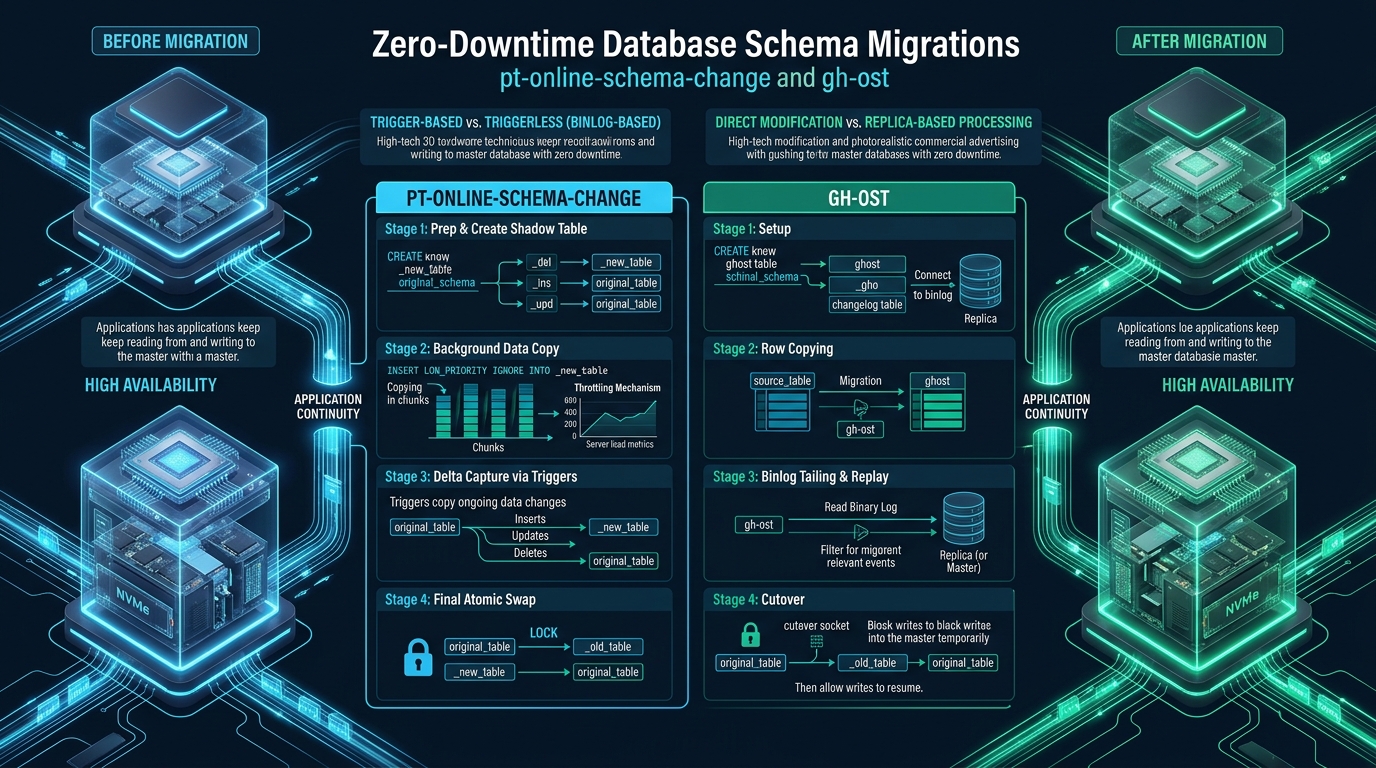
Executing large-scale DDL operations on terabyte-scale relational databases without degrading OLTP latency is one of the most hazardous engineering challenges in production operations. At CpanelFree, maintaining millisecond query responsiveness requires eliminating table locks and metadata locking bottlenecks entirely during live database alters. By replacing legacy blocking DDL queries with asynchronous, lock-free migration frameworks, infrastructure teams can safely perform schema updates on mission-critical databases without risking query timeouts or connection spikes.
Understanding Zero-Downtime Online Schema Changes (OSC)
In standard MySQL and MariaDB deployments, executing an ALTER TABLE statement triggers an exclusive metadata lock (MDL) or forces a full table copy. Even with the introduction of InnoDB Online DDL (ALGORITHM=INPLACE), many operations—such as modifying column data types, adding generated columns, or reorganizing clustered indexes—still demand substantial exclusive locking phases or cause extreme I/O spikes that exhaust server IOPS. Under heavy concurrent traffic, an incoming DDL statement waiting for an MDL queues all subsequent incoming SELECT, INSERT, and UPDATE queries behind it, causing rapid connection pool exhaustion, application request pileups, and severe operational outages.
To circumvent table-level and metadata locks, the database engineering community developed two primary paradigms for Online Schema Change (OSC): trigger-based replication (championed by Percona’s pt-online-schema-change) and binary log stream inspection (engineered by GitHub in gh-ost). Both utilities build a new ghost table reflecting the desired schema definition, backfill existing records in manageable chunk sizes, synchronize live modifications occurring during the migration window, and execute an atomic table swap to complete the cutover.
Architectural Comparison: pt-online-schema-change vs. gh-ost
Selecting the optimal migration utility requires understanding their underlying mechanisms for capturing real-time mutations, managing transaction overhead, and interacting with the database engine’s concurrency model.
pt-online-schema-change is transactional amplification. Every application write operation to the original table executes synchronous trigger code that writes to the ghost table within the exact same InnoDB transaction boundary. If your database experiences an unexpected write spike, trigger executions double the write workload, potentially pushing database threads into lock wait timeouts and thread exhaustion.Kernel & Storage Tuning for High-Throughput Migrations
During backfill operations involving millions of rows, background read and write pressure can saturate storage controllers and displace cached hot working sets from the InnoDB buffer pool. To mitigate I/O thrashing and ensure stable kernel-level page flushing, implement the following production sysctl configuration file before running data migrations.
# /etc/sysctl.d/99-mysql-migration.conf
# Linux Kernel I/O and Concurrency Hardening for Database Migrations

# Prevent kernel page cache from aggressively monopolizing RAM during bulk copying
vm.dirty_background_ratio = 5
vm.dirty_ratio = 10

# Extend dirty page expire time to allow steady, continuous background flushing
vm.dirty_expire_centisecs = 3000
vm.dirty_writeback_centisecs = 500

# Minimize swapping aggressive behavior on database hosts
vm.swappiness = 1

# Increase network socket backlog to absorb cutover connection bursts
net.core.somaxconn = 65535
net.ipv4.tcp_max_syn_backlog = 16384
net.core.netdev_max_backlog = 10000

# Protect local port exhaustion during intense replica health-checking
net.ipv4.ip_local_port_range = 10240 65535
net.ipv4.tcp_fin_timeout = 15
net.ipv4.tcp_tw_reuse = 1

# Optimize file descriptor limits for high connection and table-open counts
fs.file-max = 2097152
Apply these parameters dynamically using sysctl -p /etc/sysctl.d/99-mysql-migration.conf. Tuning dirty ratios ensures that asynchronous chunk copies do not saturate the Linux page cache, which would otherwise force synchronous blocking writes at the block device layer.
Deploying gh-ost: Binlog-Driven Production Migration
gh-ost operates as an external client connecting to your database cluster. It can stream binary logs directly from a replica server while writing chunked data to the primary writer instance, completely isolating migration read overhead from your primary transactional workload.
Prerequisites for gh-ost
- Row-Based Replication: The MySQL server must run with
binlog_format=ROWandbinlog_row_image=FULL. - Explicit Primary Key: The table must have an explicit integer or unique primary key to facilitate deterministic row chunking.
- Absence of Foreign Keys: Tables referencing foreign key constraints are intentionally not supported due to triggerless binlog limitations.
gh-ost with dynamic replica inspection. In this topology, gh-ost reads binary logs and validates replication lag against a secondary replica while directing backfill writes to the primary database. This guarantees that your primary database never expends CPU cycles decoding binlogs.Automated Systemd Service for gh-ost Migrations
To ensure migrations run within a controlled process supervisor with full resource management, structured logging, and automated failure signaling, encapsulate your migration jobs in a parameterized systemd service.
# /etc/systemd/system/[email protected]
[Unit]
Description=gh-ost Schema Migration Runner for %I
After=network.target mysql.service
Wants=mysql.service

[Service]
Type=simple
User=mysql
Group=mysql
WorkingDirectory=/var/log/ghost
ExecStart=/usr/local/bin/gh-ost \
  --conf=/etc/ghost/%i.conf \
  --execute \
  --verbose

# Process resiliency & resource accounting
Restart=no
TimeoutSec=86400
LimitNOFILE=65536
CPUQuota=150%
MemoryHigh=4G
MemoryMax=6G

# Security sandboxing
ProtectSystem=strict
ProtectHome=true
ReadWritePaths=/var/log/ghost /tmp
NoNewPrivileges=true

[Install]
WantedBy=multi-user.target
Production Configuration File for gh-ost
Create the instance-specific configuration file referenced by the systemd unit. This decouples database credentials, throttling thresholds, and table identifiers from your command-line interface.
# /etc/ghost/production_users.conf
# Production gh-ost configuration for schema alteration

host=127.0.0.1
port=3306
user=migration_svc
password=SecretEnterpriseVaultKey99!
database=app_production
table=users
alter=ADD COLUMN two_factor_enforced TINYINT(1) UNSIGNED NOT NULL DEFAULT 0, ADD INDEX idx_users_2fa (two_factor_enforced)

# Concurrency and chunking parameters
chunk-size=2500
max-lag-millis=1200
max-load=Threads_running=35,Threads_connected=400
critical-load=Threads_running=70,Threads_connected=800
throttle-control-replicas=192.168.10.21:3306,192.168.10.22:3306

# Dynamic control socket & inspection
serve-socket-file=/tmp/ghost.app_production.users.sock
initially-drop-ghost-table=true
initially-drop-old-table=false
cut-over=atomic
cut-over-lock-timeout-seconds=3
approve-renamed-columns=true
Deploying pt-online-schema-change: Trigger-Based Migration
While gh-ost is ideal for large OLTP tables, pt-online-schema-change remains the industry standard when dealing with tables bounded by foreign keys or environments where row-based binary logging is unavailable. When executing Percona’s tool, strict safeguards must be enforced to prevent trigger-induced locking cascades.
#!/usr/bin/env bash
# /usr/local/bin/run-pt-osc.sh
# Hardened pt-online-schema-change execution wrapper

set -euo pipefail

DB_NAME="app_production"
TABLE_NAME="orders"
ALTER_STMT="ADD COLUMN fulfillment_status VARCHAR(32) NOT NULL DEFAULT 'unfulfilled', ADD INDEX idx_orders_fulfillment (fulfillment_status)"
AUTH_FILE="/etc/mysql/migration_auth.cnf"

echo "[$(date --iso-8601=seconds)] Initializing pt-online-schema-change dry run..."

# Step 1: Mandatory Dry-Run Verification
pt-online-schema-change \
  --defaults-file="${AUTH_FILE}" \
  --host=127.0.0.1 \
  --database="${DB_NAME}" \
  --table="${TABLE_NAME}" \
  --alter="${ALTER_STMT}" \
  --dry-run \
  --print

echo "[$(date --iso-8601=seconds)] Dry run passed. Executing live migration..."

# Step 2: Live Execution with Load Throttling
pt-online-schema-change \
  --defaults-file="${AUTH_FILE}" \
  --host=127.0.0.1 \
  --database="${DB_NAME}" \
  --table="${TABLE_NAME}" \
  --alter="${ALTER_STMT}" \
  --execute \
  --chunk-size=1500 \
  --chunk-size-limit=3.5 \
  --max-load="Threads_running=30" \
  --critical-load="Threads_running=60" \
  --max-lag=1 \
  --check-interval=1s \
  --recursion-method="processlist" \
  --alter-foreign-keys-method="auto" \
  --preserve-triggers \
  --set-vars="innodb_lock_wait_timeout=3,lock_wait_timeout=5" \
  --print

echo "[$(date --iso-8601=seconds)] Migration successfully completed."--set-vars="innodb_lock_wait_timeout=3,lock_wait_timeout=5" setting in the script above. This forces pt-online-schema-change to fail immediately if it cannot acquire metadata locks during trigger installation or cutover, rather than waiting and queuing subsequent incoming production queries behind it.The Atomic Cutover Mechanism Explained
Both tools conclude the data migration phase by executing a cutover. Understanding the cutover mechanism is critical to guaranteeing zero dropped connections and complete data consistency.
In pt-online-schema-change, the swap is achieved via MySQL’s atomic multi-table rename statement:
RENAME TABLE `app_production`.`orders` TO `app_production`.`_orders_old`,
             `app_production`.`_orders_new` TO `app_production`.`orders`;
MySQL executes this rename as a single atomic operation. However, acquiring the exclusive metadata lock required for this rename can be blocked by long-running SELECT queries. If blocked, the rename statement will queue behind the slow query, blocking all subsequent incoming reads and writes on the table.
gh-ost solves this lock acquisition hazard through a dual-connection atomic cutover strategy:
- Lock Phase (Connection A):
gh-ostissuesLOCK TABLES users WRITE, `_users_gho` WRITE. While this holds the lock, incoming application writes tousersare blocked and queue harmlessly. - Rename Phase (Connection B):
gh-ostopens a second connection and issuesRENAME TABLE users TO `_users_del`, `_users_gho` TO users. This statement waits for the lock held by Connection A. - Release Phase (Connection A):
gh-ostcloses Connection A. MySQL immediately prioritizes the waitingRENAMEquery from Connection B before any queued application writes are granted access. The swap executes instantaneously, and the queued queries resume on the newly altered table without dropping a single packet.
Frequently Asked Questions
Why does pt-online-schema-change cause thread pool spikes during traffic surges?
Because pt-online-schema-change uses synchronous MySQL triggers, every single write (INSERT, UPDATE, DELETE) made to the original table must synchronously execute the trigger code to mirror the mutation to the ghost table within the exact same transaction. When write throughput spikes, this synchronous overhead doubles the lock footprint and write IOPS, quickly saturating MySQL threads_running and causing connection pool exhaustion.
Can gh-ost migrate tables without binary logging enabled?
No. gh-ost is fundamentally architected as a binary log stream consumer. It requires MySQL to have binary logging enabled with row-based formatting (binlog_format=ROW). If your database instance cannot enable binary logging, you must utilize pt-online-schema-change or MySQL native Online DDL instead.
How does gh-ost handle foreign key constraints?
gh-ost strictly disallows running migrations on tables with foreign keys. Because it relies on asynchronous binlog inspection rather than database-level triggers, it cannot reliably maintain foreign key referential integrity cascades across tables during live migrations. If your schema uses foreign keys, you must use pt-online-schema-change with appropriate --alter-foreign-keys-method settings.
What happens if a migration is abruptly killed halfway through?
Both utilities are designed to fail safely without corrupting production data. In gh-ost, terminating the process simply leaves the ghost table (_table_gho) and binlog tracking table intact; your production table is never modified until the final cutover. In pt-online-schema-change, terminating the process leaves triggers and the temporary table in place, requiring cleanup via DROP TRIGGER and DROP TABLE before starting a new run.
Ready to Deploy High-Performance Infrastructure?
Experience blazing-fast NVMe storage, unmetered bandwidth, and enterprise LiteSpeed caching on CpanelFree.