
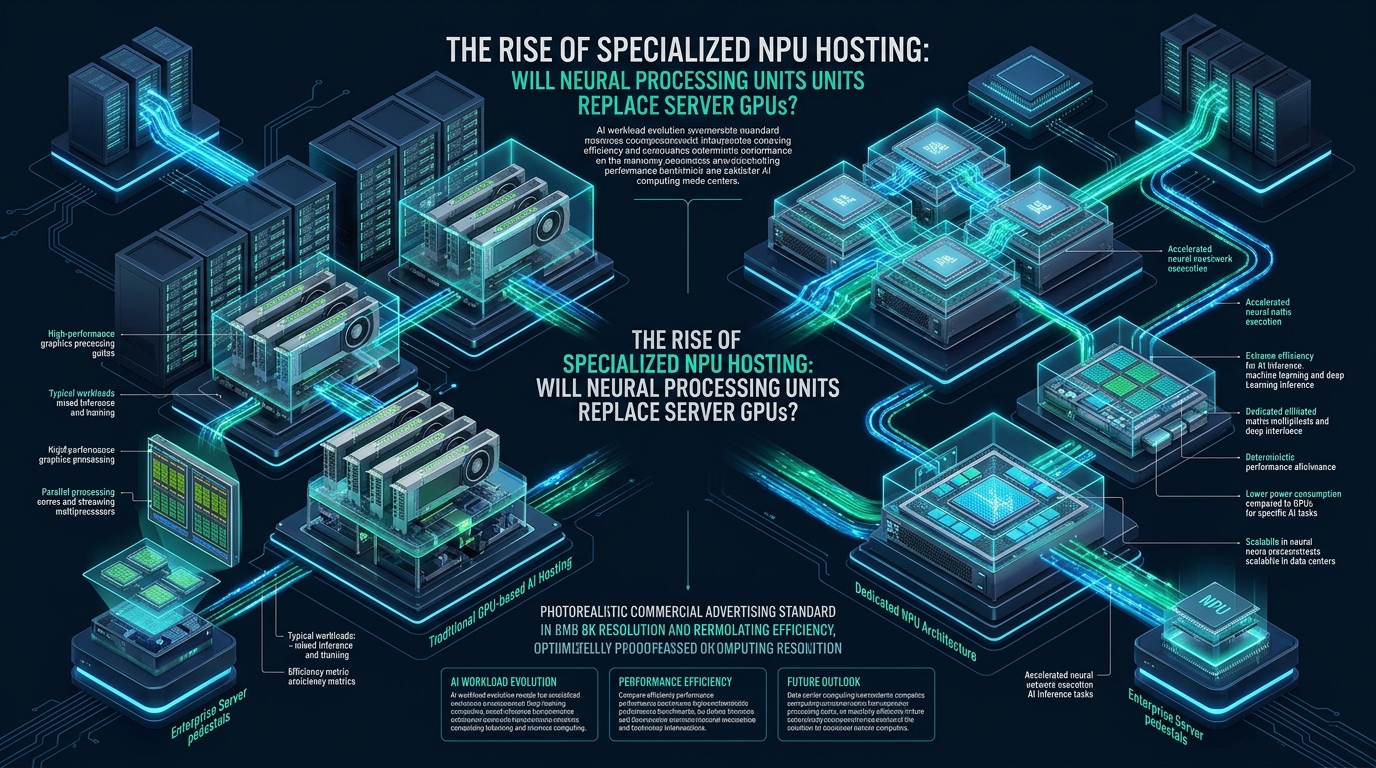
Datacenter operators and enterprise infrastructure engineers are colliding directly with a punishing physical ceiling: deploying traditional general-purpose server GPUs for continuous artificial intelligence inference incurs catastrophic thermal densities, exorbitant electrical power draws reaching 700 to 1,000 watts per board, and prohibitive hardware acquisition cycles. Systems engineers orchestrating lightweight staging environments and distributed service pipelines on CpanelFree recognize that while massive GPU clusters remain indispensable for large-scale model pre-training, utilizing general-purpose SIMT architectures strictly to serve low-latency matrix tokenization is profoundly inefficient. Specialized npu web hosting servers—engineered around deterministic systolic arrays, dedicated on-chip tensor memories, and lean domain-specific instruction sets—are emerging as the definitive architectural alternative to liberate datacenter thermal envelopes and slash operational hosting expenditures.
Will Neural Processing Units Replace Server GPUs in Web Hosting?
Direct Answer: NPUs will not entirely replace server GPUs for foundational model training, but they are rapidly displacing GPUs in production web hosting and high-density inference. Delivering up to 4x higher performance-per-watt and 60% lower hardware acquisition costs, specialized NPU hosting servers excel at low-latency token streaming, vector embeddings, and real-time API workloads.
The architectural paradigm shift across modern hosting datacenters is driven by workload specialization. For over a decade, general-purpose graphics processing units (GPUs) served as the default accelerator for parallel compute tasks because of their massive floating-point throughput. However, serving trained transformer models, quantised generative weights (e.g., INT8, FP8, INT4), and real-time semantic search pipelines does not require graphics rasterization hardware, dynamic warp schedulers, or oversized cache hierarchies. Instead, inference workloads depend almost exclusively on matrix multiplication (GEMM) throughput and memory bandwidth. Neural Processing Units (NPUs) eliminate legacy silicon overhead, delivering tightly coupled, power-optimized execution pipelines specifically targeted at inference serving.
Silicon Microarchitecture: SIMT GPUs vs. Systolic Array NPUs
To evaluate the viability of npu web hosting servers, infrastructure architects must understand how the silicon execution model differs from traditional PCIe server GPUs. Traditional GPUs rely on Single Instruction, Multiple Threads (SIMT). In an SIMT architecture, hundreds of streaming multiprocessors (SMs) share instruction decoders, dynamic branch predictors, large register files, and complex thread dispatch logic. When executing dense linear algebra calculations, significant portions of the GPU’s thermal design power (TDP) are dissipated simply managing thread scheduling, resolving branch divergences, and routing data across multi-level cache hierarchies.
In stark contrast, specialized NPUs implement Domain-Specific Architectures (DSAs), predominantly utilizing 2D systolic arrays or dataflow graph processors (such as Google Cloud TPUs, Intel Gaudi 3, Qualcomm Cloud AI 100, and Tenstorrent Wormhole). In a systolic array:
- Pipelined Data Reuse: Input activations and matrix weights flow deterministically through a grid of tightly coupled Multiply-Accumulate (MAC) arithmetic units. Data read from local SRAM is passed directly to neighboring processing elements without writing intermediate results back to registers or off-chip memory.
- Elimination of Dynamic Scheduling: Compiler toolchains (such as TVM, OpenVINO, or ONNX Runtime execution providers) map tensor operations directly onto the hardware grid ahead of time. This eliminates runtime branch prediction and instruction caching silicon entirely.
- Direct Memory Access (DMA) & Scratchpad SRAM: Rather than relying on massive hardware-managed L2/L3 caches that consume silicon die area and generate standby heat, NPUs utilize explicit software-managed scratchpad memories and high-bandwidth DMA engines.
- Quantized Native Precision: Inference engines operate with native hardware pipelines for FP8 (E4M3, E5M2), INT8, and emerging micro-scaling formats (MXFP4). This cuts memory bandwidth requirements in half compared to FP16 while maintaining perceptual model fidelity.
Architecture Note: In web hosting environments where API endpoints process millions of short-context requests (such as customer support embeddings, spam classification, and automated code completion), an NPU operates with virtually zero instruction fetch latency. The server GPU, conversely, incurs massive context-switching and kernel launch latencies that degrade tail response percentiles (p99).
Enterprise Comparative Matrix: Server GPU vs. Specialized NPU Hosting
When provisioning infrastructure for production AI inference, comparing theoretical peak TFLOPS is misleading. Sysadmins must evaluate actual inference power efficiency, rack thermal density limits, software runtime integration, and capital expenditure per concurrent stream.
| Feature / Metric | Standard Server GPU (e.g., L40S / H100 PCIe) | Specialized NPU Server (e.g., Cloud AI 100 / Wormhole) |
|---|---|---|
| Thermal Design Power (TDP) | 300W – 700W per card | 75W – 150W per card |
| Power Efficiency (Tokens/sec/Watt) | Baseline (1.0x) | 2.8x – 4.2x Superior |
| Rack Power Density Required | 25kW – 40kW per rack (Specialized cooling) | 8kW – 14kW per rack (Standard air-cooled) |
| Form Factor & Interconnect | Dual-slot, PCIe 5.0 x16 / NVLink bridge | Single-slot low-profile, standard PCIe 4.0/5.0 |
| Inference Precision Focus | FP32 / FP16 / TF32 / FP8 | INT8 / FP8 / MXFP4 / BF16 optimized |
| Hardware Acquisition Cost (CAPEX) | $10,000 – $35,000+ per accelerator | $1,800 – $4,500 per accelerator |
| Software Runtime Ecosystem | NVIDIA CUDA, TensorRT-LLM, vLLM | ONNX Runtime, OpenVINO, PyTorch XLA |
| Primary Workload Suitability | Foundation training & large-context MoE | High-concurrency web hosting & API inference |
Production Linux Configuration for NPU Web Hosting Servers
Operating npu web hosting servers in an enterprise Linux environment requires deterministic driver initialization, PCIe link power management, zero-copy memory locking, and isolated systemd execution limits. Modern Linux kernels (version 6.2 and newer) natively incorporate the accel subsystem (under /dev/accel/), which unifies compute accelerator drivers alongside the traditional Direct Rendering Manager (DRM).
1. Linux Udev Rules for NPU PCIe Device Permissions & Power Management
To guarantee non-root web services and containerized inference microservices have secure, low-latency access to NPU character devices while locking PCIe power states against latency-inducing ASPM transitions, deploy this production udev rule:
# /etc/udev/rules.d/99-npu-accel.rules
# Production udev rules for Specialized NPU Hosting Accelerators
# Enforces device access controls, group permissions, and PCIe ASPM persistence

# Match Linux kernel accelerator subsystem devices
SUBSYSTEM=="accel", KERNEL=="accel[0-9]*", GROUP="npu-operators", MODE="0660", TAG+="systemd"
SUBSYSTEM=="accel", KERNEL=="accel_control[0-9]*", GROUP="npu-operators", MODE="0660"

# Fallback match for vendor PCIe accelerator character devices (e.g., Tenstorrent, Qualcomm Cloud AI)
SUBSYSTEM=="char", KERNEL=="qaic[0-9]*", GROUP="npu-operators", MODE="0660"
SUBSYSTEM=="char", KERNEL=="tenstorrent*", GROUP="npu-operators", MODE="0660"

# Disable Active State Power Management (ASPM) to eliminate PCIe wake-up micro-latencies
ACTION=="add", SUBSYSTEM=="pci", ATTR{vendor}=="0x17cb", ATTR{power/control}="on"
ACTION=="add", SUBSYSTEM=="pci", ATTR{vendor}=="0x1e36", ATTR{power/control}="on"

# Configure DMA memory allocation masks and persistent clocking
ACTION=="add", SUBSYSTEM=="accel", ATTR{device/power/control}="on"
Reload and trigger the udev subsystem immediately after saving the configuration:
udevadm control --reload-rules && udevadm trigger --subsystem-match=accel --subsystem-match=pci2. Kernel Memory & Hugepages Tuning (/etc/sysctl.d/99-npu-hosting.conf)
High-concurrency NPU inference relies on zero-copy Direct Memory Access (DMA) between host system RAM and the NPU’s onboard SRAM/LPDDR memory. If host memory is paged out or fragmented, DMA transfers stall, spiking inference tail latency. The following kernel parameters reserve 2MB HugePages, prevent virtual memory compaction stalls, and optimize socket buffer queuing:
# /etc/sysctl.d/99-npu-hosting.conf
# Linux Kernel Optimization for Dedicated NPU Web Hosting Servers

# Reserve 2048 2MB HugePages (4GB pool) for zero-copy NPU tensor memory buffers
vm.nr_hugepages = 2048
vm.hugetlb_shm_group = 1002

# Eliminate swap aggressive tendencies and memory compaction latency
vm.swappiness = 1
vm.dirty_ratio = 10
vm.dirty_background_ratio = 5
vm.zone_reclaim_mode = 0
vm.compact_unevictable_allowed = 0

# Maximize locked memory and I/O buffer headroom for high-throughput streaming
fs.file-max = 2097152
fs.inotify.max_user_watches = 524288

# TCP stack buffers tuned for real-time SSE (Server-Sent Events) token streaming
net.core.rmem_max = 16777216
net.core.wmem_max = 16777216
net.core.somaxconn = 65535
net.ipv4.tcp_rmem = 4096 87380 16777216
net.ipv4.tcp_wmem = 4096 65536 16777216
net.ipv4.tcp_max_syn_backlog = 16384
net.ipv4.tcp_slow_start_after_idle = 0
Apply the parameters into the running kernel without requiring a server reboot:
sysctl --system3. Hardened Systemd Service Unit for NPU Inference Daemons
Production inference serving engines (such as an ONNX Runtime server or an open-source vLLM fork adapted for NPU execution providers) must run under strict POSIX resource limits with locked memory permissions and NUMA affinity:
# /etc/systemd/system/npu-inference-gateway.service
[Unit]
Description=High-Performance NPU Inference Gateway Service
After=network.target local-fs.target
Wants=network-online.target

[Service]
Type=simple
User=npu-svc
Group=npu-operators
WorkingDirectory=/opt/npu-runtime

# Pin process to the exact NUMA node physically wired to the NPU PCIe slot
ExecStart=/usr/bin/numactl --cpunodebind=0 --membind=0 /opt/npu-runtime/bin/npu-server     --model-path /models/llama-3-8b-instruct-fp8     --device-id 0     --batch-size 32     --port 8080

Restart=always
RestartSec=5s

# Unlimited locked memory is mandatory for zero-copy DMA memory pinning
LimitMEMLOCK=infinity
LimitNOFILE=1048576
LimitNPROC=524288

# Linux security hardening policies
ProtectSystem=strict
ProtectHome=true
PrivateTmp=true
ProtectKernelTunables=true
ProtectControlGroups=true
ReadWritePaths=/opt/npu-runtime/logs /tmp

[Install]
WantedBy=multi-user.target
Operational Best Practice: Always align host CPU core pinning and RAM allocation to the identical NUMA node hosting the PCIe slot of your NPU accelerator. Crossing the Ultra Path Interconnect (UPI) or Infinity Fabric bus to access memory attached to a remote CPU socket adds 60–120 nanoseconds of latency per DMA transaction, severely cannibalizing the NPU’s latency advantage.
Hosting Economics: Total Cost of Ownership (TCO) Analysis
The financial justification for adopting npu web hosting servers centers on thermal density and rack economics. In standard tier-3 colocation facilities, typical server cabinets are provisioned for 5kW to 10kW of power. Installing an enterprise 8x H100 PCIe GPU server requires between 6.5kW and 10kW for a single 4U or 5U chassis. As a direct consequence, hosting providers can only install one or two GPU systems per standard rack before exhausting their electrical breaker capacity or cooling infrastructure, leaving 80% of rack vertical space empty.
Conversely, specialized NPU accelerator cards draw only 75W to 150W under peak synthetic stress tests. A standard 2U enterprise dual-socket server equipped with four single-slot NPU cards consumes roughly 700W total. Datacenter facilities can comfortably mount ten to twelve 2U NPU servers in a standard 10kW rack cabinet, hosting up to 48 discrete acceleration units in the exact same footprint that could support only 8 traditional GPUs. For web hosting providers offering AI-augmented managed WordPress, real-time code synthesis, or vector search as a service, this represents a 400% improvement in colocation revenue density.
When building mission-critical SaaS platforms, production stability requires pairing specialized accelerators with deterministic hosting platforms. High-concurrency AI gateways require bulletproof baseline compute, ultra-low latency storage fabrics, and predictable renewal pricing. For enterprise deployments that cannot afford performance degradation or unexpected hosting cost escalations, deploying your primary application layer on MeraHost Enterprise Cloud guarantees dedicated compute instances backed by pure Enterprise NVMe drives and LiteSpeed Web Server architecture.
Frequently Asked Questions (FAQ)
Can NPU web hosting servers run open-source models like Llama 3, Mistral, and DeepSeek?
Yes. Modern NPUs support industry-standard open intermediate representations (IR) including ONNX, PyTorch XLA, and Hugging Face Optimum. Popular transformer models such as Llama 3 (8B and 70B), Mistral, Qwen, and DeepSeek are easily compiled and deployed on NPUs using native INT8, FP8, or BF16 quantization with zero architectural modifications.
How does the software ecosystem for NPUs compare to NVIDIA CUDA?
NVIDIA’s CUDA remains the undisputed standard for cutting-edge research, novel kernel experimentation, and massive foundation model training. However, for inference serving, the industry has standardized on high-level abstractions like ONNX Runtime, OpenVINO, vLLM, and Triton Inference Server. Because NPUs provide robust execution providers for these frameworks, deploying a model on an NPU no longer requires writing custom low-level device kernels.
What are the cooling and power requirements of an NPU server versus a GPU server?
Specialized NPU cards operate within standard PCIe slot power limits (75W without auxiliary cables, or up to 150W with an 8-pin connector) and rely on conventional server chassis airflow. Server GPUs frequently require 350W to 700W+ per card, often demanding expensive rear-door heat exchangers, liquid-to-chip cooling loops, or dedicated high-CFM blower fans that drastically increase datacenter auxiliary power consumption.
Is an NPU suitable for model fine-tuning or strictly inference?
While high-end NPUs like Intel Gaudi 3 and Google TPUs are specifically engineered to handle distributed training and full parameter fine-tuning, PCIe-based edge and datacenter inference NPUs (such as Qualcomm Cloud AI 100) are explicitly optimized for forward-pass inference. For Parameter-Efficient Fine-Tuning (PEFT/LoRA), modern training NPUs are capable, but dedicated server GPUs still maintain broader framework compatibility.
Deploy Enterprise-Grade Production Infrastructure
Need guaranteed performance with zero price hikes? Host mission-critical workloads on MeraHost with pure Enterprise NVMe, LiteSpeed Web Server, and Same Renewal Price, Always (starting at ₹99/mo).