
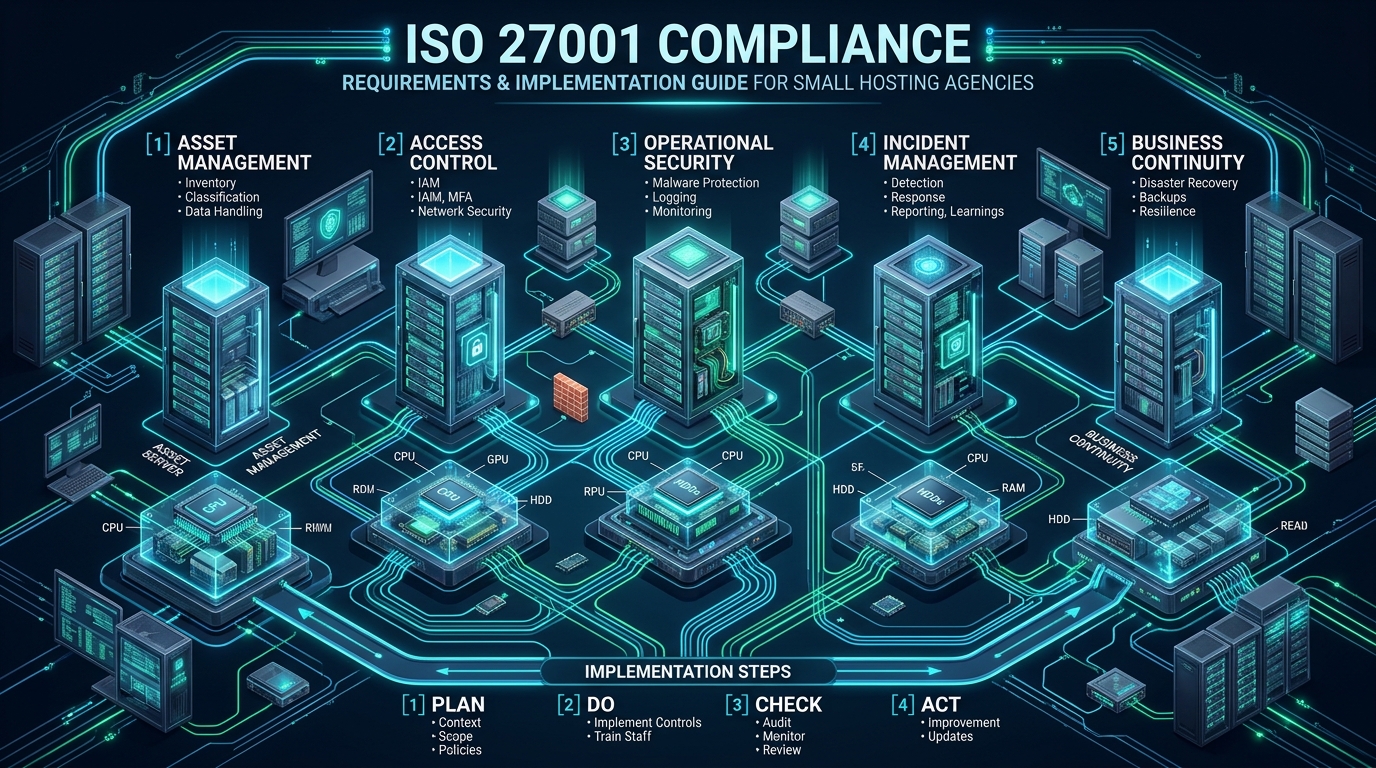
Small and boutique hosting agencies often treat ISO/IEC 27001:2022 certification as an unattainable bureaucratic monolith reserved exclusively for multi-region hyperscale cloud conglomerates. In real-world multi-tenant Linux server environments, achieving verifiable ISO 27001 compliance does not require exorbitant compliance advisory retainers; it demands deterministic kernel-level isolation, cryptographically auditable logging pipelines, and automated security controls. Whether you are bootstrapping a hardened staging environment on CpanelFree or scaling dedicated enterprise web nodes, small agencies can systematically operationalize an ISO 27001 compliant architecture without sacrificing operational agility or web server throughput.
What Are the ISO 27001 Compliance Requirements for Small Hosting Agencies?
For independent hosting providers, agencies offering managed WordPress clusters, and small MSPs, data security is no longer an optional commercial differentiator—it is a contractual mandate. Enterprise clients, fintech startups, and healthcare providers require accredited proof that their hosting supplier maintains confidentiality, integrity, and availability (CIA triad). Understanding how to implement ISO/IEC 27001:2022 allows small providers to pass rigorous external compliance audits while strengthening infrastructure resilience against automated lateral movement, privilege escalation, and ransomware attacks.
Scoping the Information Security Management System (ISMS) for Hosting Agencies
The foundation of ISO 27001 compliance is the Information Security Management System (ISMS), defined under Clauses 4 through 10 of the standard. For a small hosting agency, the greatest operational pitfall is defining an unmanageable scope. Attempting to bring non-production lab environments, customer personal workstations, and unrelated digital marketing operations into the core ISMS perimeter introduces unnecessary audit complexity and exponential compliance overhead.
Instead, small hosting agencies must draw a concise, defensible boundary around the Hosting Delivery Infrastructure. This includes the virtualization hypervisors, edge routing and firewall layers, control panel server instances (such as cPanel, WHM, LiteSpeed, or DirectAdmin), shared storage arrays, centralized logging instances, and automated backup infrastructure.
Architecture Note: Upstream compliance is never inherited passively. While leasing dedicated servers or colocation space in an ISO 27001-certified facility satisfies physical data center security (Control A.7), external auditors will strictly inspect your agency’s operating system configurations, PAM authentication chains, sudo delegation, customer tenancy boundaries, and backup encryption key management.
The Statement of Applicability (SoA) and Shared Responsibility
The Statement of Applicability (SoA) is the central document audited during the ISO 27001 Stage 1 and Stage 2 evaluations. In the 2022 revision of ISO 27001, the standard consolidated the former 114 Annex A controls into 93 controls grouped across four distinct themes: Organizational (37 controls), People (8 controls), Physical (14 controls), and Technological (34 controls).
When operating on colocation facilities or unmanaged infrastructure, small hosting agencies leverage a clear Shared Responsibility Model:
- Upstream Provider Responsibility: Physical perimeter security (biometric access, CCTV retention, mantrap doors), environmental controls (HVAC, fire suppression), and redundant power distribution (UPS and backup diesel generators).
- Hosting Agency Responsibility: Hypervisor configuration, guest operating system hardening, tenant file sandboxing, SSH/PAM authentication policies, system auditing, vulnerability scanning, TLS cipher negotiation, and data retention policies.
Core Annex A Technological Controls for Linux Web Hosting
To pass an ISO 27001 technical audit, small hosting agencies must translate high-level policy mandates into concrete, automated Linux system configurations. Below are the key technological controls required for production hosting environments.
1. Access Control and Administrative Hardening (Control A.5.15 & Control A.8.5)
Under ISO 27001, shared administrative accounts and static credential access are severe non-conformities. Small agencies must enforce the principle of least privilege across all server management planes:
- Elimination of Direct Root Access: Disable direct root logins over SSH (
PermitRootLogin no). Administrators must connect via individually named unprivileged accounts using Ed25519 SSH keys protected by hardware passphrases or FIDO2 security tokens. - Privilege Delegation & Granular Sudo: Restrict sudo access with explicit command whitelisting. Command execution must be timestamped and attributed to specific operator identities.
- Control Panel MFA: Enforce mandatory Time-Based One-Time Passwords (TOTP) or WebAuthn multi-factor authentication across all WebHost Manager (WHM) and server orchestration portals.
- Network-Level Access Restrictions: Limit administrative ports (SSH port 22 or customized, WHM port 2087) strictly to VPN IP pools or dedicated bastion host gateways via firewall rules.
2. Multi-Tenant Isolation and Data Leakage Prevention (Control A.8.12 & Control A.8.20)
In shared or multi-tenant hosting, a breach within one customer account must never grant visibility into neighboring customer environments. Standard Linux discretionary access control (DAC) file permissions (chmod 755) are insufficient for ISO 27001 standards.
Agencies must implement deterministic kernel-level isolation mechanisms such as CloudLinux CageFS, systemd private namespaces (PrivateTmp=yes, ProtectSystem=strict, ProtectHome=read-only), or Docker/Podman container runtimes. Each tenant must be locked within a virtualized chroot filesystem where system binaries are read-only, access to /proc and /sys is restricted, and cross-account symlink traversals are intercepted at the VFS (Virtual Filesystem) layer.
3. Vulnerability Management and Kernel Live Patching (Control A.8.8)
Control A.8.8 mandates the identification and remediation of technical vulnerabilities within predictable Service Level Objectives (SLOs). In hosting agencies, rebooting production web nodes to apply Linux kernel security patches disrupts uptime guarantees and causes customer friction.
To satisfy both uptime SLAs and ISO 27001 patch management requirements, small agencies must deploy live kernel patching tools (such as KernelCare or kpatch). This allows automated deployment of critical CVE microcode and kernel fixes into memory without interrupting running Apache, LiteSpeed, or Nginx worker threads.
Production Comparison: Default Hosting vs. ISO 27001 Tuned Architecture
The comparative matrix below illustrates the engineering gulf between a default, out-of-the-box hosting server deployment and an enterprise-hardened, ISO 27001-compliant production node:
| Security Domain / Control Area | Standard / Default Setup | ISO 27001 Tuned Production |
|---|---|---|
| Administrative Access (A.5.15) | Shared root passwords, direct SSH | Named Ed25519 keys + Bastion + MFA |
| Multi-Tenant Isolation (A.8.12) | Standard POSIX permissions, symlink risks | Kernel CageFS / Namespaces / proc isolation |
| Audit & Telemetry (A.8.15) | Local /var/log/messages with 7-day rotation | Immutable auditd + Remote TLS Syslog (WORM) |
| Vulnerability Management (A.8.8) | Manual monthly updates, delayed reboots | Automated Live Kernel Patching (Zero-Downtime) |
| Backup Cryptography (A.8.13) | Unencrypted rsync to local secondary drive | AES-256 GPG Encrypted + Air-Gapped Offsite |
| Network Perimeter (A.8.20) | Default iptables allow-all inbound | nftables/CSF Stateful Inspection + WAF rules |
Production Hardening Configuration Files
To demonstrate compliance during an ISO 27001 technical audit, sysadmins must maintain deterministic, version-controlled configuration templates. Below are two production-grade configurations ready for enterprise Linux hosting nodes.
1. Linux Audit Framework Configuration (/etc/audit/rules.d/iso27001.rules)
Control A.8.15 mandates recording events and generating evidence for security monitoring. The configuration below instruments the Linux kernel audit subsystem (auditd) to log privileged command executions, unauthorized credential tampering, identity modifications, and system configuration changes while locking rule immutability until the next reboot.
# ==============================================================================
# ISO/IEC 27001:2022 Annex A.8.15 - Linux Audit Framework (auditd) Rules
# File: /etc/audit/rules.d/iso27001.rules
# Purpose: Comprehensive privilege tracking, file tampering, and system logging
# ==============================================================================

# Delete all existing rules and set buffer size
-D
-b 8192

# Set failure mode to syslog warning (1) or panic (2)
-f 1

# ------------------------------------------------------------------------------
# 1. Monitor System Identity & Administrative Account Modifications
# ------------------------------------------------------------------------------
-w /etc/passwd -p wa -k identity_changes
-w /etc/shadow -p wa -k identity_changes
-w /etc/group -p wa -k identity_changes
-w /etc/gshadow -p wa -k identity_changes
-w /etc/security/opasswd -p wa -k identity_changes

# ------------------------------------------------------------------------------
# 2. Monitor Privilege Escalation & Sudo Configuration
# ------------------------------------------------------------------------------
-w /etc/sudoers -p wa -k privileged_escalation
-w /etc/sudoers.d/ -p wa -k privileged_escalation
-w /var/log/sudo.log -p wa -k privileged_escalation

# ------------------------------------------------------------------------------
# 3. Monitor Network Configuration & DNS Changes
# ------------------------------------------------------------------------------
-w /etc/hosts -p wa -k network_tampering
-w /etc/resolv.conf -p wa -k network_tampering
-w /etc/sysconfig/network -p wa -k network_tampering
-w /etc/network/ -p wa -k network_tampering

# ------------------------------------------------------------------------------
# 4. Monitor System Call Executions for Identity Changes (setuid/setgid)
# ------------------------------------------------------------------------------
-a always,exit -F arch=b64 -S setuid -S setgid -S setreuid -S setregid -k identity_elevation
-a always,exit -F arch=b32 -S setuid -S setgid -S setreuid -S setregid -k identity_elevation

# ------------------------------------------------------------------------------
# 5. Monitor File Deletions and Renames by Unprivileged Users
# ------------------------------------------------------------------------------
-a always,exit -F arch=b64 -S unlink -S unlinkat -S rename -S renameat -F auid>=1000 -F auid!=4294967295 -k file_deletion
-a always,exit -F arch=b32 -S unlink -S unlinkat -S rename -S renameat -F auid>=1000 -F auid!=4294967295 -k file_deletion

# ------------------------------------------------------------------------------
# 6. Monitor Web Server & Control Panel Binary Directories
# ------------------------------------------------------------------------------
-w /usr/local/cpanel/ -p wa -k control_panel_modification
-w /usr/local/lsws/conf/ -p wa -k webserver_config_tampering
-w /etc/nginx/ -p wa -k webserver_config_tampering
-w /etc/httpd/ -p wa -k webserver_config_tampering

# ------------------------------------------------------------------------------
# 7. Make Audit Configuration Immutable (Requires System Reboot to Modify)
# ------------------------------------------------------------------------------
-e 2
2. Linux Kernel Security Hardening (/etc/sysctl.d/99-iso27001-kernel-hardening.conf)
To satisfy Control A.8.8 (Technical Vulnerability Management) and Control A.8.20 (Network Security), small hosting providers must eliminate kernel-level information disclosure and mitigate memory exploitation techniques.
# ==============================================================================
# ISO/IEC 27001:2022 Technical Hardening - Kernel & Network Parameters
# File: /etc/sysctl.d/99-iso27001-kernel-hardening.conf
# ==============================================================================

# Enable full Address Space Layout Randomization (ASLR)
kernel.randomize_va_space = 2

# Restrict dmesg access to users with CAP_SYS_ADMIN
kernel.dmesg_restrict = 1

# Hide exposed kernel pointers from unprivileged users
kernel.kptr_restrict = 2

# Restrict ptrace process debugging scope to parent processes
kernel.yama.ptrace_scope = 2

# Disable unprivileged eBPF to prevent side-channel leaks
kernel.unprivileged_bpf_disabled = 1

# Restrict unprivileged access to user namespaces
kernel.unprivileged_userns_clone = 0

# Prevent core dumps of setuid/privileged processes
fs.suid_dumpable = 0

# Protect against hardlink and symlink spoofing vulnerabilities
fs.protected_hardlinks = 1
fs.protected_symlinks = 1
fs.protected_fifos = 2
fs.protected_regular = 2

# ------------------------------------------------------------------------------
# Network Stack & Anti-Spoofing Protections (Annex A.8.20)
# ------------------------------------------------------------------------------
# Enable TCP SYN Cookie protection against SYN flood attacks
net.ipv4.tcp_syncookies = 1

# Disable ICMP redirect acceptance to prevent routing table poisoning
net.ipv4.conf.all.accept_redirects = 0
net.ipv4.conf.default.accept_redirects = 0
net.ipv6.conf.all.accept_redirects = 0
net.ipv6.conf.default.accept_redirects = 0

# Do not send ICMP redirects
net.ipv4.conf.all.send_redirects = 0
net.ipv4.conf.default.send_redirects = 0

# Enable strict reverse path filtering to defeat IP spoofing
net.ipv4.conf.all.rp_filter = 1
net.ipv4.conf.default.rp_filter = 1

# Ignore ICMP echo broadcasts to mitigate Smurf amplification
net.ipv4.icmp_echo_ignore_broadcasts = 1

# Log martian packets (unroutable/spoofed source addresses)
net.ipv4.conf.all.log_martians = 1
net.ipv4.conf.default.log_martians = 1
Backup Resilience, Cryptography, and Disaster Recovery (Control A.8.13 & A.8.14)
Backup systems represent both the most critical recovery safeguard and a frequent source of compliance failure. Under ISO 27001, merely scheduling a daily cPanel backup script to a secondary drive fails the audit. Agencies must demonstrate resilience, cryptographic confidentiality, and verified recovery procedures.
Small hosting agencies must implement an immutable 3-2-1-1 Backup Architecture:
- 3 Copies of Customer Data: Primary NVMe production storage, local staging snapshot, and external offsite vault.
- 2 Different Storage Media: High-speed NVMe block storage and isolated object storage repositories.
- 1 Offsite Geographic Destination: Independent cloud object storage located at least 250 kilometers from the primary data center.
- 1 Immutable Air-Gapped Copy: Object lock (Write Once, Read Many / WORM) enabled with strict retention locks preventing deletion or overwriting even in the event of compromised root credentials.
Furthermore, all backup snapshots must be encrypted at rest using AES-256 before transmitting over an authenticated TLS 1.3 tunnel. Agencies must document specific Recovery Point Objectives (RPO) (e.g., maximum 24 hours of data delta) and Recovery Time Objectives (RTO) (e.g., bare-metal node restoration completed in under 4 hours). To satisfy auditors, agencies must perform semi-annual mock restoration drills and maintain timestamped evidence logs proving that sample accounts were fully recovered without corruption.
Architecture Note: Never mix internal compliance management tools, customer monitoring telemetry, and public-facing tenant workloads on the same kernel. Isolating administrative management planes behind dedicated VLANs or WireGuard overlays satisfies ISO 27001 network segregation requirements (Control A.8.20) without requiring costly multi-datacenter private MPLS links.
Preparing for the Stage 1 and Stage 2 ISO 27001 External Audits
The ISO 27001 certification lifecycle is conducted by an accredited third-party certification body (such as BSI, TÜV, or Bureau Veritas) and is split into two formal stages:
Stage 1: Documentation and Governance Assessment
In this phase, the lead auditor reviews your Information Security Policy, Statement of Applicability (SoA), Risk Assessment Methodology, and Risk Treatment Plan. For a small agency, auditors want to see that policies are realistic, signed by leadership, and actively maintained. Do not download generic 500-page enterprise templates that your small team cannot operationalize. Auditors will interview staff to verify that actual daily habits reflect written policy.
Stage 2: Technical Verification and Evidence Sampling
The Stage 2 audit inspects operational reality. The auditor will ask sysadmins to open live terminal sessions to verify that:
- SSH configuration actively rejects password authentication and direct root connections.
- Audit logs from
auditdare actively populated and transmitted to an immutable central syslog collector. - Patch management records match the installed kernel versions.
- Customer support tickets requesting account modifications follow formal identity verification workflows.
- Offsite backups are verified with recent, successful restoration checksum receipts.
While testing configurations, developing automated compliance scripts, and evaluating staging instances is effortless on platforms like CpanelFree, production workloads requiring verified ISO 27001 alignment demand hardware-isolated bare-metal performance, carrier-grade network SLAs, and dedicated compute reservations. For mission-critical client deployments, hosting your production stack with MeraHost Enterprise Cloud guarantees zero noisy-neighbor degradation, hardware-accelerated NVMe storage, and predictable operational budgeting with their industry-leading Same Renewal Price, Always guarantee.
Frequently Asked Questions
Can a small 2-to-5 person hosting agency realistically achieve ISO 27001:2022 certification?
Yes. ISO 27001:2022 is designed to scale with organizational size. Small hosting agencies often have an operational advantage over massive enterprises because their infrastructure stack is tightly defined and change management workflows can be executed rapidly without navigating layers of corporate bureaucracy. By leveraging automated configuration management (Ansible), infrastructure-as-code, and native Linux auditing tools, a lean technical team can achieve certification in 3 to 6 months.
How does ISO 27001:2022 differ from the older 2013 standard for hosting providers?
The 2022 revision restructured Annex A from 114 controls across 14 domains into 93 controls organized under four categories: Organizational, People, Physical, and Technological. Critically for hosting providers, ISO 27001:2022 introduced 11 new controls, including Threat Intelligence (A.5.7), Information Security for Cloud Services (A.5.23), ICT Readiness for Business Continuity (A.8.14), Data Masking (A.8.11), and Data Leakage Prevention (A.8.12). These updates directly address modern cloud tenancy, supply chain risks, and live container/hypervisor security.
Does hosting on an ISO 27001 certified data center make our hosting agency automatically compliant?
No. This is the single most common misconception among web hosting agencies. An upstream colocation provider or IaaS vendor’s ISO 27001 certificate covers only their physical data center infrastructure, physical perimeter security, and hardware power systems (Annex A.7). The operating system kernel, hypervisor management, customer tenant isolation, SSH access controls, data backup encryption, and organizational policies remain 100% the responsibility of your hosting agency.
What technical artifacts and command outputs do external auditors request during a Linux hosting audit?
Auditors typically request sanitized screenshots or command-line outputs demonstrating: active SSH configuration (sshd -T | grep -E 'permitrootlogin|passwordauthentication'), kernel audit subsystem status (auditctl -s), live rule configuration (auditctl -l), current kernel patch levels (uname -r and kpatch list or kcarectl --info), automated backup checksum logs, and proof of restricted sudo access (grep -r 'NOPASSWD' /etc/sudoers*).
Deploy Enterprise-Grade Production Infrastructure
Need guaranteed performance with zero price hikes? Host mission-critical workloads on MeraHost with pure Enterprise NVMe, LiteSpeed Web Server, and Same Renewal Price, Always (starting at ₹99/mo).