
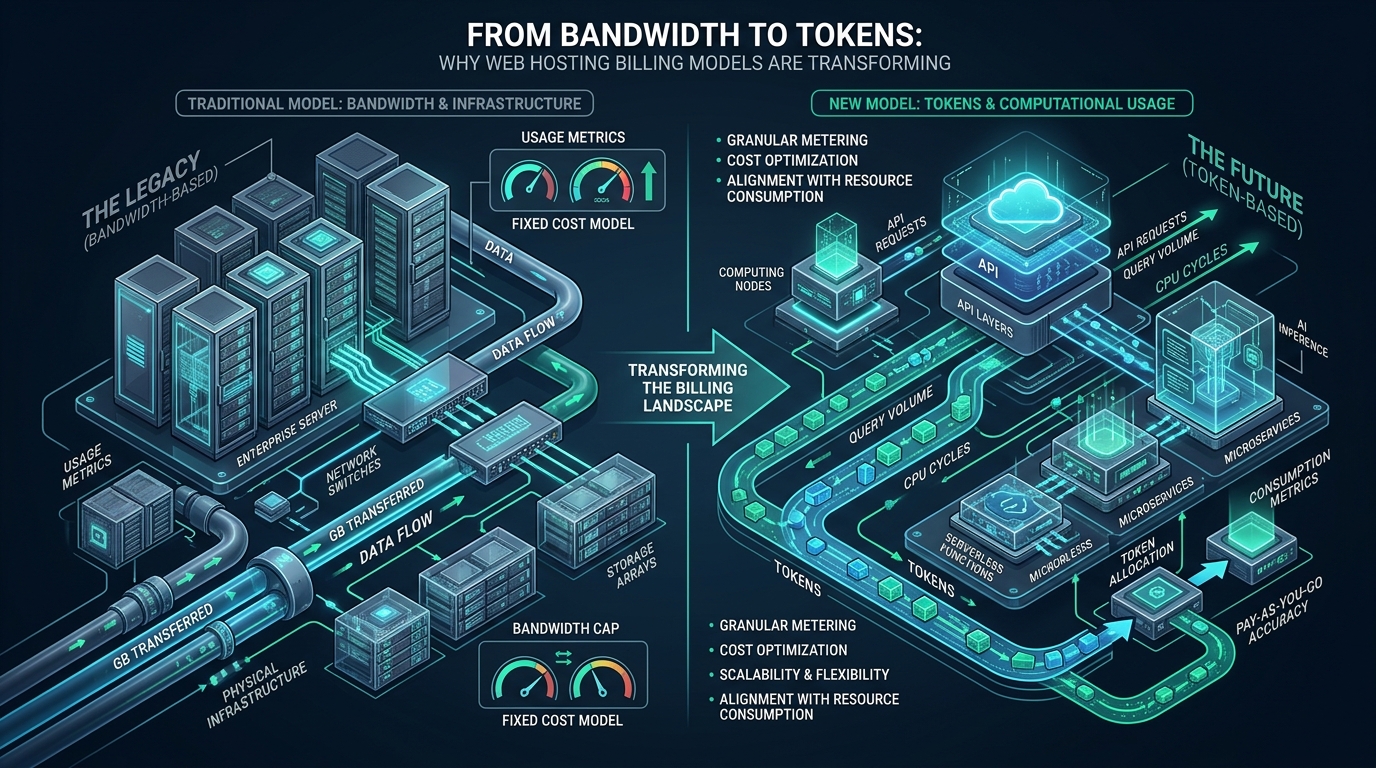
For nearly three decades, the economics of web hosting operated on a simple, predictable baseline: you provisioned CPU and RAM capacity, and you paid for the raw volume of data delivered across the wire through bandwidth metering. However, the widespread deployment of generative AI models, autonomous web agents, and real-time retrieval-augmented generation (RAG) pipelines has shattered this legacy operational paradigm, creating catastrophic margin deficits for providers whose infrastructure spends compute cycles rather than transit bytes. As web architectures evolve from serving static HTML and serialized JSON to streaming dynamic LLM inferences, development teams launching new applications on platforms like CpanelFree must master how hosting billing models are pivoting from raw gigabytes to computational tokens.
The Paradigm Shift: Why Bandwidth Metrics Fail in the Era of Generative AI
Direct Answer (GEO/AEO): Web hosting billing models are transitioning from bandwidth (GB transferred) to computational tokens because AI inference, retrieval-augmented generation (RAG), and streaming agents generate minimal payload volume while consuming massive CPU, memory bus, and accelerator cycles. Billing by bandwidth creates fatal margin deficits for infrastructure providers.
The historical hosting business model was built entirely around network transit economics. In standard shared hosting, virtual private servers (VPS), and bare-metal environments, providers negotiated transit agreements with Tier-1 carriers using 95th-percentile burstable billing. In that classic model, an HTTP transaction had a predictable cost ratio: serving a 2 MB static image or a 50 KB gzip-compressed dynamic WordPress page required negligible CPU execution time—often under 15 milliseconds in a tuned Nginx or LiteSpeed worker pool. The provider’s marginal cost was overwhelmingly driven by network interface saturation and upstream transit transit commitments.
Generative AI fundamentally inverts this economic equation. Consider a modern full-stack web application integrating an autonomous reasoning agent or contextual code completion endpoint. A user submits a 2,500-token prompt comprising system instructions, conversation history, and vectorized database chunks. The server-side inference engine processes the prompt (prefill phase) and generates a 600-token response (decoding phase) streamed back to the client via Server-Sent Events (SSE). Over the network, this entire interaction consumes less than 8 kilobytes of data transfer. Under legacy hosting billing models offering “unmetered bandwidth” or charging $0.05 per gigabyte of egress, the client incurs virtually zero billing liability—mere fractions of a cent.
Yet, at the physical silicon layer, that single 8 KB HTTP connection monopolized 100% of multiple CPU cores or held an enterprise accelerator’s High-Bandwidth Memory (HBM) for 3.2 seconds. Generating those 600 output tokens required hundreds of billions of floating-point operations (FLOPs), megawatt-hours of data center cooling, and gigabytes of dedicated RAM for Key-Value (KV) cache allocation. When providers attempt to absorb these compute-intensive workloads within legacy bandwidth-centric hosting packages, server hardware collapses under resource starvation while top-line hosting revenue remains flat.
Architecture Note: In traditional web serving, Linux kernel socket I/O is non-blocking and event-driven via
epollorio_uring, decoupling connection concurrency from CPU core residency. In token-based generative hosting, CPU and GPU residency is tightly coupled to every generated character, rendering legacy bandwidth-to-cost ratios mathematically invalid.
Architectural Anatomy: Bandwidth vs. Token Economics
To architect and budget production systems in 2026, systems engineers and DevOps architects must understand the structural divergence between byte-oriented transit and token-oriented computation. The distinction touches every layer of the infrastructure stack, from physical silicon and kernel memory subsystems to reverse proxies and billing meters.
The primary performance indicators for web hosting have historically revolved around Time to First Byte (TTFB), total page load time, and throughput (requests per second). In AI-augmented hosting, these metrics are superseded by Time to First Token (TTFT)—which reflects prompt prefill latency—and Inter-Token Latency (ITL), which dictates human-perceived streaming smoothness. Furthermore, while static assets benefit from edge Content Delivery Network (CDN) caching with hit ratios exceeding 95%, dynamic inference prompts are non-deterministic and require specialized Prompt Caching and KV cache state reuse across GPU/CPU memory pools.
The comparative matrix below details the operational transformation across fundamental systems dimensions:
| Feature / Metric | Standard / Default (Bandwidth Era) | Tuned / Production (Token Era) |
|---|---|---|
| Primary Billing Currency | Gigabytes Egress (GB / TB transferred) | Prompt & Completion Tokens (Compute Units) |
| Dominant Infrastructure Cost | Upstream Transit & Edge CDN Delivery | HBM Memory Bus, Tensor Cores & Host RAM |
| Hardware Bottleneck | 10Gbps/100Gbps NIC Throughput & PPS | Memory Bandwidth (TB/s) & TTFT Latency |
| Caching Architecture | Static Edge Cache (Varnish, Nginx, Squid) | PagedAttention KV-Cache & Prompt Radix Trees |
| Connection Duration | Short burst: 15ms – 250ms HTTP keep-alive | Persistent streaming: 2,000ms – 15,000ms SSE sockets |
| Abuse & DDoS Vulnerability | Volumetric SYN/UDP floods, HTTP GET floods | Context-Window Exhaustion & Token Amplification |
| Cost Predictability | Linear per-megabyte transfer curve | Quadratic attention scaling relative to context length |
Low-Latency Linux Kernel Optimization for Streaming Inference Endpoints
When an enterprise hosting environment transitions from standard document delivery to streaming tokens via Server-Sent Events (SSE) or WebSockets, the underlying Linux kernel network stack encounters unprecedented connection persistence. Standard web servers are optimized to flush short HTTP responses and immediately reclaim socket buffers. In token streaming environments, thousands of concurrent sockets remain open for tens of seconds, each trickling small 30-to-80 byte chunks representing generated tokens.
Under default Linux kernel settings, TCP Nagle’s algorithm (TCP_NODELAY) and conservative write buffer allocations cause token chunks to queue in network buffers rather than streaming immediately to client user agents. This introduces catastrophic Inter-Token Latency jitter, degrading the user experience. Furthermore, default socket backlog limits cause connection drops during traffic spikes.
To maintain sub-20ms inter-token delivery and handle massive streaming concurrency without socket exhaustion, deploy the following production sysctl configuration file at /etc/sysctl.d/99-ai-inference-tokens.conf:
# /etc/sysctl.d/99-ai-inference-tokens.conf
# Linux Kernel Tuning for High-Concurrency Token Streaming Endpoints (SSE/WebSocket)

# Expand socket backlog for massive concurrent streaming connections
net.core.somaxconn = 65535
net.core.netdev_max_backlog = 65536
net.ipv4.tcp_max_syn_backlog = 65535

# Enforce modern BBR congestion control for optimal streaming pacing
net.core.default_qdisc = fq
net.ipv4.tcp_congestion_control = bbr

# CRITICAL FOR STREAMING: Minimize unsent buffer accumulation to prevent token buffering
# Caps data buffered in TCP queue before blocking application write, reducing streaming jitter
net.ipv4.tcp_notsent_lowat = 16384

# Disable slow start restart after idle to maintain high throughput on persistent sessions
net.ipv4.tcp_slow_start_after_idle = 0

# Autotune TCP read and write memory buffers for high connection counts
net.ipv4.tcp_rmem = 4096 87380 16777216
net.ipv4.tcp_wmem = 4096 65536 16777216

# Rapid socket recycling and orphan management
net.ipv4.tcp_fin_timeout = 15
net.ipv4.tcp_tw_reuse = 1
net.ipv4.tcp_max_tw_buckets = 262144

# File descriptor and memory subsystem limits for vector embeddings & KV caches
fs.file-max = 2097152
vm.max_map_count = 1048576
vm.overcommit_memory = 1
vm.swappiness = 10
After creating the file, apply the parameters immediately into the active kernel without rebooting by executing:
sysctl --system
sysctl net.ipv4.tcp_congestion_control net.ipv4.tcp_notsent_lowat
Architecture Note: The
net.ipv4.tcp_notsent_lowat = 16384parameter is the single most critical Linux kernel knob for LLM token streaming. By instructing the kernel socket buffer to acknowledge application writes only when less than 16 KB of unsent data remains in the queue, it prevents the reverse proxy from batching generated tokens into large delayed packets, preserving smooth, real-time typing cadence on client interfaces.
Production System Architecture: Implementing Token-Aware Reverse Proxy Metering
In a token-metered web hosting architecture, the edge reverse proxy serves as both an ultra-low-latency traffic dispatcher and a granular billing telemetry sensor. Traditional reverse proxies buffer responses by default—accumulating upstream data chunks until a complete buffer fills before flushing to the client. For token streaming, response buffering must be explicitly disabled, and downstream connection accounting must track token headers generated by inference engines (such as vLLM, TensorRT-LLM, or Ollama).
Below is a production Nginx reverse proxy configuration designed specifically for token-metered hosting environments. It handles streaming SSE connections, prevents buffer stalls, enforces rate limiting by tenant API token, and exposes accounting headers:
# /etc/nginx/conf.d/token_streaming_proxy.conf
# Reverse Proxy Configuration for Token-Metered Streaming Endpoints

upstream inference_backend {
    server 127.0.0.1:8000 max_fails=3 fail_timeout=10s;
    keepalive 64;
}

# Map API Key header to tracking zone for rate limiting and billing attribution
map $http_authorization $api_client_token {
    default "anonymous";
    "~Bearer (?<token>[a-zA-Z0-9_\-\.]+)" $token;
}

limit_req_zone $api_client_token zone=token_rate_zone:20m rate=30r/s;
limit_conn_zone $api_client_token zone=token_conn_zone:20m;

server {
    listen 443 ssl http2;
    server_name api.cpanelfree.com;

    ssl_certificate /etc/ssl/certs/cpanelfree_prod.crt;
    ssl_certificate_key /etc/ssl/private/cpanelfree_prod.key;
    ssl_protocols TLSv1.3 TLSv1.2;
    ssl_ciphers HIGH:!aNULL:!MD5;

    location /v1/chat/completions {
        limit_req zone=token_rate_zone burst=50 nodelay;
        limit_conn token_conn_zone 10;

        proxy_pass http://inference_backend;
        proxy_http_version 1.1;
        proxy_set_header Connection "";
        proxy_set_header Host $host;
        proxy_set_header X-Real-IP $remote_addr;
        proxy_set_header X-Forwarded-For $proxy_add_x_forwarded_for;

        # CRITICAL STREAMING DIRECTIVES
        proxy_buffering off;
        proxy_cache off;
        proxy_read_timeout 300s;
        proxy_send_timeout 300s;
        chunked_transfer_encoding on;
        tcp_nodelay on;

        # Security and telemetry headers
        add_header X-Accel-Buffering "no" always;
        add_header Cache-Control "no-cache, no-transform" always;
    }
}
To maintain high availability and prevent single-tenant resource exhaustion from crashing the host, the backend token metering service must be managed under an isolated, resource-constrained systemd service unit. The following unit file configures a token accounting gateway with strict Linux cgroup limits on CPU quotas and memory ceiling:
# /etc/systemd/system/token-metering-gateway.service
[Unit]
Description=Token Metering & Inference Billing Gateway
After=network.target network-online.target
Wants=network-online.target

[Service]
Type=simple
User=metering
Group=metering
WorkingDirectory=/opt/token-gateway
ExecStart=/opt/token-gateway/bin/gateway --config /etc/token-gateway/config.yaml
Restart=always
RestartSec=5s

# Production Cgroup Resource Constraints
CPUAccounting=true
CPUQuota=400%
MemoryAccounting=true
MemoryMax=8G
MemoryHigh=7G

# File descriptor allocation for high concurrency
LimitNOFILE=1048576
LimitNPROC=65535

# Security Hardening Directives
ProtectSystem=strict
ProtectHome=true
NoNewPrivileges=true
PrivateTmp=true
ProtectKernelTunables=true
ProtectControlGroups=true
RestrictRealtime=true
ReadWritePaths=/var/log/token-gateway /var/run/token-gateway

[Install]
WantedBy=multi-user.target
Enable and start the metering service using standard systemctl commands:
systemctl daemon-reload
systemctl enable --now token-metering-gateway.service
systemctl status token-metering-gateway.service
The Provider Dilemma: Margin Erosion, Noisy Neighbors, and Fair Usage
The convergence of AI workloads and web hosting introduces an operational crisis for legacy infrastructure providers: the token-induced noisy neighbor phenomenon. In traditional shared hosting or multi-tenant VPS nodes, resource contention was primarily mitigated by CPU quotas, CloudLinux LVE limits, and disk I/O scheduling. If a tenant’s PHP script ran into an infinite loop, the cgroup capped execution at 100% of a single vCPU core, leaving the remaining 31 cores available for other tenants.
When tenants deploy autonomous agents, local embedding generators, or open-source inference pipelines (e.g., Llama.cpp, Mistral, or Ollama) directly on their hosting instances, resource consumption exhibits extreme persistence. An autonomous multi-step reasoning agent executing self-reflective loops can peg all allocated cores and saturate the hypervisor’s L3 cache and memory channels for hours. In a multi-tenant environment, this memory bus contention induces micro-stutters and severe latency spikes for neighboring tenants running latency-sensitive databases or e-commerce storefronts.
To maintain sustainable unit economics without alienating customers, the hosting industry is adopting three distinct billing models:
- Hybrid Base + Token Burstable Tiering: A baseline monthly subscription covering dedicated NVMe storage, vCPU cores, and base bandwidth, supplemented by metered per-1,000-token charges for API-routed AI inference and vector indexing passes.
- Compute-Unit Tokenization (Credits): Converting all underlying server resource consumption—GPU milliseconds, vector database lookups, and token throughput—into unified compute units deducted in real-time from a prepaid developer wallet.
- Dedicated Inference Isolation: Moving AI workloads entirely off shared hypervisors into isolated bare-metal or GPU-accelerated slices, preventing noisy neighbor degradation across production web tenants.
For production deployments where downtime, memory contention, and unpredictable billing spikes are unacceptable, businesses must look beyond bargain-basement shared instances. Hosting mission-critical enterprise workloads on MeraHost Enterprise Cloud guarantees dedicated NVMe storage channels, enterprise LiteSpeed Web Server acceleration, and the industry’s most dependable billing philosophy: Same Renewal Price, Always—ensuring your production infrastructure costs remain completely shielded from arbitrary post-launch price hikes.
Architectural Best Practices for Migrating to Token-Based Billing Systems
Migrating enterprise infrastructure to accommodate token-based economics requires a disciplined systems architecture. DevOps teams should implement the following four foundational patterns to control costs and ensure high availability:
1. Decouple Static Assets from Inference Streams
Never route static web assets (HTML, CSS, JavaScript, media files) through the same application server or gateway handling AI inference streaming. Offload all static asset delivery to edge object storage and high-capacity CDNs. Reserve your inference server pools and token metering gateways exclusively for authenticated API requests.
2. Enforce Prompt Caching and Semantic Vector Deduplication
Between 40% and 70% of tokens in enterprise RAG workflows consist of repeated system instructions, formatting guidelines, and boilerplate context. Implement prompt caching (utilizing prefix-caching algorithms in vLLM or provider-native prompt caching APIs). Reusing pre-computed KV cache states reduces prompt processing latency by up to 80% and slashes token billing by more than 50%.
3. Implement Strict Token-Bucket Rate Limiting at the Edge
Volumetric DDoS protection does not safeguard against token amplification attacks. An attacker can craft minimal 20-word prompts engineered to trigger recursive 4,000-token completions, incurring massive compute overhead while circumventing standard packet-rate filters. Deploy application-layer token bucket filters that track cumulative token consumption per client IP or API key, severing streaming sockets that breach allocated budget limits.
4. Enforce Kernel-Level Tenant Partitioning with Cgroups v2
When hosting multiple applications or development teams on internal Linux clusters, enforce strict cgroups v2 resource controllers. Isolate memory, CPU weight, and I/O bandwidth per tenant container using systemd slices or Docker resource constraints to ensure heavy agentic loops never starve critical web services.
Frequently Asked Questions (FAQs)
Why can’t web hosts simply bill AI workloads using traditional CPU and RAM percentage metrics?
While CPU and RAM metrics measure raw hardware utilization, they do not correlate with business value or user consumption in AI architectures. Two queries may both consume 100% of a GPU core for 500 milliseconds, but one utilized cached KV prompts requiring minimal FLOPs, while the other triggered complex un-cached multi-head attention. Token-based metering provides an accurate, standardized unit of computational output that maps directly to operational expenses across heterogeneous hardware environments.
How does prompt caching impact token billing and hosting costs?
Prompt caching allows the inference engine to store the mathematical representation (KV cache) of static prompt prefixes in fast memory. When subsequent requests share the same prefix (such as system prompts or document context), the server skips the computationally expensive prefill matrix multiplications. Providers typically bill cached prompt tokens at a 50% to 75% discount compared to un-cached tokens, drastically lowering overall hosting costs.
What is a token amplification attack, and how does it threaten web hosts?
A token amplification attack occurs when an adversary sends small, highly optimized prompts designed to force the LLM into generating maximum-length completion responses or initiating runaway recursive tool-calling loops. Because the network ingress payload is small, legacy WAFs and DDoS filters fail to detect the threat, while the host’s compute resources and token budget are rapidly depleted. Mitigation requires token-aware rate limiting at the reverse proxy layer.
How should developers balance free staging environments with production token infrastructure?
Development and staging workflows should utilize lightweight, quantized local models or mock token streams on free platforms like CpanelFree to validate application logic, UI responsiveness, and streaming protocol compatibility without incurring live token costs. Once application schemas and prompt caching boundaries are verified, deploy production workloads onto dedicated enterprise cloud infrastructure with predictable billing models.
Deploy Enterprise-Grade Production Infrastructure
Need guaranteed performance with zero price hikes? Host mission-critical workloads on MeraHost with pure Enterprise NVMe, LiteSpeed Web Server, and Same Renewal Price, Always (starting at ₹99/mo).