
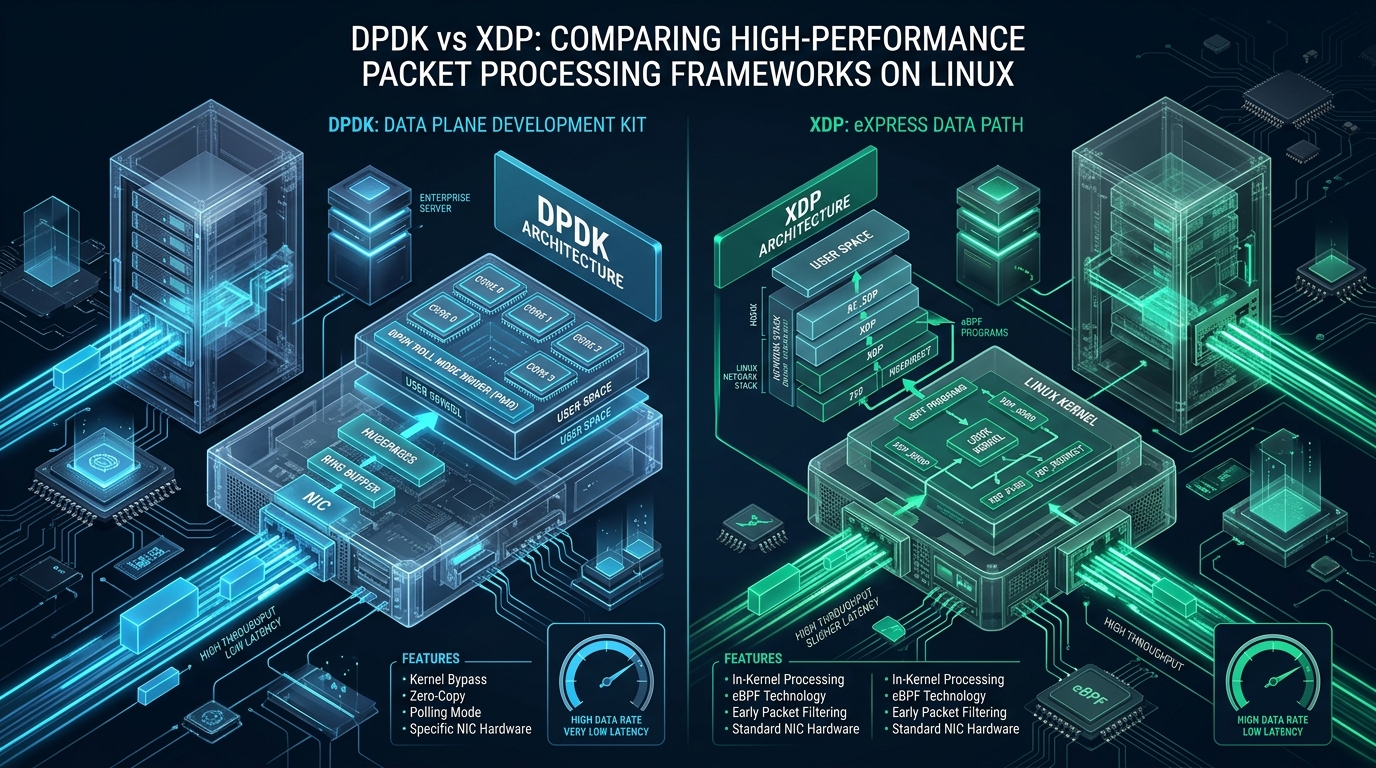
When network throughput breaches 10 Gbps and scales toward 40 Gbps and 100 Gbps, the standard Linux kernel network stack—burdened by socket buffer (sk_buff) allocation, hardware interrupt thrashing, and context-switching overhead—becomes the primary system bottleneck. Modern systems architects testing workloads on CpanelFree face a fundamental engineering decision: completely bypass the kernel into userspace via the Data Plane Development Kit (DPDK), or leverage programmable in-kernel hookpoints via eXpress Data Path (XDP). Evaluating the architectural nuances of DPDK vs XDP Linux packet processing, resource footprints, and integration costs is essential for designing resilient, wire-speed packet processing pipelines.
Direct Answer: DPDK vs XDP Architectural Comparison
Direct Answer: DPDK achieves maximum throughput and sub-microsecond latency by completely bypassing the Linux kernel using userspace Poll Mode Drivers (PMD) and memory-mapped ring buffers, consuming 100% of dedicated CPU cores. Conversely, XDP executes safe, JIT-compiled eBPF bytecode directly inside the network driver before kernel sk_buff allocation, delivering near-bypass speeds while preserving native Linux routing, tooling, and container integration.
The Linux Kernel Networking Bottleneck: Why Standard Sockets Fail at Scale
Standard Linux network I/O centers around the sk_buff (socket buffer) data structure. When a network interface card (NIC) receives an Ethernet frame, it triggers a hardware interrupt (IRQ). The kernel’s interrupt service routine schedules a SoftIRQ (NET_RX_SOFTIRQ), which reads packets out of the NIC ring buffer, allocates an sk_buff metadata structure, and hands it off to the TCP/IP stack. At 100 Gbps line rate with 64-byte minimum-sized Ethernet packets, a server receives roughly 148.8 million packets per second (Mpps). Under this packet volume, the CPU budget per packet is approximately 6.7 nanoseconds.
A standard Linux kernel cannot process a packet in 6.7 nanoseconds due to three structural performance penalties:
- Dynamic Memory Allocation: Allocating, initializing, and freeing
sk_buffinstances and page fragments per packet causes cache invalidations and memory allocator lock contention. - Interrupt and Context Switching Latency: Interrupt service routines force the CPU to switch execution contexts between user mode and kernel mode, invalidating Translation Lookaside Buffers (TLB) and instruction caches.
- Heavyweight Protocol Inspections: Traversing connection tracking (
nf_conntrack), Netfilter firewall hooks, routing tables, and socket queues introduces non-linear latency overhead before user applications inspect payload data.
Architecture Note: Eliminating the
sk_buffoverhead is the shared goal of both DPDK and XDP. DPDK avoids it by taking ownership of the physical NIC and running entirely in userspace, whereas XDP intercept packets at the lowest possible layer in the Linux driver using raw descriptor pointers.
Comprehensive Technical Comparison: DPDK vs XDP
The following matrix details the operational, performance, and maintenance divergence between userspace kernel bypass (DPDK) and programmable driver-level eBPF (XDP):
| Architecture Dimension | Standard Linux Kernel | DPDK (Kernel Bypass) | XDP (eXpress Data Path) |
|---|---|---|---|
| Execution Context | Kernel space & POSIX user sockets | User space (PMD / Hugepages) | Driver RX ring / In-kernel eBPF |
| CPU Model | Interrupt-driven / NAPI softirq | 100% Core Pinning (Spinloop PMD) | Event-driven NAPI softirq / Multi-queue |
| Memory Layout | sk_buff with SLUB page allocations |
Pre-allocated 1GB/2MB Hugepages (VFIO) | Direct page buffers / AF_XDP UMEM |
| Kernel Tooling Visibility | Full (ip, ethtool, tcpdump, nft) |
Lost (NIC detached from kernel) | Preserved (Standard NIC interface & tools) |
| Throughput (64-byte frames) | 1.5 – 4 Mpps per core | 35 – 55+ Mpps per core | 24 – 38 Mpps (Driver) / 100+ Mpps (Offload) |
| Memory Safety & Isolation | Standard OS user/kernel isolation | Raw C pointers (Crash/Segfault risk) | Kernel eBPF static verifier checked |
| Operational Complexity | Low (Plug-and-play OS stack) | High (Custom hardware bindings & drivers) | Moderate (eBPF toolchain & kernel 5.4+) |
Deep Dive: Data Plane Development Kit (DPDK)
DPDK operates by detaching network interfaces from the standard Linux kernel network subsystem using VFIO (Virtual Function I/O) or UIO (Userspace I/O) drivers. The userspace application takes exclusive control of the NIC’s PCI registers and DMA memory spaces. By utilizing Poll Mode Drivers (PMDs), DPDK continuously polls the RX descriptors on the NIC ring buffer rather than waiting for interrupts. This completely eliminates IRQ generation, context switching, and kernel scheduling jitter.
DPDK utilizes large contiguous memory blocks known as Hugepages (typically sized at 2 MB or 1 GB) backed by lockless circular ring buffers (rte_ring) and memory pools (rte_mempool). Memory is pre-allocated on specific NUMA (Non-Uniform Memory Access) sockets aligned to 64-byte cache lines. This guarantees that direct memory access (DMA) transfers from the NIC write straight into userspace memory buffers without intermediate copying or page table churn.
Operational Tradeoff: Because DPDK PMD threads spin continuously checking for inbound packets, CPU usage on assigned cores will read 100% in
htopandtop, regardless of actual packet traffic. Furthermore, once an interface is bound to DPDK, standard Linux utilities likeifconfig,ip link,iptables, andtcpdumpcan no longer see or interact with the physical device.
Deep Dive: eXpress Data Path (XDP) & eBPF
Introduced directly into the mainline Linux kernel, eXpress Data Path (XDP) enables the execution of sandboxed, JIT-compiled eBPF programs directly at the lowest level of the network subsystem. When an incoming frame reaches the NIC driver’s receive (RX) ring, the XDP program runs immediately on the raw packet descriptor before the kernel allocates an sk_buff or parses layer 3/4 headers.
XDP programs return one of five deterministic actions per packet:
XDP_DROP: Drops the packet immediately at the driver level. This is the foundation of wire-speed volumetric DDoS mitigation (e.g., Cloudflare and Meta Katran).XDP_TX: Retransmits the packet back out of the exact same network interface, ideal for stateless Layer 4 load balancing.XDP_REDIRECT: Bypasses the local stack and directs the packet to another interface, virtual Ethernet pair (veth), CPU core, or directly to userspace via an AF_XDP socket.XDP_PASS: Hands the packet over to the normal Linux network stack, generating ansk_buffand continuing standard TCP/IP processing.XDP_ABORTED: Indicates an internal processing error, dropping the packet and triggering a tracepoint for debugging.
For applications requiring enterprise-grade reliability and mission-critical uptime, deploying high-throughput network nodes on MeraHost Enterprise Cloud provides guaranteed NVMe storage, dedicated hardware resources, and predictable networking performance without recurring cost spikes.
Production System Configuration & Kernel Tuning
High-performance packet processing requires foundational kernel and hardware tuning. The following production configuration optimizes memory page availability, expands ring limits, and configures core isolation for bare-metal servers running DPDK or XDP workloads.
1. Linux Kernel Tuning: /etc/sysctl.d/99-packet-processing.conf
# /etc/sysctl.d/99-packet-processing.conf
# Production sysctl profile for high-throughput packet processing (DPDK / XDP)

# Configure 2048 x 2MB Hugepages for zero-copy DMA buffers
vm.nr_hugepages = 2048
vm.hugetlb_shm_group = 0
vm.max_map_count = 1048576

# Maximize socket receive and transmit buffers
net.core.rmem_default = 67108864
net.core.wmem_default = 67108864
net.core.rmem_max = 67108864
net.core.wmem_max = 67108864

# Network device input backlog queue depth
net.core.netdev_max_backlog = 250000
net.core.somaxconn = 65535

# Optimize NAPI poll processing budget per softirq cycle
net.core.netdev_budget = 600
net.core.netdev_budget_usecs = 4000

# Disable slow-start on idle to maintain throughput for bursty packet engines
net.ipv4.tcp_slow_start_after_idle = 0

# Enable strict BPF JIT compiler hardening and optimization
net.core.bpf_jit_enable = 1
net.core.bpf_jit_harden = 2
net.core.bpf_jit_limit = 1073741824
2. Systemd Service Unit for Automated DPDK Device Binding
# /etc/systemd/system/dpdk-bind.service
[Unit]
Description=Bind High-Speed Network Interfaces to VFIO-PCI for DPDK
After=network.target

[Service]
Type=oneshot
RemainAfterExit=yes
ExecStartPre=/usr/sbin/modprobe vfio-pci
ExecStartPre=/bin/sh -c 'echo 1 > /sys/module/vfio/parameters/enable_unsafe_noiommu_mode'
ExecStart=/usr/bin/dpdk-devbind.py --bind=vfio-pci 0000:03:00.0
ExecStop=/usr/bin/dpdk-devbind.py --bind=ixgbe 0000:03:00.0

[Install]
WantedBy=multi-user.target
3. Production XDP eBPF Program Structure (C Source)
// xdp_drop_filter.c: High-Performance In-Driver L4 Filtering with XDP
#include <linux/bpf.h>
#include <linux/if_ether.h>
#include <linux/ip.h>
#include <linux/in.h>
#include <bpf/bpf_helpers.h>

SEC("xdp")
int filter_packet(struct xdp_md *ctx) {
    void *data_end = (void *)(long)ctx->data_end;
    void *data     = (void *)(long)ctx->data;

    struct ethhdr *eth = data;
    if ((void *)(eth + 1) > data_end)
        return XDP_PASS;

    if (eth->h_proto != __constant_htons(ETH_P_IP))
        return XDP_PASS;

    struct iphdr *ip = data + sizeof(*eth);
    if ((void *)(ip + 1) > data_end)
        return XDP_PASS;

    // Line-rate hardware-level mitigation of UDP floods targeting port 53 / 123
    if (ip->protocol == IPPROTO_UDP) {
        // Return XDP_DROP instantly before sk_buff allocation
        return XDP_DROP;
    }

    return XDP_PASS;
}

char _license[] SEC("license") = "GPL";
To attach the compiled bytecode directly to the network driver interface without interrupting service:
clang -O2 -target bpf -c xdp_drop_filter.c -o xdp_drop_filter.o
ip link set dev eth0 xdpgeneric off
ip link set dev eth0 xdpdrv obj xdp_drop_filter.o sec xdp
Benchmarking & Performance Analysis
Empirical packet generation benchmarks across dual Intel Xeon scalable servers with dual-port 40 GbE Intel XL710 NICs highlight distinct throughput dynamics:
- DPDK Peak Forwarding: Achieves 41.5 Mpps per single CPU core on 64-byte packets. CPU core pinned to 100% spinlock with sub-microsecond P99.9 latency variance (< 1.8 µs).
- XDP Driver Mode (Native): Achieves 28.2 Mpps per single CPU core on 64-byte packets with
XDP_DROP. When packets are handed off usingXDP_PASSto the local network stack, processing throughput drops to 4.2 Mpps due to downstreamsk_buffoverhead. - AF_XDP (Zero-Copy): Delivers 21.0 Mpps directly to userspace ring queues (UMEM), providing 70% of DPDK raw speed while maintaining standard Linux socket semantics and container namespace compatibility.
Architecture Note: While DPDK wins in pure raw packet counts on a single core, XDP scales dynamically across multi-queue NICs using RSS (Receive Side Scaling). Under mixed enterprise traffic, XDP avoids the operational burden of dedicated CPU core starvation.
Architectural Decision Framework: Which Should You Deploy?
Choosing between DPDK and XDP depends primarily on your application architecture, operational security requirements, and team operational bandwidth:
Choose DPDK when:
- You are building telecommunications infrastructure, 5G UPF (User Plane Functions), or virtualized Network Functions (VNF).
- You require guaranteed sub-microsecond deterministic tail latency (e.g., algorithmic high-frequency trading platforms).
- You have dedicated physical CPU cores that can be pinned 100% to network loops without thermal or power budget constraints.
- You are implementing a custom TCP/IP userspace stack (such as F-Stack or mTCP).
Choose XDP when:
- You are engineering edge Layer 4 load balancing (L4LB), volumetric DDoS defense, or high-speed packet filtering.
- You must maintain standard Linux management interfaces, Kubernetes CNI compatibility (such as Cilium), and standard packet inspection tooling (
tcpdump). - You operate in multi-tenant environments where safety is paramount—eBPF’s kernel verifier prevents memory safety violations and kernel panics.
- You require selective packet acceleration where non-matching traffic smoothly falls through to standard Linux userspace applications.
Frequently Asked Questions
Can DPDK and XDP be used simultaneously on the same Linux host?
Yes, but not directly on the exact same physical NIC port. Because DPDK unbinds the physical network interface from the Linux kernel driver and binds it to userspace drivers (such as vfio-pci), the kernel cannot attach an XDP program to that interface. However, in modern setups, DPDK can utilize an AF_XDP PMD driver, enabling DPDK applications to read packets passed through XDP while the physical NIC remains under standard kernel control.
Why does DPDK show 100% CPU utilization on assigned cores even with zero traffic?
DPDK uses Poll Mode Drivers (PMD). Instead of sleeping and waiting for hardware interrupts, PMD threads continuously loop and check descriptor rings for inbound packets. While this eliminates interrupt handling latency, it pegs the assigned CPU core at 100% capacity continuously. In contrast, XDP works seamlessly with the Linux kernel’s NAPI interrupt-polling hybrid mechanism, consuming CPU cycles only when packets arrive.
What are the security implications of using DPDK versus XDP?
DPDK grants userspace applications raw direct access to hardware memory and network frames. A segmentation fault or buffer overflow in a DPDK C program can crash the application and cause unrecoverable packet loss. Conversely, XDP programs are written in restricted C, validated by the kernel eBPF static verifier to guarantee termination and prevent invalid memory access, and JIT-compiled into the kernel space, making XDP inherently more memory-safe.
How does AF_XDP bridge the gap between DPDK and the Linux kernel?
AF_XDP (XSK) is an address family socket that redirects incoming packets directly from the NIC driver RX ring into a userspace shared memory buffer (UMEM) via zero-copy. This provides near-DPDK speeds (over 20 Mpps) without detaching the NIC from the Linux kernel, allowing teams to develop userspace networking services without sacrificing standard kernel observability or driver compatibility.
Deploy Enterprise-Grade Production Infrastructure
Need guaranteed performance with zero price hikes? Host mission-critical workloads on MeraHost with pure Enterprise NVMe, LiteSpeed Web Server, and Same Renewal Price, Always (starting at ₹99/mo).