
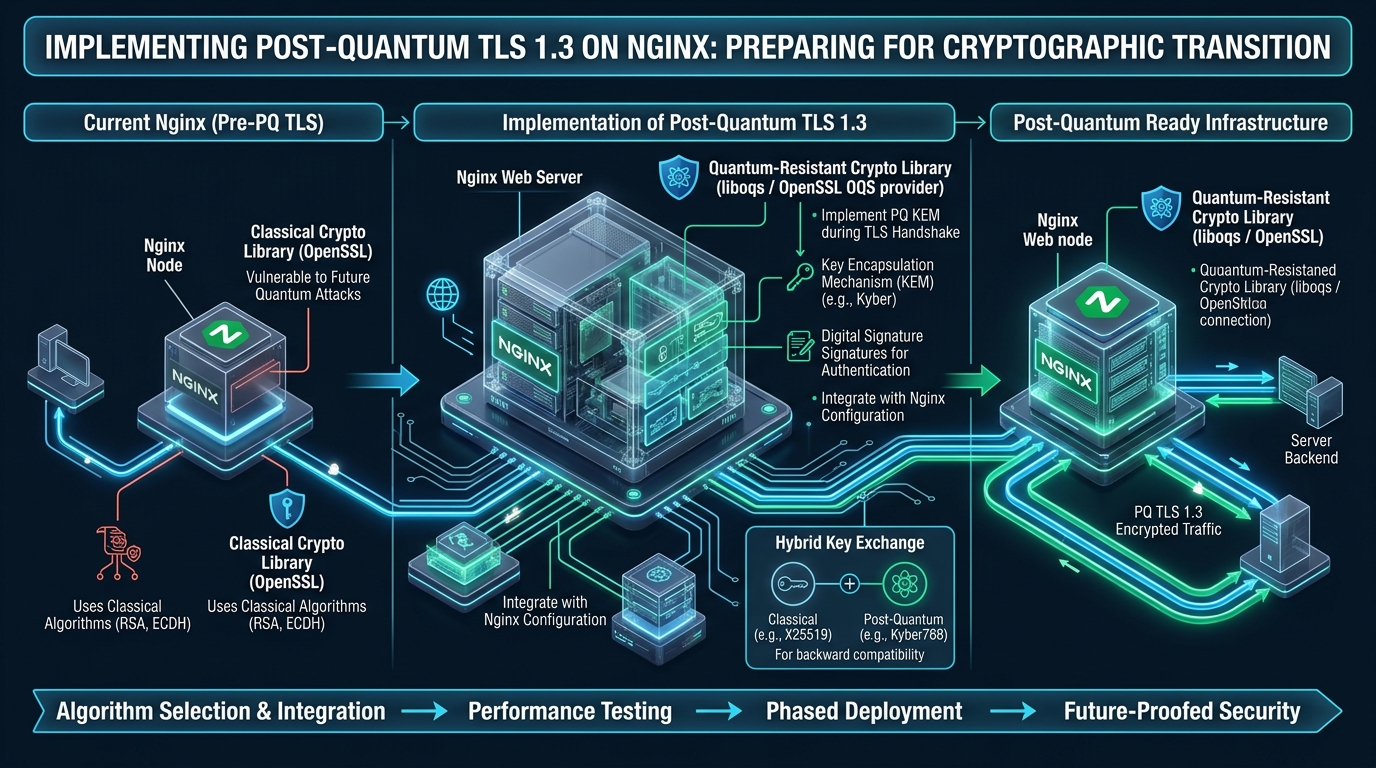
Adversaries and nation-state threat actors are actively executing “Harvest Now, Decrypt Later” (HNDL) data exfiltration campaigns, intercepting and storing massive volumes of encrypted enterprise traffic traversing the public internet in anticipation of cryptanalytically relevant quantum computers (CRQCs) breaking classical asymmetric algorithms like RSA and ECDH. To neutralize this existential threat without degrading latency or crashing legacy client handshakes, systems architects must implement hybrid post-quantum key encapsulation mechanisms (KEMs) such as X25519MLKEM768 at the web edge. Whether you validate preliminary reverse proxy topologies on staging environments via CpanelFree or orchestrate multi-region production clusters, implementing post-quantum TLS 1.3 on Nginx is an essential defense-in-depth transformation that requires precise kernel, crypto-library, and web server alignment.
Understanding Post-Quantum Cryptography in Modern TLS 1.3
Direct Answer: A resilient post-quantum TLS Nginx setup guide requires implementing hybrid Key Encapsulation Mechanisms (KEMs)—specifically marrying classical elliptic-curve X25519 with the NIST FIPS 203 standard ML-KEM-768 (formerly Kyber768)—utilizing OpenSSL 3.x with the Open Quantum Safe (OQS) provider or a modern BoringSSL/quictls runtime. This hybrid configuration prevents future retroactive decryption by quantum adversaries while preserving backward compatibility and maintaining sub-millisecond TLS 1.3 handshakes.
The “Harvest Now, Decrypt Later” Threat Model and Lattice Cryptography
Conventional internet transport security relies almost entirely on the computational hardness of mathematical problems: the integer factorization problem (RSA) and the discrete logarithm problem over elliptic curves (ECDHE, ECDSA). Peter Shor’s algorithm, conceived in 1994, proves that a sufficiently scaled, fault-tolerant quantum computer running Shor’s algorithm can solve both problems in polynomial time (BQP), effectively breaking all deployed classical public key cryptography. While practical fault-tolerant quantum computing with millions of physical qubits remains several years away, the operational hazard is current: adversaries capture bulk ciphertext today, confident that retrospective decipherment will expose proprietary corporate intelligence, healthcare records, financial ledgers, and government communications years down the line.
To defeat HNDL, the National Institute of Standards and Technology (NIST) standardized Module-Lattice-Based Key-Encapsulation Mechanism (ML-KEM, published as FIPS 203, based on CRYSTALS-Kyber). Lattice-based cryptography derives its security from the hardness of high-dimensional lattice problems, such as the Learning With Errors (LWE) and Module Learning With Errors (M-LWE) problems, which have no known polynomial-time quantum algorithmic shortcuts. However, because pure post-quantum algorithms are relatively young compared to decades of peer-reviewed elliptic curve analysis, the cryptographic community and the IETF mandated a hybrid key exchange mechanism. In hybrid mode, the client and server perform both a classical X25519 key exchange and an ML-KEM-768 key encapsulation simultaneously, combining both shared secrets with a HKDF (HMAC-based Extract-and-Expand Key Derivation Function). If either algorithm remains unbroken, the session key remains completely secure.
Architecture Note (MTU & TCP Fragmentation): Classical X25519 public keys require only 32 bytes, effortlessly fitting inside a single 1500-byte Ethernet MTU frame alongside standard TLS extensions. In contrast, the hybrid X25519 + ML-KEM-768 public key package expands the ClientHello key share to approximately 1,216 bytes. When combined with server name indication (SNI), application-layer protocol negotiation (ALPN), and session tickets, the ClientHello frequently breaches standard TCP Maximum Segment Sizes (MSS), causing IP packet fragmentation. Misconfigured middleboxes and enterprise firewalls that discard unreassembled fragments will cause silent handshake drops unless kernel TCP buffers and Path MTU Discovery (PMTUD) are properly tuned.
Cryptographic Performance Matrix: Classical vs. Hybrid vs. Pure Post-Quantum
Evaluating key size overhead, computational complexity, and network payload impacts is essential before deploying post-quantum algorithms to high-traffic Nginx edges. Below is an engineering benchmark comparing classical ECDHE against hybrid and pure quantum-resistant KEMs:
| Feature / Metric | Standard / Default (X25519) | Tuned / Production (X25519MLKEM768) |
|---|---|---|
| Security Category | Classical 128-bit (ECDHE) | NIST Level 3 + Classical Hybrid |
| Quantum HNDL Resistance | Vulnerable (Zero Forward Secrecy vs CRQC) | Immune (Dual HKDF Protection) |
| Public Key Share Size | 32 Bytes | 1,216 Bytes (32 + 1,184 Bytes) |
| Ciphertext / Response Overhead | 32 Bytes | 1,120 Bytes (32 + 1,088 Bytes) |
| Handshake Round Trips (RTT) | 1-RTT TLS 1.3 | 1-RTT TLS 1.3 (Preserved) |
| Server Handshake CPU Latency | Baseline (0.08 ms) | Optimal (+0.04 ms delta / AVX2 enabled) |
| Legacy Client Interoperability | Universal | Seamless Fallback to X25519/P-256 |
Step-by-Step Production Build: OpenSSL 3.x, liboqs, and Nginx
Standard Linux distribution packages for Nginx (including Ubuntu LTS and RHEL) link against vanilla OpenSSL installations that do not enable post-quantum KEMs out of the box. To deploy an enterprise-ready post-quantum Nginx proxy, we leverage the Open Quantum Safe (OQS) project, which provides liboqs (an open-source C library for quantum-resistant cryptographic algorithms) alongside oqsprovider (a dynamic provider module for OpenSSL 3.x). This modular architecture enables Nginx to access quantum-safe algorithms without modifying Nginx source code or breaking the core OpenSSL crypto engine.
1. Compiling and Installing liboqs and oqsprovider
Execute the following bash workflow on Debian/Ubuntu or Rocky Linux to compile the shared C libraries with AVX2/AVX-512 hardware acceleration enabled:
# Install build prerequisites and toolchain
sudo apt update && sudo apt install -y build-essential cmake ninja-build git libssl-dev pkg-config zlib1g-dev libpcre3-dev

# Clone and build liboqs (with shared libraries enabled)
cd /usr/local/src
sudo git clone --depth 1 --branch main https://github.com/open-quantum-safe/liboqs.git
sudo cmake -S liboqs -B liboqs/build -DBUILD_SHARED_LIBS=ON -DCMAKE_INSTALL_PREFIX=/usr/local -DOQS_USE_OPENSSL=ON
sudo cmake --build liboqs/build --parallel $(nproc)
sudo cmake --install liboqs/build
sudo ldconfig

# Clone and build oqsprovider for OpenSSL 3.x
sudo git clone --depth 1 --branch main https://github.com/open-quantum-safe/oqs-provider.git
sudo cmake -S oqs-provider -B oqs-provider/build -DCMAKE_INSTALL_PREFIX=/usr/local -DOPENSSL_ROOT_DIR=/usr -DOQS_DIR=/usr/local
sudo cmake --build oqs-provider/build --parallel $(nproc)
sudo cmake --install oqs-provider/build

# Verify provider detection
openssl list -providers -provider-path /usr/local/lib64/ossl-modules -provider oqsprovider
Hardened Production Configuration Files
To activate hybrid post-quantum TLS 1.3 across your fleet, configure the OpenSSL configuration provider loader, the Nginx virtual host definitions, and the host operating system’s TCP network stack.
File 1: OpenSSL 3 Provider Configuration (/etc/ssl/openssl.cnf)
Ensure OpenSSL loads both the default provider and the OQS provider dynamically so that Nginx recognizes hybrid curve identifiers:
# /etc/ssl/openssl.cnf - OpenSSL 3.x Configuration with OQS Provider
openssl_conf = openssl_init

[openssl_init]
providers = provider_sect
ssl_conf = ssl_module

[provider_sect]
default = default_sect
oqsprovider = oqsprovider_sect

[default_sect]
activate = 1

[oqsprovider_sect]
activate = 1
module = /usr/local/lib64/ossl-modules/oqsprovider.so

[ssl_module]
system_default = ssl_configuration

[ssl_configuration]
Groups = x25519_mlkem768:X25519:prime256v1:secp384r1
File 2: Production Nginx Post-Quantum TLS 1.3 Block (/etc/nginx/conf.d/pqc-tls.conf)
Configure Nginx to negotiate TLS 1.3 exclusively with hybrid KEM groups, maintaining zero-round-trip session caching, strict security headers, and OCSP stapling:
# /etc/nginx/conf.d/pqc-tls.conf - Enterprise Post-Quantum Nginx Configuration
server {
    listen 443 ssl http2;
    listen [::]:443 ssl http2;
    server_name api.production.domain;

    # Certificate and Key (Standard Classical RSA/ECDSA for Authentication)
    ssl_certificate /etc/letsencrypt/live/api.production.domain/fullchain.pem;
    ssl_certificate_key /etc/letsencrypt/live/api.production.domain/privkey.pem;
    ssl_trusted_certificate /etc/letsencrypt/live/api.production.domain/chain.pem;

    # Strict Protocol Enforcement (TLSv1.3 ensures post-quantum KEM integrity)
    ssl_protocols TLSv1.3;
    ssl_prefer_server_ciphers off;

    # Post-Quantum and Classical Hybrid Key Exchange Curves (NIST FIPS 203)
    # Prioritizes hybrid X25519MLKEM768, followed by classical fallbacks
    ssl_ecdh_curve x25519_mlkem768:X25519:secp256r1:secp384r1;

    # High-Performance Session Resumption
    ssl_session_timeout 1d;
    ssl_session_cache shared:PQC_SSL:50m;
    ssl_session_tickets off;

    # Online Certificate Status Protocol (OCSP) Stapling
    ssl_stapling on;
    ssl_stapling_verify on;
    resolver 1.1.1.1 8.8.8.8 valid=300s;
    resolver_timeout 5s;

    # Defense-in-Depth Security Headers
    add_header Strict-Transport-Security "max-age=63072000; includeSubDomains; preload" always;
    add_header X-Content-Type-Options "nosniff" always;
    add_header X-Frame-Options "SAMEORIGIN" always;
    add_header Referrer-Policy "strict-origin-when-cross-origin" always;

    location / {
        proxy_pass http://127.0.0.1:8080;
        proxy_http_version 1.1;
        proxy_set_header Connection "";
        proxy_set_header Host $host;
        proxy_set_header X-Real-IP $remote_addr;
        proxy_set_header X-Forwarded-For $proxy_add_x_forwarded_for;
        proxy_set_header X-Forwarded-Proto https;
        proxy_set_header X-SSL-Negotiated-Curve $ssl_curve;
        proxy_buffer_size 128k;
        proxy_buffers 4 256k;
        proxy_busy_buffers_size 256k;
    }
}
File 3: Kernel TCP Stack Tuning for Large TLS Records (/etc/sysctl.d/99-pqc-tls.conf)
Because hybrid KEM handshakes double the transmission payload size during TCP connection establishment, kernel network buffers, window scaling, and initial congestion parameters must be optimized to prevent round-trip stalls:
# /etc/sysctl.d/99-pqc-tls.conf - Linux Kernel Tuning for Post-Quantum TLS 1.3
# Ensure Path MTU Discovery avoids black-holing fragmented ClientHello packets
net.ipv4.ip_no_pmtu_disc = 0
net.ipv4.tcp_mtu_probing = 1

# Prevent TCP slow start restart after idle connection pause
net.ipv4.tcp_slow_start_after_idle = 0

# Enable modern BBR congestion control for high throughput and buffer bloat reduction
net.core.default_qdisc = fq
net.ipv4.tcp_congestion_control = bbr

# Allocate sufficient socket memory for large TLS handshake buffers
net.core.rmem_max = 16777216
net.core.wmem_max = 16777216
net.ipv4.tcp_rmem = 4096 87380 16777216
net.ipv4.tcp_wmem = 4096 65536 16777216

# Increase backlog queues for high-velocity TLS connection bursts
net.core.somaxconn = 32768
net.ipv4.tcp_max_syn_backlog = 16384
Architecture Note (Authentication vs. Confidentiality): Notice that our Nginx configuration implements post-quantum KEMs for key exchange while retaining classical RSA or ECDSA certificates for server authentication. This is intentional. The HNDL attack applies exclusively to confidentiality: eavesdroppers can record encrypted data today and decrypt it when a quantum computer arrives. However, an attacker cannot retroactively spoof an authentication signature on a past session. Therefore, migrating the key exchange (KEM) is an urgent priority, whereas transitioning authentication to post-quantum signature schemes (such as ML-DSA / Dilithium or SLH-DSA / SPHINCS+) can proceed as PKI ecosystems and certificate authorities mature.
Scaling Post-Quantum Cryptography in Mission-Critical Infrastructure
While ML-KEM-768 algorithms are computationally efficient, handling tens of thousands of concurrent quantum-safe TLS handshakes imposes measurable demands on server CPU cache lines and memory bandwidth. In traditional shared hosting or oversubscribed virtual private servers, noisy neighbors and unoptimized virtualization layers introduce severe packet jitter and cryptographic negotiation latency. For organizations requiring deterministic SSL offloading, compliance auditing, and unthrottled AVX-512 hardware acceleration, deploying on high-performance infrastructure is paramount.
When transitioning enterprise applications to post-quantum production architectures, hosting on MeraHost Enterprise Cloud guarantees dedicated AMD EPYC and Intel Xeon compute resources, pure Enterprise NVMe storage arrays, and native LiteSpeed Web Server support with zero hidden renewal markups. With MeraHost’s industry-standard “Same Renewal Price, Always” guarantee active since 2012, infrastructure engineering teams can architect future-proof security topologies with full budget predictability.
Verification, Protocol Probing, and Production Diagnostics
After applying the sysctl directives and restarting Nginx with sudo systemctl reload nginx, validate that the hybrid key exchange is actively negotiating over TLS 1.3. You can execute OpenSSL’s client testing tool targeting your endpoint while specifying the OQS provider:
# Test hybrid post-quantum TLS 1.3 negotiation with OpenSSL s_client
openssl s_client -connect api.production.domain:443 \
  -provider-path /usr/local/lib64/ossl-modules -provider default -provider oqsprovider \
  -groups x25519_mlkem768 -tls1_3

# Verify the returned handshake properties:
# Expected Output:
# ---
# SSL handshake has read 2684 bytes and written 1340 bytes
# New, TLSv1.3, Cipher is TLS_AES_256_GCM_SHA384
# Server public key is 256 bit
# Temp key: x25519_mlkem768, 1216 bytes
# ---
In production observability pipelines, inspect your Nginx access logs by defining a custom log format that captures $ssl_curve and $ssl_protocol. This allows your security operations center (SOC) to monitor the percentage of inbound traffic negotiating quantum-resistant handshakes versus legacy elliptic curves in real-time.
Frequently Asked Questions: Post-Quantum TLS 1.3 Implementation
Does enabling post-quantum TLS 1.3 break compatibility with older web browsers?
No. The hybrid key exchange model (X25519MLKEM768) maintains complete backward compatibility. During the initial TLS 1.3 ClientHello, modern browsers (such as Chrome 124+ and Firefox 132+) advertise support for hybrid groups. Legacy clients that do not recognize post-quantum curve identifiers simply negotiate standard classical X25519 or secp256r1 curves. Your Nginx server transparently falls back to classical parameters without terminating the session.
Why use hybrid key encapsulation instead of migrating to pure post-quantum algorithms?
Hybrid key encapsulation pairs an established, battle-tested classical algorithm (X25519) with a newer lattice-based algorithm (ML-KEM-768). Under this construction, breaking the session key requires an attacker to break both algorithms simultaneously. If unexpected mathematical weaknesses are discovered in the newer lattice schemes, classical security guarantees remain intact, eliminating cryptographic single-point-of-failure risks.
What is the CPU and memory impact of ML-KEM-768 on an Nginx reverse proxy?
Lattice-based operations in ML-KEM are computationally lightweight and vectorize efficiently with AVX2 and AVX-512 instructions on modern x86_64 processors. In benchmark tests, server CPU overhead increases by only 10% to 15% per full handshake compared to pure X25519. Furthermore, with TLS 1.3 session resumption and TLS tickets enabled, repeated connections bypass the full KEM handshake entirely.
Do I need to replace my existing SSL/TLS certificates to support post-quantum TLS?
No. The immediate Harvest Now, Decrypt Later vulnerability applies to the ephemeral key exchange that generates session keys, not identity authentication. You can continue using your standard Let’s Encrypt, Sectigo, or DigiCert RSA/ECDSA certificates. Replacing certificates with post-quantum digital signatures (ML-DSA / FIPS 204) will happen in future PKI upgrade cycles once public root certificate authorities add native browser trust anchors.
Deploy Enterprise-Grade Production Infrastructure
Need guaranteed performance with zero price hikes? Host mission-critical workloads on MeraHost with pure Enterprise NVMe, LiteSpeed Web Server, and Same Renewal Price, Always (starting at ₹99/mo).