
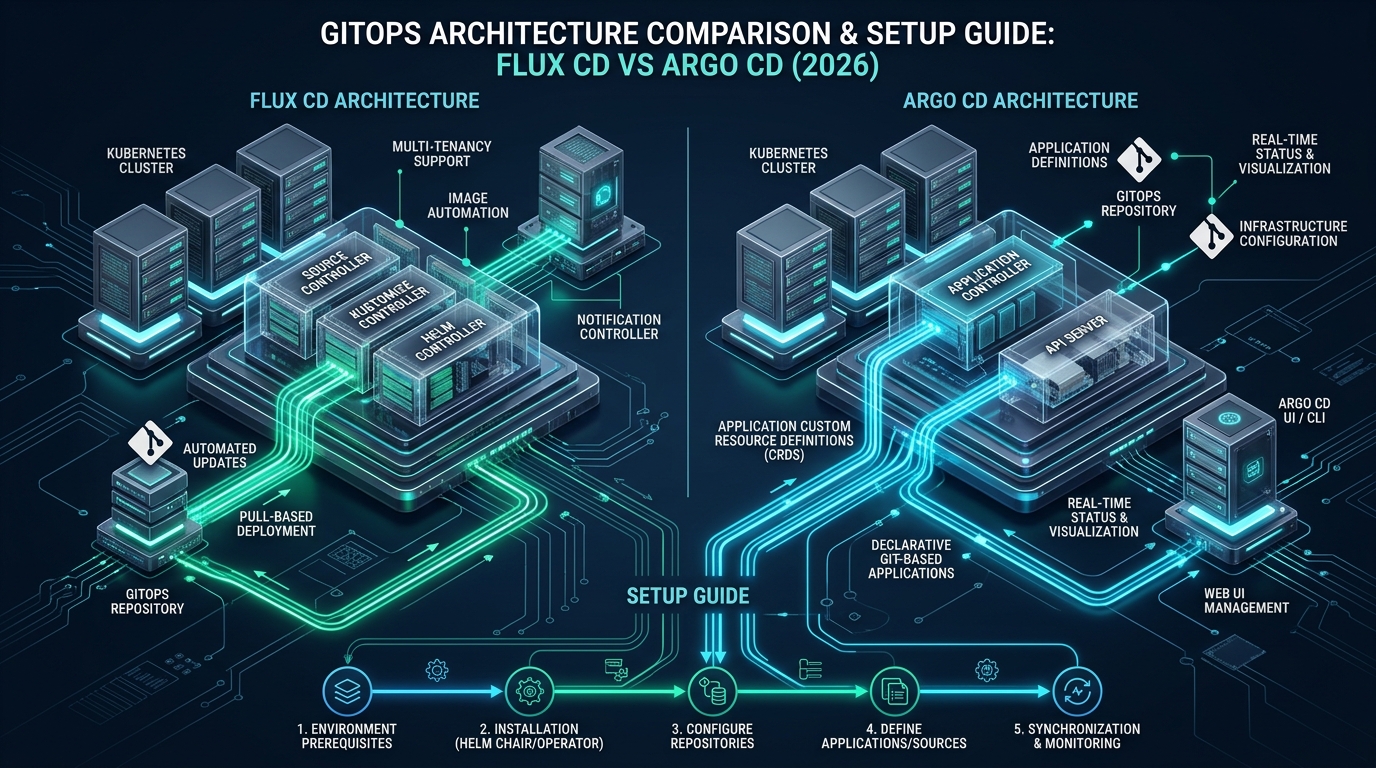
Modern cloud-native engineering at scale hinges on continuous state convergence, yet platform teams frequently collide with controller contention, bloated memory footprints, and security boundaries when managing multi-tenant Kubernetes clusters. Deploying declarative continuous delivery pipelines requires choosing between decoupled micro-reconcilers and centralized, visual control planes—a dilemma many developers first encounter when staging experimental workloads on environments like CpanelFree. Understanding the architectural divergence between Flux CD and ArgoCD in 2026 is critical for mitigating reconciliation latency, enforcing strict RBAC impersonation, and maintaining zero-trust GitOps workflows across distributed fleets.
The GitOps Landscape in 2026: Architectural Paradigms and Decision Matrix
GitOps has matured from a novel deployment pattern into the foundational standard for infrastructure automation, platform engineering, and workload lifecycle management. At its core, GitOps mandates that the desired state of a Kubernetes cluster lives immutably within version control repositories (Git or OCI registries), while autonomous software agents running within or alongside the cluster continuously reconcile the live environment to eliminate configuration drift.
In 2026, two open-source titans dominate the Cloud Native Computing Foundation (CNCF) GitOps landscape: Flux CD (part of the GitOps Toolkit project) and ArgoCD (part of the Argo Project suite). While both tools fulfill the foundational OpenGitOps standards, their underlying engineering philosophies, runtime architectures, tenancy models, and operational overhead profiles represent fundamentally divergent approaches to platform delivery.
Core Architectural Paradigms: Micro-Controllers vs Unified Control Plane
To make an informed architectural decision, platform engineers must dissect the internal machinery of both engines. The contrast centers on the Unix philosophy of single-purpose modular daemons versus the unified, application-centric control plane model.
1. Flux CD: The Composable GitOps Toolkit (GOTK)
Flux CD abandons monolithic architecture entirely. Instead, it is engineered as a collection of specialized, decoupled Kubernetes controllers collectively known as the GitOps Toolkit (GOTK). Each controller operates independently, watching dedicated Custom Resource Definitions (CRDs) and communicating exclusively through standard Kubernetes API primitives:
- source-controller: Dedicated exclusively to acquiring artifacts from external repositories (Git repositories, OCI registries, Helm charts, and Amazon S3/GCS buckets), packaging them as compressed tarballs, and serving them over HTTP within the cluster.
- kustomize-controller: Specialized in applying Kustomize overlays and raw manifest directories, executing Mozilla SOPS/Age decryption, and performing atomic prune/apply operations using server-side apply (SSA).
- helm-controller: Orchestrates the full lifecycle of Helm releases, interacting directly with Helm action libraries to perform automated upgrades, rollbacks, and test executions based on custom declarative specs.
- notification-controller: Manages inbound webhooks (e.g., from GitHub, GitLab, Docker registries) and outbound alerting (Slack, Microsoft Teams, PagerDuty, generic webhooks).
- image-reflector & image-automation-controllers: Continuously monitor container image registries, detect new semantic version tags, and autonomously commit updated image tags back to the Git source repository.
Because Flux CD controllers operate in a headless fashion without an embedded API server or mandatory graphical user interface, the system consumes exceptionally low memory and CPU cycles during steady-state operation. It treats the native Kubernetes API server as the sole orchestrator and database.
2. ArgoCD: The Centralized Application Control Plane
ArgoCD approaches continuous delivery through an application-centric, enterprise-first lens. Rather than spreading responsibilities across independent CRD micro-controllers, ArgoCD provides a unified, tightly integrated platform consisting of three primary architectural components backed by state caches:
- Application Controller: The central reconciliation brain. It watches Kubernetes cluster state, queries target repositories for desired state, calculates the delta, and executes synchronization tasks.
- Repo Server: A dedicated, stateless manifest hydration worker that clones Git repositories and runs generators (Kustomize, Helm, Jsonnet, or custom config management plugins) to output hydrated plain Kubernetes YAML.
- API Server: A gRPC and REST API daemon that serves the ArgoCD CLI, Web UI, and external webhook integrations. It provides native multi-tenancy, authentication via Dex (OIDC, OAuth2, LDAP), and fine-grained RBAC enforcement.
- Redis Cache: An essential in-memory database used to cache manifest trees, Git revisions, and live cluster resource states to shield external Git providers and internal Kubernetes API servers from repetitive polling strain.
ArgoCD’s architecture prioritizes developer ergonomics, observability, and team visibility. Its interactive visual UI provides real-time Directed Acyclic Graph (DAG) visualizations of resource relationships, health indicators, and instantaneous visual diffs between Git and live cluster states.
spec.serviceAccountName impersonation. Conversely, ArgoCD maintains its own RBAC model via ConfigMaps and relies heavily on an external Redis cache to store parsed manifests, dramatically accelerating UI rendering at the cost of higher stateful memory overhead.Technical Comparison Matrix: Flux CD vs ArgoCD in 2026
The following technical matrix provides an exhaustive, benchmarked architectural comparison between Flux CD (v2.4+) and ArgoCD (v2.12+) running on modern Linux production nodes:
Security Posture, Tenancy Isolation, and Blast Radius Mitigation
Security engineering is where the ideological division between Flux CD and ArgoCD becomes most apparent. When operating multi-tenant clusters hosting multiple independent development squads, how each platform enforces authorization boundaries dictates the enterprise security posture.
Kubernetes-Native Impersonation in Flux CD
Flux CD executes all state modifications by leveraging standard Kubernetes ServiceAccount impersonation. Within a tenant’s Kustomization or HelmRelease resource, the platform engineer specifies spec.serviceAccountName. When the kustomize-controller or helm-controller reconciles the manifest, it drops its own high-privilege cluster credentials and interacts with the Kubernetes API server using only the permissions bound to that specific ServiceAccount via native Role and RoleBinding objects.
This design makes privilege escalation mathematically impossible within the cluster: even if a developer attempts to commit a cluster-wide ClusterRoleBinding inside their tenant Git repository, the API server rejects the reconciliation because the impersonated ServiceAccount lacks authorization to grant cluster roles.
AppProjects and Custom RBAC in ArgoCD
ArgoCD introduces its own tenancy abstraction known as AppProjects. AppProjects group applications and enforce logical boundaries by defining:
- Permitted Git source repositories (whitelisting source URLs).
- Permitted destination Kubernetes clusters and target namespaces.
- Permitted cluster-scoped or namespace-scoped resource types (e.g., blocking Ingress or CRD creation).
- Granular role policies mapping OIDC groups (from Okta, Keycloak, or Azure AD) to ArgoCD actions (
get,sync,override,delete).
While AppProjects provide immense administrative control for platform engineering teams through a clean administrative UI, ArgoCD’s central Application Controller typically runs with high-level cluster-admin privileges. Security teams must ensure that ArgoCD’s custom RBAC engine is configured flawlessly to avoid privilege leakages across application project boundaries.
Blast Radius: Autonomous Agents vs Hub-and-Spoke Topology
When operating a fleet of fifty or one hundred Kubernetes clusters across hybrid clouds, two primary operational models emerge:
- Autonomous In-Cluster Agents (Flux Approach): Every edge, staging, or production cluster runs its own lightweight instance of Flux CD. The cluster pulls manifests directly from Git over outbound HTTPS/SSH. The cluster exposes zero inbound network ports, and no administrative credentials leave the cluster boundary. If the management cluster fails, edge clusters continue operating and self-healing autonomously.
- Hub-and-Spoke Central Management (ArgoCD Approach): A centralized management cluster hosts ArgoCD, which connects remotely to target clusters using long-lived
ServiceAccountbearer tokens stored as Kubernetes Secrets in the management plane. This architecture provides unmatched visibility, as platform engineers can monitor fifty clusters from a single Web UI. However, it creates a concentrated blast radius: compromising the central management cluster grants an attacker administrative access to all managed satellite clusters.
Hands-On Production Implementation: Step-by-Step Configuration
Below are production-ready configuration manifests illustrating how to deploy both engines with enterprise security guardrails, automated drift reconciliation, and secret decryption.
1. Flux CD Production Setup: GitRepository & Multi-Tenant Kustomization
The following manifest demonstrates a production Flux CD configuration utilizing automated Mozilla SOPS encryption, native ServiceAccount impersonation, interval tuning, and dependency chaining:
apiVersion: source.toolkit.fluxcd.io/v1
kind: GitRepository
metadata:
  name: production-fleet-source
  namespace: flux-system
spec:
  interval: 1m0s
  url: https://github.com/enterprise-org/k8s-infrastructure-fleet.git
  ref:
    branch: main
  secretRef:
    name: fleet-git-deploy-key
  timeout: 45s
  ignore: |
    # Ignore non-manifest assets to conserve controller CPU cycles
    /*
    !/clusters/production
    !/infrastructure/base
---
apiVersion: kustomize.toolkit.fluxcd.io/v1
kind: Kustomization
metadata:
  name: tenant-frontend-prod
  namespace: flux-system
spec:
  interval: 5m0s
  retryInterval: 1m0s
  timeout: 3m0s
  sourceRef:
    kind: GitRepository
    name: production-fleet-source
  path: ./clusters/production/tenants/frontend
  prune: true
  wait: true
  serviceAccountName: frontend-tenant-reconciler
  decryption:
    provider: sops
    secretRef:
      name: sops-age-encryption-key
  postBuild:
    substitute:
      ENVIRONMENT: "production"
      CLUSTER_REGION: "us-east-1"
  healthChecks:
    - apiVersion: apps/v1
      kind: Deployment
      name: frontend-service
      namespace: tenant-frontend
Notice the declaration of serviceAccountName: frontend-tenant-reconciler. Flux will restrict this reconciliation strictly to the permissions granted to that namespace-scoped service account, isolating the blast radius completely.
2. ArgoCD Production Setup: Enterprise ApplicationSet with Git Generator
For large-scale platform operations managing dynamic environments across multiple clusters, ArgoCD’s ApplicationSet controller automates application lifecycle management across Git folder trees:
apiVersion: argoproj.io/v1alpha1
kind: ApplicationSet
metadata:
  name: production-tenant-applications
  namespace: argocd
spec:
  generators:
    - git:
        repoURL: https://github.com/enterprise-org/k8s-infrastructure-fleet.git
        revision: HEAD
        directories:
          - path: clusters/production/tenants/*
  template:
    metadata:
      name: 'prod-{{path.basename}}'
      labels:
        environment: production
        tenant: '{{path.basename}}'
    spec:
      project: enterprise-production-project
      source:
        repoURL: https://github.com/enterprise-org/k8s-infrastructure-fleet.git
        targetRevision: HEAD
        path: '{{path}}'
      destination:
        server: https://kubernetes.default.svc
        namespace: 'tenant-{{path.basename}}'
      syncPolicy:
        automated:
          prune: true
          selfHeal: true
          allowEmpty: false
        syncOptions:
          - CreateNamespace=true
          - PrunePropagationPolicy=foreground
          - ServerSideApply=true
        retry:
          limit: 5
          backoff:
            duration: 5s
            factor: 2
            maxDuration: 3m
      ignoreDifferences:
        - group: apps
          kind: Deployment
          jsonPointers:
            - /spec/replicas
In this production ApplicationSet, the selfHeal: true parameter immediately overwrites manual drift if an operator tampers with resources via kubectl edit, while ServerSideApply=true handles high-concurrency manifest reconciliation against the Kubernetes control plane.
3. Host Linux Kernel & Network Socket Optimization for GitOps Controllers
When hosting GitOps controllers reconciling thousands of manifests across hundreds of Git repositories and container registries, Linux worker nodes frequently experience TCP socket exhaustion, conntrack table saturation, and filesystem inotify watch exhaustion. Deploy the following tuned configuration to /etc/sysctl.d/99-gitops-reconciler.conf on your Kubernetes host nodes:
# /etc/sysctl.d/99-gitops-reconciler.conf
# Enterprise Linux Host Optimization for GitOps High-Concurrency Reconcilers

# Prevent inotify exhaustion during recursive Git repository tree scanning
fs.inotify.max_user_watches = 1048576
fs.inotify.max_user_instances = 8192
fs.file-max = 2097152

# Prevent ephemeral port exhaustion from repetitive outbound Git/Registry HTTPS requests
net.ipv4.ip_local_port_range = 10240 65535
net.ipv4.tcp_tw_reuse = 1
net.ipv4.tcp_fin_timeout = 15

# Maximize socket listen backlogs for internal webhook handlers and API servers
net.core.somaxconn = 32768
net.ipv4.tcp_max_syn_backlog = 16384
net.core.netdev_max_backlog = 16384

# Scale connection tracking table to prevent packet drops under heavy API churn
net.netfilter.nf_conntrack_max = 1048576
net.netfilter.nf_conntrack_tcp_timeout_established = 432000
net.netfilter.nf_conntrack_tcp_timeout_close_wait = 30

# Virtual memory management to avoid sudden OOM killer strikes on controller buffers
vm.max_map_count = 524288
vm.swappiness = 10
Apply these parameters instantly across your cluster nodes without rebooting by executing:
sudo sysctl -p /etc/sysctl.d/99-gitops-reconciler.confInfrastructure Sizing and Host Performance Optimization
A frequent mistake in platform engineering is under-provisioning the underlying compute nodes that power GitOps controllers. Both Flux CD and ArgoCD perform heavy I/O operations: cloning Git trees, untarring artifacts, hydrating templates via external binaries, and communicating with etcd over secure gRPC channels.
Scaling GitOps controllers across enterprise Kubernetes clusters requires rock-solid Linux compute and ultra-low I/O latency to prevent repository cloning timeouts and etcd serialization bottlenecks. For critical production workloads, deploying your control plane or hosting nodes on MeraHost Enterprise Cloud guarantees predictable performance with pure Enterprise NVMe storage, LiteSpeed Web Server, dedicated CPU cores, and an unbreakable commitment to Same Renewal Price, Always (starting at just ₹99/mo). Eliminating unexpected infrastructure price surges enables DevOps teams to forecast operational budgets with surgical precision.
Troubleshooting Common GitOps Bottlenecks in Production
When operating GitOps controllers under heavy enterprise load, platform architects frequently encounter three specific failure modes:
1. GitHub / GitLab API Rate Limiting
If you have 500 applications configured with a 1-minute polling interval without webhooks, your controllers will trigger secondary rate limits on GitHub or GitLab within minutes. To resolve this, always implement event-driven reconciliation using inbound webhooks handled by Flux’s notification-controller or ArgoCD’s webhook endpoint, and lengthen the polling fallback interval to 30 or 60 minutes.
2. Kubernetes API Server Throttling (HTTP 429)
During a major release rollout across multiple clusters, concurrent reconciliations can saturate the Kubernetes API server request priority and fairness (APF) queues. Mitigate this by adjusting client-side rate limits in your controller arguments:
- In Flux CD: configure
--concurrent=10and tune--kube-api-qps=50and--kube-api-burst=100on the kustomize-controller and helm-controller. - In ArgoCD: tune the
argocd-application-controllerflags with--status-processors 50,--operation-processors 25, and tune--repo-server-timeout-seconds 180.
3. OOM Kills in Repo-Server During Helm Hydration
Complex Helm charts with large subchart dependency graphs and extensive schema validations can cause sudden memory spikes in ArgoCD’s repo-server pod during helm template generation. Never leave ArgoCD repo-server without memory limits; set requests to at least 1Gi and limits to 4Gi on production nodes.
Frequently Asked Questions (FAQ)
Is Flux CD or ArgoCD better for enterprise multi-cluster deployments?
Flux CD is superior for distributed edge clusters, defense-in-depth security, and zero-ingress environments because it operates via autonomous in-cluster pull agents that never require inbound ports or centralized credential storage. ArgoCD is superior if your enterprise demands a single-pane-of-glass dashboard where central operations teams can monitor and manually trigger syncs across 50+ clusters simultaneously.
How does Helm management differ between Flux CD and ArgoCD?
Flux CD natively integrates with the Helm SDK via its dedicated helm-controller, maintaining complete Helm release metadata secrets, executing Helm pre/post test hooks, and automatically managing rollbacks on failure. ArgoCD, by default, acts as a template hydrator: it executes ‘helm template’ to render raw YAML and applies it using the Kubernetes API, bypassing Helm release tracking secrets entirely unless using specialized third-party plugins.
What are the memory and CPU overhead differences at scale?
Flux CD operates with a remarkably lean profile, typically requiring 350MB to 650MB of RAM across its micro-controllers when managing over 1,000 applications. ArgoCD requires significantly more resources—typically 1.4GB to 3.2GB of RAM across its application controller, repo server, API server, and Redis cache instance—due to its live in-memory caching and real-time UI websocket state synchronization.
Can you run Flux CD and ArgoCD together in the same cluster?
Yes. Many platform engineering organizations adopt a hybrid approach: they utilize Flux CD at the root infrastructure level to bootstrap core cluster components (CNI, CSI, cert-manager, external-dns, and ArgoCD itself), and then empower application developers to manage user-facing microservices via ArgoCD’s visual dashboard and AppProjects.
Final Architectural Verdict
Choosing between Flux CD and ArgoCD in 2026 is not a question of which tool is objectively superior, but rather which architectural model aligns with your operational team structure:
- Choose Flux CD if you believe in pure GitOps purism, headless automation, zero-trust edge computing, minimal memory footprints, and strict Kubernetes RBAC ServiceAccount impersonation.
- Choose ArgoCD if your organization relies on visual dashboards for developer self-service, requires centralized OIDC authentication for mixed-skill development teams, and values instant visibility over minimalistic resource footprints.
Both tools deliver enterprise-grade state convergence. By tailoring your selection to your team’s operational maturity, network topology, and governance requirements, you can build a resilient, fully automated delivery pipeline that eliminates deployment fatigue and accelerates time-to-production.
Deploy Enterprise-Grade Production Infrastructure
Need guaranteed performance with zero price hikes? Host mission-critical workloads on MeraHost with pure Enterprise NVMe, LiteSpeed Web Server, and Same Renewal Price, Always (starting at ₹99/mo).