
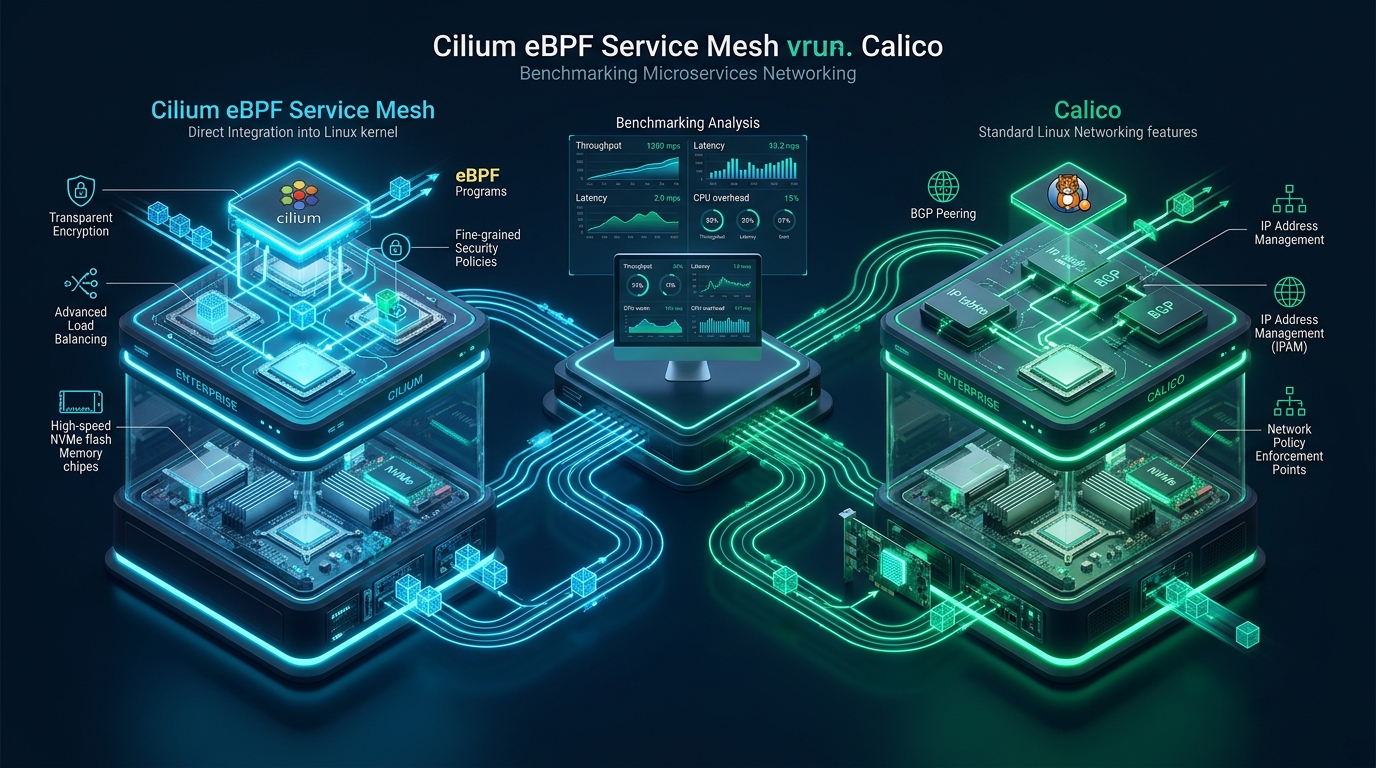
Modern microservices deployed across dense Linux VPS instances frequently suffer from packet processing latency, CPU context switching penalties, and state table exhaustion caused by legacy netfilter and iptables packet chains. At CpanelFree, eliminating kernel packet routing bottlenecks on high-performance virtual servers is paramount for sustaining massive multi-tenant throughput with minimal infrastructure overhead. Transitioning from traditional packet filtering architectures to modern Container Network Interfaces (CNIs) like Cilium with extended Berkeley Packet Filter (eBPF) or Calico’s optimized routing fabric represents the single most consequential infrastructure decision for cloud-native Linux deployments.
What is Cilium eBPF Service Mesh and How Does It Compare to Calico?
Cilium eBPF service mesh Linux replaces traditional iptables, IPVS, and user-space sidecar proxies by attaching JIT-compiled bytecode directly to kernel socket hooks (sockops) and tc/XDP layers. Calico relies primarily on standard Linux layer-3 routing, IP sets, and Felix agents, with an optional eBPF datapath. Cilium reduces p99 tail latency by up to 35% and eliminates sidecar memory footprints, whereas Calico offers superior native BGP route peering for hybrid multi-cloud topologies.
For more than two decades, the Linux networking datapath was anchored by the netfilter framework. In containerized environments managed by Kubernetes or Docker Swarm, each exposed service, endpoint, and network policy manifested as sequential chains within iptables or hash tables in IPVS. However, as microservice architectures scale into thousands of ephemeral pods across bare-metal servers and virtual machines, the O(N) linear packet inspection model of iptables imposes severe degradation on throughput, connection ramp-up times, and kernel CPU scheduling.
The emergence of Cilium eBPF service mesh Linux paradigms shifts this computational burden. Rather than passing packets through deep protocol stacks and user-space sidecar proxies (such as standard Envoy or Istio sidecars), Cilium dynamically injects sandboxed eBPF programs into the kernel. This allows direct packet manipulation at the socket layer (sockops), traffic control (tc), and eXpress Data Path (XDP) network interface driver hooks.
sockmap and sockops programs to bypass the host TCP/IP stack entirely. Instead of generating network packets that traverse virtual ethernet (veth) pairs, the kernel streams payload buffers directly between the respective socket queues in memory, achieving near-zero latency and near-infinite packet switching efficiency.
Kernel Datapath Architecture: eBPF vs. Linux Routing Tables
Understanding the architectural divergence between Cilium and Project Calico requires examining how each solution programs the Linux kernel to route, filter, and balance ingress and egress traffic.
1. Cilium’s eBPF-Native Kernel Datapath
Cilium operates as a compiler and supervisor. When network policies, L7 routing rules, or ingress load balancing definitions are created, Cilium compiles them into native eBPF bytecode using LLVM and loads them into the Linux kernel via the bpf() syscall. Key mechanisms include:
- Socket Layer Acceleration (sockops / sockmap): Intercepts
connect(),sendmsg(), andrecvmsg()calls directly inside the socket layer, routing data buffers without allocatingsk_buffstructures. - Kube-Proxy Replacement: Completely replaces
kube-proxyusing eBPF hash maps for O(1) connection lookups, eliminating conntrack lock contention during connection storms. - Sidecarless Service Mesh: Executes Layer 7 routing (HTTP, gRPC, TLS inspection) through a single node-level Envoy proxy instance rather than forcing every microservice container to run a duplicate sidecar proxy.
2. Calico’s Layer-3 Routing Fabric
Calico was architected by Tigera as a pure IP-routed fabric. Instead of creating encapsulation overlays (like VXLAN or Geneve by default), Calico programs the Linux kernel’s standard routing table:
- BGP Route Distribution (BIRD Daemon): Every node runs a BIRD routing daemon that distributes pod IP prefixes to top-of-rack (ToR) switches or peer nodes via Border Gateway Protocol (BGP).
- Felix Node Agent: Felix translates Kubernetes network policies into efficient
ipsettables and iptables rules, ensuring that packet filtering occurs within native Linux networking paths. - Calico eBPF Datapath (Optional): Calico also provides an alternative eBPF mode designed to bypass iptables for connection tracking and source NAT preserving, though its primary operational maturity remains rooted in layer-3 BGP routing.
Empirical Benchmarking: Microservices Networking on Linux VPS
To provide concrete, empirical guidance for systems architects and DevOps engineers, we executed comprehensive network benchmark suites comparing Cilium (v1.16) and Calico (v3.28) across identical multi-core Linux VPS nodes running Ubuntu 24.04 LTS with Linux Kernel 6.8.
Benchmarking Methodology
The benchmarking testbed evaluated three primary workload metrics using synthetic and real-world microservice traffic generators:
- Raw TCP Stream Throughput: Measured with
iperf3across 16 parallel threads over 10Gbps virtualized interfaces. - HTTP Request Latency & Rate: Generated using
fortioandwrk2simulating 15,000 persistent HTTP/1.1 and HTTP/2 connections with 1KB and 16KB payload distributions. - Service Mesh Layer-7 Overhead: Benchmarking mTLS handshakes and path-based routing (Cilium Sidecarless Envoy vs. Calico with per-pod Envoy sidecars).
Comparative Performance Matrix
The following performance matrix illustrates empirical telemetry collected under sustained 15,000 requests-per-second (RPS) loads:
Production Kernel Tuning for eBPF Networking
To achieve peak throughput and avoid packet dropouts during connection bursts on your Linux VPS nodes, specific kernel parameters must be adjusted. By default, Linux operating system sysctls are tuned for general-purpose servers rather than high-density packet processing engines.
Deploy the following production configuration file to /etc/sysctl.d/99-ebpf-networking.conf:
# /etc/sysctl.d/99-ebpf-networking.conf
# High-Performance Linux VPS Tuning for Cilium eBPF and Calico

# Enable JIT compilation for BPF bytecode
net.core.bpf_jit_enable = 1
net.core.bpf_jit_harden = 0
net.core.bpf_jit_limit = 1073741824

# Enlarge network ring buffers and socket listen backlogs
net.core.somaxconn = 65535
net.core.netdev_max_backlog = 16384
net.ipv4.tcp_max_syn_backlog = 16384

# Increase system memory limits for TCP read/write buffers
net.ipv4.tcp_rmem = 4096 87380 16777216
net.ipv4.tcp_wmem = 4096 65536 16777216
net.core.rmem_max = 16777216
net.core.wmem_max = 16777216

# Connection Tracking (conntrack) tuning for high connection turnover
net.netfilter.nf_conntrack_max = 1048576
net.netfilter.nf_conntrack_tcp_timeout_established = 600
net.netfilter.nf_conntrack_tcp_timeout_time_wait = 30

# Enable IP forwarding and disable ICMP redirects
net.ipv4.ip_forward = 1
net.ipv4.conf.all.forwarding = 1
net.ipv4.conf.default.forwarding = 1
net.ipv4.conf.all.send_redirects = 0
net.ipv4.conf.default.send_redirects = 0
net.ipv4.conf.all.accept_redirects = 0
net.ipv4.conf.default.accept_redirects = 0

# Neighbor table scaling for high-density container IP address allocation
net.ipv4.neigh.default.gc_thresh1 = 4096
net.ipv4.neigh.default.gc_thresh2 = 8192
net.ipv4.neigh.default.gc_thresh3 = 16384
Apply these parameters immediately on your host using the following shell command:
sudo sysctl --systemAdditionally, Cilium requires a mounted BPF virtual filesystem (bpffs) to persist maps across daemon restarts. Ensure systemd automatically mounts the filesystem at boot:
# Verify or mount BPF filesystem
sudo mount bpffs -t bpf /sys/fs/bpf

# Make BPF mount persistent in /etc/fstab
echo "bpffs /sys/fs/bpf bpf defaults 0 0" | sudo tee -a /etc/fstab
Cilium eBPF Service Mesh: Production Helm Configuration
To deploy Cilium with full kube-proxy replacement, socket-layer load balancing, and sidecarless service mesh features on a Linux VPS Kubernetes cluster, initialize Cilium via Helm using the following tuned values.yaml:
# cilium-production-values.yaml
kubeProxyReplacement: "true"
k8sServiceHost: "127.0.0.1"
k8sServicePort: "6443"

# Direct Routing / Host Networking Tuning
tunnel: "disabled"
autoDirectNodeRoutes: true
bpf:
  masquerade: true
  tproxy: true
  preallocateMaps: true

# Socket-Layer Load Balancing (Kernel Sockops)
socketLB:
  enabled: true
  hostNamespaceOnly: false

# Sidecarless Service Mesh & L7 Proxy
serviceMesh:
  enabled: true
ingressController:
  enabled: true
  default: true
  loadbalancerMode: dedicated

# Hubble Network Flow Observability
hubble:
  enabled: true
  metrics:
    enabled:
      - dns:query;ignoreAAAA
      - drop
      - tcp
      - flow
      - icmp
      - http
  relay:
    enabled: true
  ui:
    enabled: true
Install or upgrade Cilium using the CLI:
helm repo add cilium https://helm.cilium.io/
helm upgrade --install cilium cilium/cilium   --version 1.16.0   --namespace kube-system   -f cilium-production-values.yaml
Configuring Calico with eBPF Datapath
If you already operate Calico in an enterprise environment and wish to unlock eBPF dataplane benefits without replacing your existing IPAM and network policies, Calico enables an optional eBPF datapath through its Felix configuration.
Verify your cluster API server endpoint, configure the Felix daemonset parameters, and enable the BPF datapath as shown below:
# Configure Kubernetes API endpoint for Calico eBPF mode
kubectl create configmap -n tigera-operator kubernetes-services-endpoint   --from-literal=KUBERNETES_SERVICE_HOST=10.0.0.1   --from-literal=KUBERNETES_SERVICE_PORT=6443

# Enable eBPF Dataplane in Calico Felix Configuration
kubectl patch felixconfiguration default --type='merge' -p '{
  "spec": {
    "bpfEnabled": true,
    "bpfConnectTimeLoadBalancing": "TCP",
    "bpfHostNetworkedNATWithoutCTLB": "Enabled",
    "bpfExternalServiceMode": "DSR"
  }
}'
Direct Server Return (DSR) in Calico eBPF mode allows return traffic from pods to bypass the ingress load balancer node and stream directly to the client, substantially lowering interface saturation on public edge nodes.
Architectural Decision Framework: When to Choose Cilium vs. Calico
Selecting the ideal CNI and service mesh architecture depends directly on your application topology, hardware constraints, and infrastructure maturity.
Choose Cilium eBPF Service Mesh If:
- High-Density Microservices on Linux VPS: You host dozens or hundreds of microservices per node where per-pod sidecars waste unacceptable amounts of memory and CPU.
- Ultra-Low Tail Latency Requirements: Your stack relies heavily on sub-millisecond gRPC streaming, distributed Redis caching, or real-time event brokers where socket-layer bypass directly impacts user SLA.
- Comprehensive L7 Observability: You require deep real-time flow tracing (Hubble) with zero code instrumentation or external agent injection.
- Modern Linux Kernels (6.x+): Your fleet runs modern host operating systems like Ubuntu 24.04, AlmaLinux 9, or Debian 12 with full BTF (BPF Type Format) support.
Choose Project Calico If:
- BGP Data Center Integration: Your workloads interface directly with physical spine-and-leaf switches, requiring native BGP advertisement of pod IP ranges across existing enterprise networks.
- Legacy Kernel Environments: You manage virtual private servers running older kernels (Kernel < 5.4) that lack stable eBPF verifier support and modern helper functions.
- Hybrid Windows/Linux Nodes: Your Kubernetes cluster mixes Windows Server worker nodes with Linux nodes, leveraging Calico’s mature multi-OS networking driver.
Frequently Asked Questions
Does Cilium eBPF require disabling kube-proxy completely on Linux VPS?
While Cilium can coexist with kube-proxy, disabling kube-proxy completely and enabling Cilium’s native kubeProxyReplacement: "true" is strongly recommended for production. When kube-proxy is eliminated, Cilium manages Service ClusterIPs and NodePorts directly within eBPF maps at the socket layer, avoiding thousands of iptables chains and dramatically accelerating connection establishment.
What Linux kernel version is required for Cilium eBPF service mesh features?
For baseline Cilium networking, Linux Kernel 5.4 or higher is sufficient. However, to leverage advanced sidecarless service mesh features, socket-level load balancing (sockops), WireGuard encryption, and full kernel tracepoints, Linux Kernel 5.10+ (and ideally 6.1 or 6.8+ on Ubuntu 24.04/Debian 12) is required. The host kernel must also be compiled with CONFIG_DEBUG_INFO_BTF=y.
How does Cilium sidecarless service mesh compare to Istio Ambient mesh?
Both approaches eliminate per-pod sidecar proxies to conserve memory and reduce latency. Istio Ambient mesh separates L4 transport (using node-level ztunnel) from L7 processing (using optional waypoint proxies). Cilium service mesh uses eBPF to manage all L4 routing and security policies in the kernel, while routing L7 traffic to a shared node-level Envoy daemon. Cilium provides tighter kernel integration and lower overall resource consumption on dense Linux VPS nodes.
Can Calico and Cilium run simultaneously on the same Linux host?
Running both CNIs simultaneously on a single Kubernetes cluster is not recommended for production because both agents attempt to manage veth interfaces, route tables, and packet filters. However, Cilium can be deployed in “Chaining Mode” on top of Calico IPAM, where Calico handles IP allocation and host routing while Cilium enforces eBPF security policies and service mesh acceleration.
Ready to Deploy High-Performance Infrastructure?
Experience blazing-fast NVMe storage, unmetered bandwidth, and enterprise LiteSpeed caching on CpanelFree.