
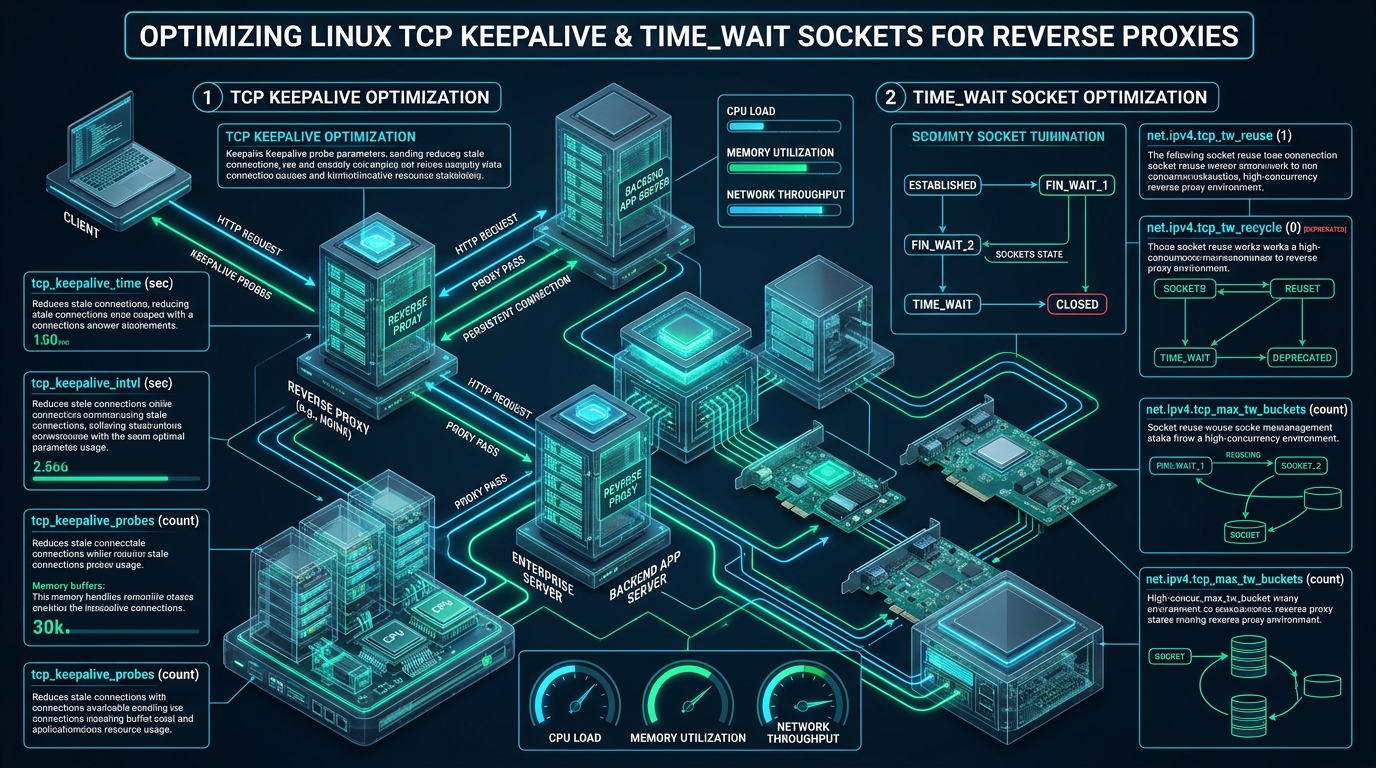
When high-concurrency reverse proxies such as NGINX, HAProxy, Envoy, or LiteSpeed scale beyond tens of thousands of requests per second, system engineers inevitably hit a catastrophic network wall: the dreaded connect() failed (99: Cannot assign requested address) kernel error. Under vanilla Linux distributions, un-tuned socket recycling routines, sluggish two-hour TCP keepalive timers, and tens of thousands of lingering TIME_WAIT sockets trigger ephemeral port exhaustion that paralyzes upstream microservices, API gateways, and web clusters. Before deploying complex multi-IP routing workarounds or load balancer sharding, infrastructure teams staging workloads on CpanelFree can eliminate this bottleneck at the kernel layer through targeted socket reuse, aggressive keepalive polling, and optimized upstream connection pools.
How to Optimize TCP TIME_WAIT and Keepalive Sockets in Linux Reverse Proxies
Direct Answer: To effectively optimize tcp time_wait linux reverse proxy performance, enable kernel socket recycling with net.ipv4.tcp_tw_reuse = 1 alongside net.ipv4.tcp_timestamps = 1, expand ephemeral source ports with net.ipv4.ip_local_port_range = 10240 65535, and reduce dead-peer detection by setting tcp_keepalive_time = 300. Crucially, pair these OS-level sysctl parameters with reverse proxy upstream connection pooling (e.g., NGINX keepalive directives) to eliminate constant TCP connection teardown at the root cause.
1. Deconstructing the TCP State Machine: Why TIME_WAIT Occurs
To resolve socket exhaustion, systems engineers must analyze the fundamental mechanics of the Transmission Control Protocol (RFC 793). Every TCP connection represents a unique communication channel identified by a 4-tuple: {Source IP, Source Port, Destination IP, Destination Port}. When terminating an established bidirectional byte stream, either peer can initiate a graceful teardown via a four-way handshake:
- FIN Initiation: The closing endpoint transmits a
FINpacket to signal that it has finished sending application data, entering theFIN_WAIT_1state. - Passive ACK: The receiving peer acknowledges the
FINwith anACK, enteringCLOSE_WAIT, while the initiator transitions intoFIN_WAIT_2. - Remote FIN: Once the receiver flushes any remaining buffered outbound data, it transmits its own
FINpacket to complete the closure, transitioning intoLAST_ACK. - Final ACK & TIME_WAIT: The initiating peer transmits the final
ACKand transitions into the TIME_WAIT state.
The fundamental rule of TCP termination is deterministic: whichever node initiates the active close enters the TIME_WAIT state. In a typical reverse proxy deployment (such as NGINX proxying requests to PHP-FPM, Gunicorn, Node.js, or upstream Go daemons), if HTTP/1.0 close semantics or unpooled HTTP/1.1 connections are used, the reverse proxy actively closes the upstream connection as soon as the response is buffered. Consequently, the reverse proxy server—not the upstream application server—accumulates hundreds of thousands of TIME_WAIT sockets.
Architecture Note on Ephemeral Port Math: In default Linux distributions,
net.ipv4.ip_local_port_rangeprovides 28,231 ports (32768 to 60999). Because the Linux kernel holdsTIME_WAITsockets for exactly2 * MSL(Maximum Segment Lifetime = 60 seconds), a proxy sustaining just 500 new short-lived connections per second to a single backend IP:Port tuple will consume500 × 60 = 30,000ephemeral ports. This exceeds available source ports, instantly triggeringEADDRNOTAVAIL (Error 99).
2. The Truth About TIME_WAIT Tuning: tcp_tw_reuse vs. Obsolete tcp_tw_recycle
A persistent legacy antipattern in outdated Linux documentation recommends enabling net.ipv4.tcp_tw_recycle. In modern systems engineering, this setting is not merely discouraged—it was completely removed from the Linux kernel in version 4.12 due to fundamental architectural flaws.
Understanding why tcp_tw_recycle was dangerous clarifies why tcp_tw_reuse is the modern enterprise standard:
- The Fatal Flaw of tcp_tw_recycle: When active, the kernel tracked per-host TCP timestamps in the
PAWS(Protection Against Wrapped Sequence Numbers) cache. If multiple client devices connected from behind a single NAT gateway (such as a corporate firewall, mobile carrier CGNAT, or CDN edge), each client possessed unsynchronized local clock timestamps. If client B sent a packet with a timestamp slightly earlier than client A, the server dropped the incoming SYN packet as a stale duplicate, silently blackholing legitimate visitors. - The Safety of tcp_tw_reuse: Unlike recycle,
tcp_tw_reuse = 1applies strictly to outbound client connections—precisely what a reverse proxy establishes when connecting to upstream backends. When allocating an outbound socket, if an existing socket with an identical 4-tuple is inTIME_WAIT, the kernel verifies that the outgoing packet’s TCP timestamp (RFC 1323) is strictly greater than the last recorded timestamp of the previous connection. If true, the socket is safely reused with zero risk of packet collision or sequence corruption.
For mission-critical production workloads requiring bulletproof network stability under high concurrency, deploying on dedicated enterprise platforms like MeraHost Enterprise Cloud ensures that underlying hypervisors and NVMe nodes operate with modern Linux kernels (6.x+) where legacy hazards are eliminated and hardware TCP offloading operates at line rate.
3. Comparative Metrics: Default Linux TCP Stack vs. Production Reverse Proxy Stack
The performance gulf between un-tuned vanilla Linux kernel defaults and an engineered reverse proxy socket stack reveals why high-load systems experience degraded throughput without proactive configuration:
| Feature / Metric | Standard / Default | Tuned / Production |
|---|---|---|
| Ephemeral Port Capacity | 28,231 ports (32768–60999) | 55,295 ports (10240–65535) |
| Outbound TIME_WAIT Reuse | Disabled (tcp_tw_reuse = 0) | Enabled (tcp_tw_reuse = 1) |
| Dead Peer Detection Time | 7,875 sec (~2 hours, 11 min) | 375 sec (6 min, 15 sec) |
| Orphan Socket FIN Timeout | 60 seconds | 15 seconds |
| Connection Teardown Overhead | Constant 4-way teardown per request | Zero teardown via persistent pool |
| Upstream Connect Latency | 1x RTT (Full TCP SYN/ACK handshake) | 0ms (Immediate socket reuse) |
| SYN Backlog / Queue Depth | 128–1024 connections | 65,535 connections |
3. TCP Keepalive vs. HTTP Keep-Alive: Clarifying the Transport Layer
A frequent source of configuration error in enterprise infrastructure is conflating Layer 4 TCP Keepalive with Layer 7 HTTP Keep-Alive. Both are essential, but they govern distinct operational layers:
- HTTP Keep-Alive (Application Layer): Negotiated via the
Connection: keep-aliveheader in HTTP/1.1 or native multiplexing in HTTP/2 and HTTP/3. It instructs the client and server to reuse an established TCP socket across sequential HTTP transactions, eliminating redundant SYN/SYN-ACK/ACK handshakes and TLS cryptographic handshakes. - TCP Keepalive (Transport Layer): Governed by the socket flag
SO_KEEPALIVE. When a TCP connection is idle (no application data being transferred), the Linux kernel periodically transmits an empty ACK probe with a sequence number one byte less than the current sequence. If the remote peer is alive, it returns an ACK. If the remote peer has crashed, ungracefully rebooted, or network routing failed, the kernel tears down the dead socket.
Vanilla Linux systems ship with absurdly conservative TCP keepalive defaults designed for 1990s dial-up connections: tcp_keepalive_time = 7200 (2 hours), tcp_keepalive_intvl = 75 (75 seconds), and tcp_keepalive_probes = 9. Under these settings, if an upstream application daemon crashes ungracefully, a reverse proxy will hold that dead socket open for 2 hours, 11 minutes, and 15 seconds before releasing kernel file descriptors and memory buffers.
Architecture Note on Keepalive Calculation: Total dead-socket timeout is formulated as:
Total Time = tcp_keepalive_time + (tcp_keepalive_probes × tcp_keepalive_intvl). Tuning these values to300s + (5 × 15s) = 375sslashes dead socket retention by 95% while preventing premature disconnects caused by transient packet loss across enterprise wide-area networks.
4. Production Implementation: Hardened Linux Kernel Configuration
To apply these optimizations persistently across system reboots, create a dedicated sysctl configuration drop-in file at /etc/sysctl.d/99-reverse-proxy-tcp.conf. This configuration hardens connection backlogs, expands ephemeral port allocation, enables safe socket reuse, and accelerates dead-peer eviction:
# /etc/sysctl.d/99-reverse-proxy-tcp.conf
# High-Throughput Linux TCP Stack Optimization for Reverse Proxies

# 1. Ephemeral Port Allocation & Socket Reuse
# Expand ephemeral source port range to accommodate high outbound connection volume
net.ipv4.ip_local_port_range = 10240 65535

# Safely reuse TIME_WAIT sockets for outbound connections to upstreams (Requires tcp_timestamps)
net.ipv4.tcp_tw_reuse = 1
net.ipv4.tcp_timestamps = 1

# Reduce lingering timeout for sockets in FIN-WAIT-2 state (default: 60)
net.ipv4.tcp_fin_timeout = 15

# Upper ceiling for simultaneous TIME_WAIT sockets held by the system
net.ipv4.tcp_max_tw_buckets = 2000000

# 2. Aggressive TCP Keepalive Detection
# Time in seconds an idle socket waits before initiating probe packets (default: 7200)
net.ipv4.tcp_keepalive_time = 300

# Interval in seconds between successive probe transmissions (default: 75)
net.ipv4.tcp_keepalive_intvl = 15

# Number of unacknowledged probes before declaring connection dead (default: 9)
net.ipv4.tcp_keepalive_probes = 5

# 3. Queue Depths, Ingress Backlogs & Connection Limits
# Maximum listen queue depth for pending established connections (default: 128 or 4096)
net.core.somaxconn = 65535

# Maximum number of incoming packets queued on the network interface card backlog
net.core.netdev_max_backlog = 65535

# Maximum half-open SYN connections the kernel can track per listening socket
net.ipv4.tcp_max_syn_backlog = 65535

# 4. TCP Congestion & Window Behavior
# Prevent TCP congestion window reset after idle periods (preserves line-rate throughput)
net.ipv4.tcp_slow_start_after_idle = 0

# Enable TCP Selective Acknowledgments (SACK) for rapid recovery from dropped packets
net.ipv4.tcp_sack = 1
net.ipv4.tcp_dsack = 1
net.ipv4.tcp_window_scaling = 1
Activate the kernel settings immediately without rebooting via:
# Apply and verify sysctl directives in real time
sudo sysctl --system

# Confirm that tcp_tw_reuse and ephemeral port range took effect
sysctl net.ipv4.tcp_tw_reuse net.ipv4.ip_local_port_range net.ipv4.tcp_keepalive_time
5. The Application Layer Fix: Reverse Proxy Upstream Connection Pooling
While kernel tuning prevents port exhaustion when connections terminate, the ultimate engineering objective is to prevent unnecessary connection teardowns entirely. By default, NGINX communicates with upstream backends using HTTP/1.0 without keepalive headers, creating a new TCP handshake for every client request.
To implement upstream connection pooling in NGINX, configure the keepalive directive within the upstream block and enforce HTTP/1.1 in the location context:
# /etc/nginx/conf.d/upstream_keepalive.conf
# NGINX High-Throughput Upstream Connection Pool

upstream api_backend_cluster {
    server 10.0.1.10:8080 max_fails=3 fail_timeout=10s;
    server 10.0.1.11:8080 max_fails=3 fail_timeout=10s;

    # Maintain up to 128 idle keepalive connections per NGINX worker process
    keepalive 128;

    # Maximum number of requests served through one keepalive connection
    keepalive_requests 10000;

    # Maximum idle time for an unused pooled connection
    keepalive_timeout 60s;
}

server {
    listen 80;
    listen 443 ssl http2;
    server_name api.enterprise.internal;

    location / {
        proxy_pass http://api_backend_cluster;

        # MANDATORY: Enforce HTTP/1.1 for upstream communication
        proxy_http_version 1.1;

        # MANDATORY: Clear client "Connection: close" header to keep pooled socket alive
        proxy_set_header Connection "";

        proxy_set_header Host $host;
        proxy_set_header X-Real-IP $remote_addr;
        proxy_set_header X-Forwarded-For $proxy_add_x_forwarded_for;
        proxy_set_header X-Forwarded-Proto $scheme;

        # Enable proxy buffering to prevent slow clients from tying up backend workers
        proxy_buffering on;
        proxy_buffers 16 16k;
        proxy_busy_buffers_size 64k;
    }
}
For infrastructures deploying HAProxy as an enterprise load balancer, configure connection reuse within the backend stanza using http-reuse always:
# /etc/haproxy/haproxy.cfg (Snippet)
backend app_servers
    mode http
    balance roundrobin

    # Aggressively reuse existing upstream connections for subsequent requests
    http-reuse always

    # Upstream persistent connection timeouts
    timeout server 30s
    timeout connect 5s
    timeout http-keep-alive 60s

    # Enable TCP keepalive probes on backend server connections
    option tcp-check
    server srv1 10.0.1.10:8080 check maxconn 500
    server srv2 10.0.1.11:8080 check maxconn 500
6. Diagnostic Commands: Monitoring Socket States in Production
After deploying sysctl and proxy pool configurations, verify socket lifecycle transitions under production load using standard Linux diagnostic utilities:
# 1. Inspect real-time TCP socket summary across all states
ss -s

# 2. Count active sockets specifically in TIME-WAIT state
ss -tan state time-wait | wc -l

# 3. Check current ephemeral port allocation to a specific backend IP
ss -tan dst 10.0.1.10:8080 | awk '{print $1}' | sort | uniq -c

# 4. Check kernel socket allocation and memory footprint
cat /proc/net/sockstat

# 5. Verify whether the kernel has rejected connections due to overflow
netstat -s | grep -iE 'listen|overflow|dropped|time wait'
In high-load scenarios, cat /proc/net/sockstat provides immediate visibility into TCP socket memory overhead. Each socket in TIME_WAIT consumes minimal memory (approximately 168 bytes of kernel memory without user-space buffer allocations), proving that TIME_WAIT is primarily a port-number limitation rather than a memory constraint.
7. Frequently Asked Questions (FAQ)
Why was net.ipv4.tcp_tw_recycle removed from Linux 4.12+?
tcp_tw_recycle tracked TCP timestamps per remote IP. When multiple remote users communicated through a shared NAT router or load balancer, their desynchronized local timestamps caused the server kernel to drop legitimate connection requests as stale packets, resulting in severe intermittent outages. Because of this fatal architectural flaw, the Linux kernel maintainers completely removed the setting in version 4.12.
Does net.ipv4.tcp_tw_reuse optimize inbound client connections?
No. tcp_tw_reuse = 1 applies strictly to outbound connections where the local machine acts as a client allocating an ephemeral source port (such as a reverse proxy connecting to upstream app servers or databases). For inbound connections from web clients to the proxy’s listening port (e.g., 443), incoming sockets entering TIME_WAIT are harmless because the server’s listening port can accept multiple connections as long as client IP/port combinations vary.
Why must net.ipv4.tcp_timestamps remain enabled for tcp_tw_reuse?
tcp_tw_reuse relies entirely on RFC 1323 TCP Timestamps to validate that a newly established connection has a strictly higher timestamp than any lingering in-flight packets from the previous socket that shared the same 4-tuple. If net.ipv4.tcp_timestamps = 0, the kernel cannot perform this validation and silently disables tcp_tw_reuse fallback.
What is the primary difference between TCP Keepalive and HTTP Keep-Alive?
TCP Keepalive operates at Layer 4 (Transport) to send probe packets across idle connections to detect dead endpoints and keep middlebox NAT/stateful firewall tables active. HTTP Keep-Alive operates at Layer 7 (Application) to allow multiple HTTP request/response cycles to be transmitted across a single established TCP connection without tearing it down.
Deploy Enterprise-Grade Production Infrastructure
Need guaranteed performance with zero price hikes? Host mission-critical workloads on MeraHost with pure Enterprise NVMe, LiteSpeed Web Server, and Same Renewal Price, Always (starting at ₹99/mo).