
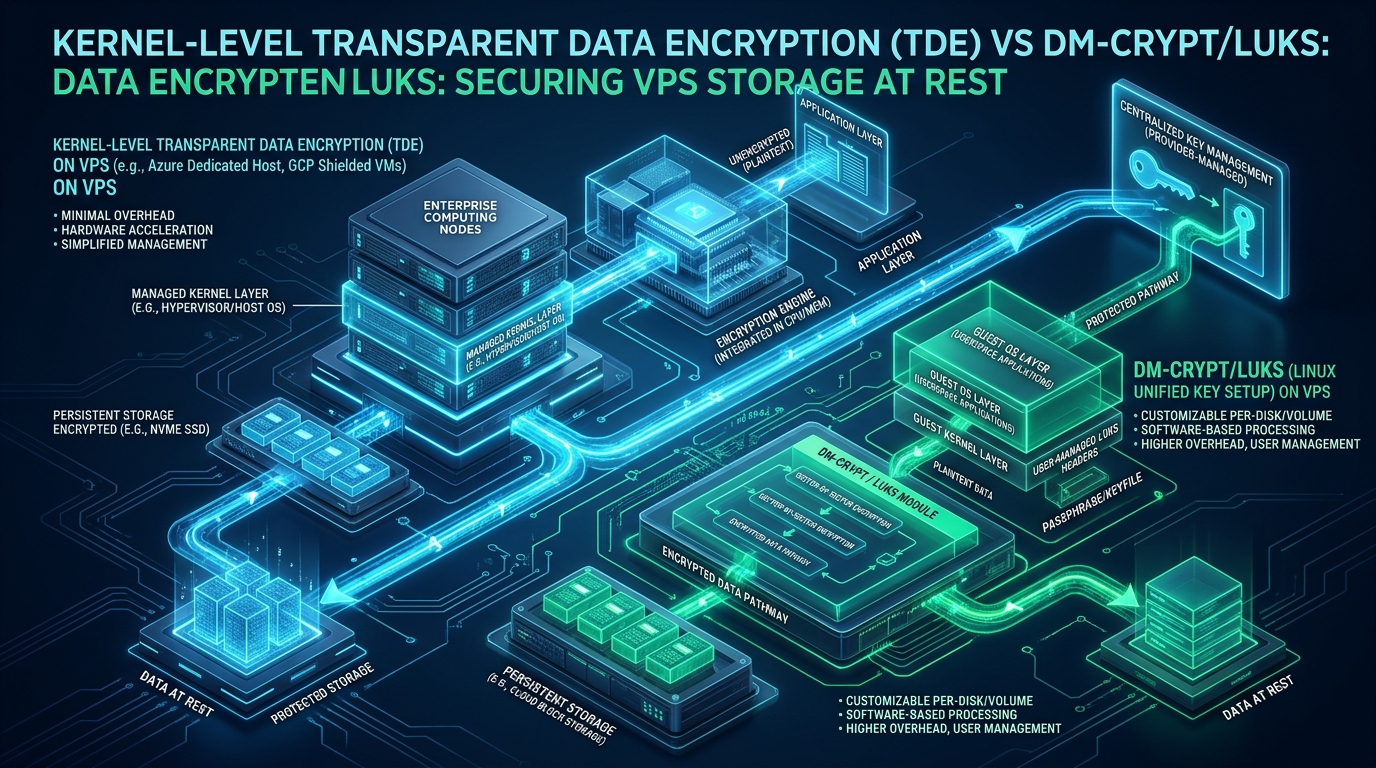
Securing high-throughput relational databases and containerized stateful workloads across multi-tenant cloud hypervisors demands a zero-trust storage model, yet introducing cryptographic layers often triggers steep I/O penalties and CPU core saturation. System architects provisioning staging environments on CpanelFree frequently confront a stark architectural dilemma: should data at rest be secured at the virtual block layer using Linux dm-crypt/LUKS2, or delegated to kernel-level and database-native Transparent Data Encryption (TDE)? Navigating the latency trade-offs between symmetric block-level vector processing and upper-layer inode serialization is essential to prevent severe storage queue choking.
Architectural Divergence: Block-Layer dm-crypt/LUKS vs Upper-Layer TDE
Direct Answer: dm-crypt/LUKS operates at the block layer (Layer 4), encrypting all sectors including metadata with hardware AES-NI acceleration, but incurs virtualization I/O overhead without bypass flags. Database/file-system TDE (Layer 7/5) encrypts only specific tablespaces or directories, reducing I/O amplification while leaving underlying inodes, directory trees, and swap volumes unencrypted.
Deconstructing the Linux Storage Encryption Stack
To understand where performance bottlenecks manifest under heavy write loads, we must inspect the distinct interception boundaries within the Linux storage subsystem. When an enterprise application initiates an I/O request (such as a database flushing dirty pages via fsync()), the execution path traverses several abstraction layers before reaching physical NAND flash:
- Application / Engine Layer (Layer 7): Database engines (e.g., PostgreSQL, MySQL/MariaDB InnoDB, Percona Server) execute software-level Transparent Data Encryption. Here, pages are encrypted in user-space buffers prior to calling system write primitives. The kernel and filesystem observe standard encrypted binary payloads, meaning filesystem-level deduplication, compression, and journaling operate on random ciphertext.
- Virtual Filesystem & Native Filesystem (Layers 6 & 5): Kernel-level filesystem encryption, standardized via
fscryptin ext4 and f2fs (and ZFS native encryption), operates on individual file payloads and directory entry hashes. Filesystem metadata (such as superblock parameters, free space bitmaps, and allocation groups) remains cleartext, enabling the OS kernel to perform optimal extent allocations while protecting file content. - Generic Block Layer & Device Mapper (Layer 4):
dm-cryptsits directly beneath the filesystem driver and above the virtual or physical block device. It abstracts the underlying storage as a mapped virtual block device (e.g.,/dev/mapper/secure_nvme). Every 512-byte or 4096-byte sector submitted down the I/O pipeline is encrypted and decrypted symmetrically. Nothing escapes: inodes, journal commits, allocation bitmaps, directory structures, and extended attributes are entirely opaque to hypervisors and host storage controllers. - Virtualization Driver & Hypervisor Bus (Layer 3): In a Linux Virtual Private Server (VPS), the block device is presented via paravirtualized drivers—predominantly
virtio-blkorvirtio-scsi—interacting with the QEMU/KVM hypervisor process via shared ring buffers and event channels.
Architecture Note: Because dm-crypt operates below the filesystem, it cannot distinguish between active application data, empty zero-blocks, and deleted inode traces. Unless discard/TRIM requests are explicitly authorized to pass through the crypto boundary, deleted blocks remain opaque ciphertext, preventing hypervisors and flash controllers from reclaiming unused wear-leveling pools.
Comparative Performance & Security Matrix: TDE vs dm-crypt/LUKS2
When engineering high-throughput storage for latency-critical database engines, standard out-of-the-box cryptographic settings can degrade random 4KB write operations by up to 45%. The following comparative matrix details the architectural differences, resource overheads, and security boundaries between default configurations, production-tuned dm-crypt/LUKS2, and kernel/database TDE implementations:
| Feature / Metric | Standard / Default LUKS | Tuned / Production LUKS2 | Kernel / Database TDE |
|---|---|---|---|
| Interception Boundary | Block Layer (All sectors) | Block Layer (Direct blk-mq) | VFS / Tablespace File |
| Metadata Confidentiality | 100% Opaque (Full disk) | 100% Opaque (Full disk) | Exposed (Names/Sizes/Inodes) |
| Latency / Overhead (4K Sync Write) | Baseline (+35-45% latency) | Optimal (+4-7% latency) | Minimal (+2-5% latency) |
| Kernel Workqueue Scheduling | Single-threaded kcryptd | Bypassed (Inline synchronous) | User/Process Worker thread |
| Memory Footprint | Double-buffering bio clone | Streamlined bio allocators | Zero kernel crypto bio alloc |
| TRIM / Discard Passthrough | Disabled by default | Enabled with secure sector tags | Native OS filesystem passthrough |
| Hypervisor Snapshot Exposure | Secure (Unreadable raw qcow2) | Secure (Unreadable raw qcow2) | Vulnerable to memory core dumps |
The Anatomy of the “LUKS Virtualization Penalty” on Modern NVMe
When engineers deploy standard LUKS volumes on virtualized Linux instances, they often observe high I/O wait (%iowait) and throttled IOPS despite hosting instances on blazing-fast enterprise PCIe Gen4/Gen5 NVMe arrays. The culprit is rarely the AES cryptographic algorithm itself; modern Intel Xeon and AMD EPYC server CPUs execute AES-XTS instructions at tens of gigabytes per second via dedicated AES-NI vector pipelines.
Instead, the latency penalty originates from the legacy architecture of the Linux kernel Device Mapper crypto target (dm-crypt.c). Historically, dm-crypt was architected for spinning disks and early SATA SSDs. To avoid blocking the submission thread during computationally intensive encryption routines, dm-crypt offloads incoming bio request structures to dedicated asynchronous kernel workqueues named kcryptd and kcryptd_io.
In high-IOPS virtualized multi-queue environments (blk-mq), this design induces catastrophic serialization bottlenecks:
- Inter-Core Cache Invalidation: When an application thread submits an I/O request on CPU Core 3, dm-crypt packages the request and posts it to a shared workqueue. The workqueue may dispatch the cryptographic transformation on CPU Core 0, forcing costly cache-line bouncing across L2/L3 CPU caches.
- Context-Switching Amplification: Instead of processing the block inline within the issuing thread’s remaining execution timeslice, the thread enters an unsolicited wait state while the kernel switches context to the
kcryptddaemon thread. Under a database burst of 80,000 IOPS, millions of context switches per second saturate the kernel scheduler. - Deep Queue Choking: Virtual NVMe storage drivers maintain multiple hardware-backed submission and completion queues mapped 1:1 with guest virtual CPUs. The default dm-crypt workqueue collapses these independent execution channels into a central serialized bottleneck, neutralizing the parallelism of the underlying NVMe storage fabric.
Architecture Note: Starting in Linux kernel 5.9 and mature in modern 6.x kernels, dm-crypt introduced the
--perf-no_read_workqueueand--perf-no_write_workqueueexecution flags. Enabling these flags instructs the Device Mapper to execute cryptographic transformations synchronously within the submitting thread and I/O completion interrupts, bypassingkcryptdcompletely and restoring native NVMe multi-queue throughput.
Production Implementation: Hardening & Tuning LUKS2 for Enterprise VPS Storage
Transitioning from a sluggish default encryption deployment to an enterprise-grade, low-latency storage array requires applying performance parameters across the volume creation, runtime mapping, kernel virtual memory, and systemd automation tiers. Follow these production configuration standards.
1. High-Performance LUKS2 Initialization
Format the target NVMe partition using 512-bit AES-XTS with a 4096-byte sector size matching modern physical flash pages. This completely eliminates 512-byte read-modify-write misalignment penalties:
# Format NVMe block device with native 4K sector size and benchmark-optimized Argon2id PBKDF
cryptsetup luksFormat \
  --type luks2 \
  --cipher aes-xts-plain64 \
  --key-size 512 \
  --hash sha512 \
  --pbkdf argon2id \
  --pbkdf-memory 1048576 \
  --pbkdf-parallel 4 \
  --sector-size 4096 \
  --label "PROD_NVME_DATA" \
  /dev/vdb1

# Open volume with workqueue bypass flags and TRIM passthrough
cryptsetup open \
  --type luks2 \
  --perf-no_read_workqueue \
  --perf-no_write_workqueue \
  --perf-same_cpu_crypt \
  --allow-discards \
  /dev/vdb1 secure_nvme_data
2. Production /etc/crypttab Declarations
To persist these performance flags across server reboots, declare them explicitly in your /etc/crypttab file. Without these options, systemd’s cryptsetup generator will re-initialize the volume using legacy, serialized workqueues upon reboot:
# /etc/crypttab: Production Low-Latency LUKS2 Configuration
# target_name       source_device           key_file                options
secure_nvme_data    UUID=e87b2c91-4d32-4f11-87a3-762d88001a4e   /etc/keys/nvme.key   luks,discard,no-read-workqueue,no-write-workqueue,same-cpu-crypt,submit-from-crypt-cpus
3. Kernel Virtual Memory & Queue Scheduler Tuning (/etc/sysctl.d/99-crypto-storage.conf)
Encrypted block devices generate intensive page-cache churn because the kernel maintains pages for both unencrypted virtual memory and encrypted bio structures. Deploy these tuned kernel parameters to optimize dirty page flushing thresholds and prevent sudden I/O stalls during intensive database checkpoints:
# /etc/sysctl.d/99-crypto-storage.conf
# Tune virtual memory subsystem for low-latency encrypted NVMe storage

# Prevent dirty page accumulation from causing massive flush stalls
vm.dirty_background_ratio = 5
vm.dirty_ratio = 10

# Accelerate background dirty page expiration
vm.dirty_expire_centisecs = 1500
vm.dirty_writeback_centisecs = 500

# Protect kernel from thrashing when allocating crypto bio memory structures
vm.min_free_kbytes = 131072
vm.vfs_cache_pressure = 50

# Ensure memory locked keys and security pages are never written to swap
vm.swappiness = 10
4. Automated Production Verification & Benchmarking Script
Deploy this verification script to inspect active dm-crypt operational flags, detect AES-NI hardware offload status, and run an automated fio benchmark confirming workqueue bypass:
#!/usr/bin/env bash
# /usr/local/bin/verify-crypto-perf.sh: Audit dm-crypt flags and benchmark throughput
set -euo pipefail

TARGET_MAPPER="secure_nvme_data"

echo "=== 1. Verifying Hardware Cryptographic Acceleration ==="
if grep -qw aes /proc/cpuinfo; then
    echo "[SUCCESS] Intel/AMD AES-NI CPU instructions active and verified."
else
    echo "[WARNING] AES hardware acceleration absent. Kernel software fallback active!" >&2
fi

echo "=== 2. Auditing Active Device-Mapper Flags ==="
DM_STATUS=$(dmsetup table --target crypt "${TARGET_MAPPER}")
echo "Active DM Table: ${DM_STATUS}"

for FLAG in no_read_workqueue no_write_workqueue same_cpu_crypt; do
    if echo "${DM_STATUS}" | grep -qw "${FLAG}"; then
        echo "[VERIFIED] Flag enabled: ${FLAG}"
    else
        echo "[CRITICAL] Missing recommended performance flag: ${FLAG}" >&2
    fi
done

echo "=== 3. Executing Synchronous 4K Random Write fio Test ==="
fio --name=crypto_test --filename=/dev/mapper/"${TARGET_MAPPER}" \
    --rw=randwrite --bs=4k --ioengine=libaio --iodepth=64 \
    --numjobs=4 --time_based --runtime=15 --group_reporting \
    --direct=1 --name=randwrite_test
Architectural Decision Matrix: When to Select TDE vs dm-crypt/LUKS
Selecting the optimal cryptographic strategy depends on your application footprint, regulatory compliance requirements, and hypervisor trust assumptions:
- Choose dm-crypt/LUKS2 when:
- You require absolute data-at-rest protection against offline disk image theft, discarded storage media inspection, or unauthorized physical snapshot clones.
- You host diverse application stacks (e.g., microservices writing logs, temporary session caches, Redis RDB dumps, SQLite state) where individual file-level encryption would introduce maintenance complexity.
- Your compliance mandate (HIPAA, PCI-DSS, GDPR, SOC2) requires complete volume and filesystem metadata obfuscation.
- Choose Database / Kernel-Level TDE when:
- You operate multi-terabyte analytical databases where only sensitive columns or specific tablespaces require cryptographic isolation.
- Your infrastructure relies heavily on filesystem-level snapshotting, volume deduplication, or thin-provisioning where block-level entropy would ruin storage compression ratios.
- You require distinct cryptographic keys per customer or per database tenant while sharing the same underlying Linux operating system.
For high-concurrency production databases, enterprise resource planning platforms, and transaction-heavy eCommerce stacks, running software-level cryptographic transforms within virtualized environments requires guaranteed hardware isolation. While developer sandboxes and staging environments on CpanelFree provide an agile testing ground for benchmarking storage scripts and testing dm-crypt workqueue flags, mission-critical infrastructure demands dedicated bare-metal NVMe throughput. For zero-compromise production deployments, MeraHost Enterprise Cloud provides dedicated hardware CPU vector extensions, enterprise NVMe storage fabric, LiteSpeed caching acceleration, and a permanent Same Renewal Price guarantee.
Frequently Asked Questions
Does enabling TRIM/discard on a LUKS-encrypted volume leak sensitive data?
Enabling discard (TRIM) passthrough allows the underlying SSD controller and cloud hypervisor to track which physical sectors contain active files versus deleted space. While this leaks information regarding filesystem usage patterns and free space geometry to hypervisor administrators, it prevents severe write amplification and maintains consistent SSD write endurance. For most enterprise threat models, the performance and hardware longevity advantages outweigh the minimal metadata disclosure.
How do I verify if my Linux kernel is utilizing hardware AES-NI instructions rather than software emulation?
Execute grep -m1 -o 'aes' /proc/cpuinfo to confirm the CPU flags include AES instructions. Then inspect active kernel crypto modules using cat /proc/crypto | grep -B2 -A4 -i 'aesni'. If aesni-intel or generic hardware acceleration is loaded with a higher driver priority than generic C software algorithms, your kernel processes cryptographic payloads directly via CPU hardware vector pipelines.
What is the performance difference between LUKS1 and LUKS2 header formats for production enterprise servers?
Runtime sector encryption speed is identical because both formats utilize the same underlying dm-crypt cipher targets (e.g., AES-XTS). However, LUKS2 supports 4096-byte native sector formatting, online key re-encryption without unmounting filesystems, redundant JSON metadata headers with automatic repair against corruption, and Argon2id memory-hard key derivation to withstand GPU-based brute-force attacks.
Can I combine database-level TDE with dm-crypt/LUKS without suffering double-encryption latency penalties?
Layering database TDE on top of a LUKS-encrypted volume results in double encryption, consuming redundant CPU cycles and inflating I/O latency by up to 20%. Unless your security compliance framework mandates defense-in-depth with distinct key custody boundaries between database administrators and infrastructure operators, select a single primary encryption layer.
Deploy Enterprise-Grade Production Infrastructure
Need guaranteed performance with zero price hikes? Host mission-critical workloads on MeraHost with pure Enterprise NVMe, LiteSpeed Web Server, and Same Renewal Price, Always (starting at ₹99/mo).