
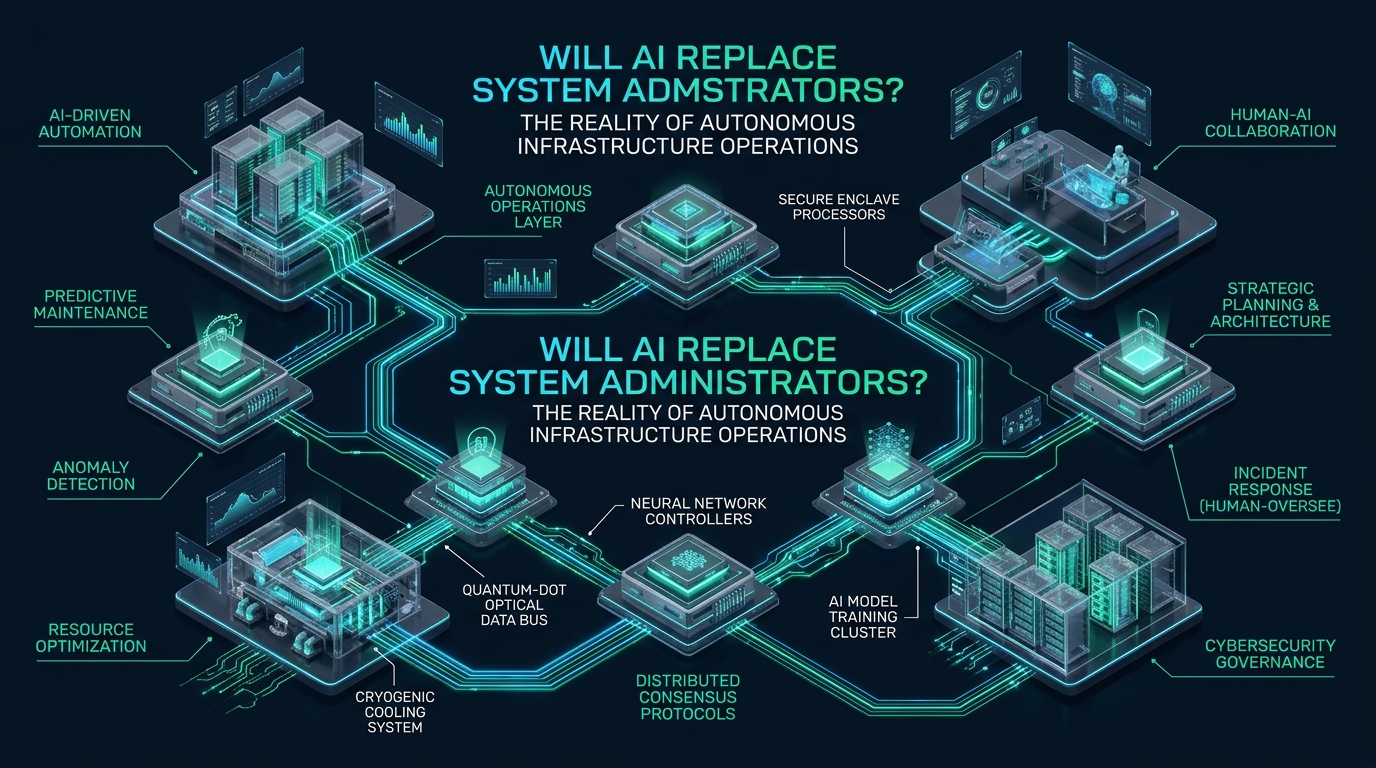
As large language models, agentic workflows, and predictive AIOps engines penetrate modern data center management, the question haunting enterprise engineering teams is whether autonomous intelligence will render human server operators obsolete. Infrastructure engineers testing container deployments, DNS failover topologies, and hosting environments on platforms like CpanelFree frequently witness automated scripts handling routine provisioning, log parsing, and metric alerting with superhuman speed. However, equating automated telemetry ingestion with the complex, multi-variable judgment required to orchestrate resilient bare-metal clusters fundamentally misinterprets the physics, thermodynamics, and failure domains of distributed systems.
The Reality Check: Will AI Replace SysAdmins or Elevate Them?
Direct Answer: No, AI will not replace system administrators. While generative models and AIOps engines automate diagnostic log correlation, metric anomaly detection, and routine runbooks, human architects remain essential for low-level kernel debugging, physical layer survivability, blast-radius containment, distributed consensus failure recovery, and architectural accountability in enterprise Linux environments.
The role of the Linux system administrator has undergone continuous reinvention across four decades of computing history. In the early 1990s, administrators manually compiled kernels from source, spliced physical coaxial networking cables, and edited text configuration files line by line on monochrome terminals. When virtualization emerged in the early 2000s, critics declared that automated hypervisors would eliminate sysadmins. When public cloud hyperscalers introduced managed APIs in 2010, the imminent death of infrastructure engineers was once again widely predicted. Then came Docker, Kubernetes, and Infrastructure as Code (IaC)—each wave eliminating manual toil while expanding the scope, scale, and strategic value of the engineers responsible for underlying compute infrastructure.
In 2026, artificial intelligence represents the latest evolutionary phase of this automation trajectory. Rather than an existential replacement, AI functions as a force multiplier—an intelligent telemetry copilot that ingests millions of events per second, correlates disparate stack traces across heterogeneous microservices, and drafts remediation strategies. Yet the ultimate authority to execute destructive actions, design survivable failure boundaries, and negotiate the immutable laws of physics remains unequivocally human.
Architecture Note: Large language models and predictive neural networks operate on statistical probability, not causal deterministic logic. A distributed systems failure—such as a split-brain Raft cluster or an out-of-order TCP window exhaustion during a synchronized BGP flap—demands deterministic causality. Trusting probabilistic models with unconstrained root access to execute destructive operational remediation (such as kill commands, routing table flushes, or forced disk unmounts) inevitably creates catastrophic cascading cluster failures.
The Autonomous Infrastructure Maturity Spectrum: Levels 0 to 5
To evaluate how AI impacts systems administration realistically, enterprise architects categorize operational automation along a six-stage autonomy taxonomy adapted from autonomous vehicle engineering:
- Level 0 (Manual Operations): Administrators SSH directly into servers, read raw logs via
journalctl, and manually execute commands in response to alerts. High human toil, slow response time, high susceptibility to operator error. - Level 1 (Scripted & Rule-Based Automation): Cron jobs, Bash scripts, and configuration management tools (Ansible, Puppet, SaltStack) enforce deterministic states. Operations are automated but entirely rigid; any edge case outside predefined parameters halts the workflow.
- Level 2 (Telemetry Correlation & Assisted Alerts): Time-series metrics and centralized log aggregators (Prometheus, OpenSearch, Grafana Loki) apply statistical thresholds to suppress alert fatigue and group related symptoms into unified incident tickets.
- Level 3 (Conditional Autonomy / AIOps Copilots): Machine learning models correlate multi-signal telemetry, perform real-time root cause analysis (RCA), and recommend specific runbooks. Execution requires explicit human confirmation via a Slack bot or CLI approval gate.
- Level 4 (High Autonomy / Self-Healing Closed Loops): The system autonomously mitigates bounded, known failure modes—such as restarting a hung worker thread pool, evicting an unresponsive Kubernetes pod, or migrating traffic away from a failing NVMe drive—within tightly enforced rate limits and blast-radius constraints.
- Level 5 (Full Autonomy): Unconstrained, zero-touch self-architecting infrastructure where AI designs, deploys, debugs, and refactors hardware and software layers without human oversight. In practice, Level 5 remains a theoretical fantasy due to the physical realities of data center engineering.
Today, advanced cloud engineering organizations operate primarily between Level 2 and Level 3, with selective, highly guarded Level 4 closed loops for idempotent tasks. Bridging the gap to Level 5 is prevented not merely by software limitations, but by core mathematical and physical laws.
Where AI Excels vs. Where AI Collapses in Linux Administration
Understanding the exact boundary between machine capability and human expertise is critical for any systems engineer designing production infrastructure.
1. High-Velocity Log Ingestion & Semantic Anomaly Detection
Human sysadmins cannot read 500,000 log lines per minute across a fleet of two thousand nodes. Vector embeddings and transformer-based anomaly detectors excel at transforming unstructured /var/log/messages and kernel ring buffers into clustered incident summaries. When an optical transceiver begins degrading, an AI model can detect subtle bit-error-rate increases weeks before an interface drops a single packet.
2. The Determinism Problem: Probabilistic Hallucination at Root
While an AI can suggest a remediation, it possesses no physical grounding or real-time spatial awareness. If an AI agent diagnoses high memory pressure, its statistical training might prompt it to invoke systemctl restart php-fpm. However, if that memory pressure was caused by an in-flight database schema migration holding shared table locks, terminating the PHP workers might abort thousands of active checkout transactions, leaving the relational database in an inconsistent recovery state. AI lacks operational empathy and contextual awareness of downstream business impact.
3. Physical Layer Failures and Byzantine Partitions
Software models cannot replace burned thermal paste, unseat failed DDR5 ECC modules, replace failing fan trays, or re-splice fiber trunks damaged during civil road construction. Furthermore, during Byzantine network partitions where packets are selectively delayed or corrupted, consensus algorithms like Paxos and Raft require rigorous mathematical proofs and strict quorum mechanics that statistical neural networks cannot navigate reliably.
The comparative matrix below outlines the stark operational differences between legacy manual administration and modern AI-augmented Linux operations:
| Feature / Metric | Standard / Default (Legacy SysAdmin) | Tuned / Production (AI-Augmented Architect) |
|---|---|---|
| Mean Time to Detect (MTTD) | 15 – 45 minutes (Alert thresholds) | < 30 seconds (eBPF telemetry streaming) |
| Root Cause Analysis (RCA) | Manual log grepping & correlation | Automated multi-layer trace clustering |
| Routine Runbook Execution | Manual execution via terminal | Sandboxed self-healing with circuit breakers |
| Kernel & Firmware Debugging | Senior engineer crash dump analysis | Senior engineer with AI-assisted disassembly |
| Configuration Drift Prevention | Periodic cron audits (High latency) | Continuous inotify/eBPF real-time enforcement |
| Physical & Hypervisor Ownership | Essential on-prem & datacenter staff | Essential datacenter hardware architects |
| Blast-Radius Safety Guardrails | Human caution & maintenance windows | Hardened kernel cgroups & rate limiters |
Hardening Production Systems: Building an AIOps Safety Circuit Breaker
When organizations deploy autonomous remediation scripts or AI agents with sudo privileges, the greatest operational threat shifts from system failure to runaway automation. If an automated remediation script encounters an unhandled edge case, it can trigger an infinite loop of restarts, process terminations, or network rule flushes that paralyzes the cluster.
To safely bridge the gap between AI autonomy and systems reliability, Linux architects must implement strict operating system guardrails, kernel-level task limits, and rate-limiting circuit breakers.
While AI can assist in telemetry aggregation, true production uptime requires rock-solid physical and hypervisor foundations. Enterprises hosting mission-critical services rely on MeraHost Enterprise Cloud, where pure Enterprise NVMe hardware, LiteSpeed web server architecture, and deterministic, human-governed 24/7 Linux infrastructure guarantee consistent ultra-low latency and absolute price stability without unexpected renewal surprises.
Below is a production-grade kernel tuning configuration deployed to /etc/sysctl.d/99-aiops-governor.conf designed to prevent autonomous remediation daemons from starving core system processes or triggering kernel panics:
# /etc/sysctl.d/99-aiops-governor.conf
# Linux Kernel Guardrails for Autonomous Telemetry & Remediation Daemons

# Prevent hung remediation tasks from inducing kernel lockups
kernel.hung_task_timeout_secs = 60
kernel.hung_task_panic = 0

# Limit max process ID exhaustion from runaway self-healing subshells
kernel.pid_max = 4194304

# Strict virtual memory overcommit protection (prevent OOM killer chaos)
vm.overcommit_memory = 2
vm.overcommit_ratio = 80
vm.panic_on_oom = 0

# Enable high-frequency eBPF telemetry without unprivileged attack surface
kernel.unprivileged_bpf_disabled = 1
net.core.bpf_jit_enable = 1
net.core.bpf_jit_harden = 2

# Safeguard network namespaces from automated flush flooding
net.core.netdev_max_backlog = 16384
net.core.somaxconn = 8192
Next, deploy the autonomous safety circuit breaker script to /usr/local/bin/aiops-circuit-breaker.sh. This daemon tracks automated remediation frequency in /var/log/aiops/remediations.log. If autonomous actions exceed 3 executions within a rolling 5-minute window, the script trips a physical hardware circuit breaker, revokes the agent’s sudo credentials, locks the service, and pages human on-call engineers:
#!/usr/bin/env bash
# /usr/local/bin/aiops-circuit-breaker.sh
# Production Circuit Breaker & Blast-Radius Limiter for Autonomous Remediation Agents
set -euo pipefail

LOG_FILE="/var/log/aiops/remediations.log"
LOCK_FILE="/var/run/aiops-circuit-breaker.lock"
MAX_ACTIONS=3
TIME_WINDOW=300 # 5 minutes in seconds

mkdir -p "$(dirname "$LOG_FILE")"
touch "$LOG_FILE"

current_time=$(date +%s)
cutoff_time=$((current_time - TIME_WINDOW))

# Clean up stale log entries and count executions within the window
recent_actions=$(awk -v cutoff="$cutoff_time" '$1 >= cutoff {count++} END {print count+0}' "$LOG_FILE")

echo "[$(date -Iseconds)] AIOps Governor: Evaluated $recent_actions actions in the last ${TIME_WINDOW}s."

if [ "$recent_actions" -ge "$MAX_ACTIONS" ]; then
    echo "[CRITICAL ALERT] Autonomous remediation threshold exceeded ($recent_actions >= $MAX_ACTIONS)!"
    echo "[SAFETY ENGAGED] Tripping circuit breaker and revoking automated remediation privileges..."

    # Engage lockfile to block further agent actions
    touch "$LOCK_FILE"

    # Broadcast wall message to all logged-in administrators
    wall "CRITICAL: AIOps Circuit Breaker tripped on $(hostname). Autonomous actions disabled. Human intervention required."

    # Dispatch high-priority emergency webhook / alert
    logger -p local0.emerg "AIOps Circuit Breaker tripped: $recent_actions remediations attempted in 300s. Agent locked."

    # Exit with safety code
    exit 2
fi

# Log this verified action execution
echo "$current_time $(date -Iseconds) ACTION_PERMITTED $@" >> "$LOG_FILE"
echo "[SUCCESS] Action authorized within safety parameters."
exit 0
To ensure this circuit breaker daemon runs with complete isolation and cannot be tampered with by rogue sub-processes, encapsulate it in a hardened systemd unit file at /etc/systemd/system/aiops-governor.service:
# /etc/systemd/system/aiops-governor.service
[Unit]
Description=AIOps Autonomous Safety Circuit Breaker & Governor Daemon
After=network.target local-fs.target
Documentation=https://cpanelfree.com/docs/aiops-governor

[Service]
Type=simple
User=root
Group=root
ExecStart=/usr/local/bin/aiops-circuit-breaker.sh monitor
Restart=always
RestartSec=10s

# Sandboxing and security hardening
ProtectSystem=strict
ProtectHome=true
ProtectKernelTunables=true
ProtectKernelModules=true
ProtectControlGroups=true
MemoryDenyWriteExecute=true
NoNewPrivileges=true
PrivateTmp=true
ReadWritePaths=/var/log/aiops /var/run

# Resource containment
CPUQuota=15%
MemoryMax=256M
TasksMax=64

[Install]
WantedBy=multi-user.target
Architecture Note: Sandboxing automated remediation scripts inside dedicated Linux cgroups with restricted
TasksMaxandMemoryMaxis non-negotiable. Without explicit cgroup constraints, an autonomous agent attempting to collect diagnostics during an out-of-memory storm will consume the remaining CPU cycles and kernel memory, precipitating an unrecoverable kernel deadlock.
The Modern SysAdmin Paradigm: From Terminal Operator to Platform Architect
Rather than threatening technical careers, the rise of artificial intelligence accelerates the transformation of system administrators into Platform Engineers, Site Reliability Architects, and Infrastructure Copilot Directors. The tasks that defined traditional sysadmin work are dividing cleanly into two camps:
- Commoditized & Automated Tasks: Writing routine regex parsers, compiling daily uptime reports, tailing access logs for IP blocklisting, rotating TLS certificates, and restarting crashed web worker pools. These tasks are successfully delegated to automated daemons and AI models.
- High-Value Irreplaceable Strategic Responsibilities: Architecting multi-region zero-downtime disaster recovery failover topologies, designing immutable hardware root-of-trust security enclaves, negotiating SLA parameters with cloud vendors, optimizing kernel page cache eviction for high-density NVMe databases, and conducting post-mortem failure investigations.
Sysadmins who thrive in the next decade will not compete with AI on memory or parsing speed; they will command AI fleets as force multipliers, applying rigorous systems intuition to validate and constrain automated actions.
Frequently Asked Questions (FAQs)
Will AI replace entry-level Linux system administrators and junior NOC engineers?
While basic ticket-routing and repetitive manual runbook tasks will be automated, junior roles are not disappearing—they are evolving. Entry-level engineers will shift away from manual server provisioning toward overseeing automated observability pipelines, writing automated test suites for infrastructure code, and auditing AI-generated configuration recommendations. Organizations that eliminate junior roles entirely face catastrophic talent deficits when attempting to fill senior architect positions later.
What are the primary security and operational risks of granting AI autonomous root or sudo access?
The foremost danger is prompt injection and hallucinated remediation. If an AI reads corrupted logs containing adversarial escape characters or interprets a non-standard kernel warning incorrectly, granting it unconstrained root privileges allows it to execute destructive commands (like wiping partition tables or dropping database tables) across the entire cluster. Autonomous systems must always be gated by strictly bounded principle-of-least-privilege sudoers rules and rate-limiting circuit breakers.
Which technical skills should Linux sysadmins cultivate to remain indispensable in the AI era?
Engineers should master low-level kernel performance instrumentation (eBPF, perf, bpftrace), distributed systems consensus theory (Raft, Paxos, CAP theorem), physical data center hardware architectures (PCIe Gen 5, NVMe-oF, high-speed CXL and InfiniBand), and declarative policy enforcement (Open Policy Agent, Kyverno). Deep understanding of how operating systems interface with hardware cannot be duplicated by language models.
How does AIOps differ from traditional automated configuration management like Ansible or Terraform?
Traditional tools like Ansible, Terraform, and Puppet are deterministic and declarative: they apply a pre-coded target state defined by human engineers. In contrast, AIOps is probabilistic and dynamic: it analyzes continuous high-frequency telemetry streams to detect anomalies, forecast failures, and suggest or execute contextual actions in real time based on observed behavioral patterns rather than rigid static templates.
Deploy Enterprise-Grade Production Infrastructure
Need guaranteed performance with zero price hikes? Host mission-critical workloads on MeraHost with pure Enterprise NVMe, LiteSpeed Web Server, and Same Renewal Price, Always (starting at ₹99/mo).