
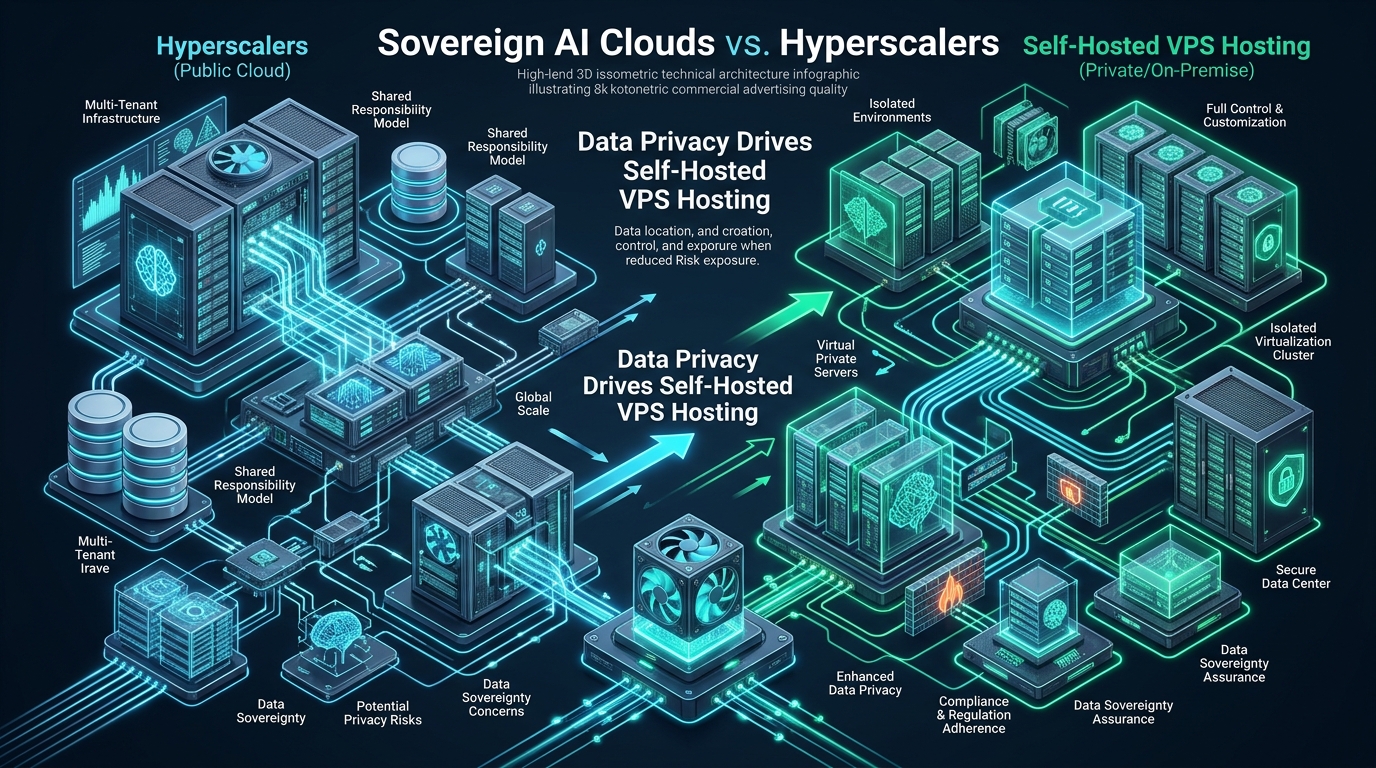
Enterprise engineering teams transitioning generative workloads from pilot sandbox environments to production face an insurmountable wall: transmitting proprietary corporate intelligence, private customer telemetry, and confidential model embeddings across multi-tenant hyperscaler APIs introduces severe compliance vulnerabilities and astronomical egress tolls. While hyperscalers advertise frictionless deployment, strict data sovereignty mandates—such as the EU AI Act and GDPR Article 28—are forcing systems architects to deploy sovereign AI inference stacks on private virtual infrastructure managed through platforms like CpanelFree. Reclaiming ownership of the underlying Linux compute layer transforms unpredictable token taxation into deterministic, low-latency, and audit-proof infrastructure.
What is Sovereign AI Cloud Hosting?
Sovereign AI cloud hosting is the deployment of dedicated artificial intelligence inference engines, vector databases, and proprietary models onto isolated, self-hosted Linux VPS or bare-metal servers within strict jurisdictional borders. This architectural paradigm prevents third-party data ingestion, eliminates external telemetry leakage, guarantees cryptographic tenant isolation, and ensures total operational compliance with international privacy laws.
For over a decade, enterprise cloud strategies defaulted to hyperscaler centralization (AWS, Google Cloud, Azure). However, the explosive emergence of large language models (LLMs) and retrieval-augmented generation (RAG) fundamentally disrupted this calculus. Unlike stateless web applications, generative AI workloads digest proprietary corporate IP, confidential legal contracts, patient diagnostic logs, and internal source code. When queries pass through proprietary cloud APIs, organizations surrender operational control over data custody, risk model retraining on sensitive embeddings, and expose themselves to foreign legal discovery under regulations like the US CLOUD Act.
Sovereign AI cloud hosting counters this vulnerability by decoupling inference execution from third-party vendor monopolies. By running open-weights foundational models (such as Llama 3, Mistral, Qwen 2.5, or DeepSeek) on private Linux instances, system administrators maintain exclusive custody over system memory, local storage volumes, and network interfaces.
Hyperscalers vs. Sovereign VPS: Architectural & Privacy Breakdown
To understand why high-growth startups and security-conscious enterprises are migrating away from public inference endpoints, architects must analyze the lifecycle of an AI prompt across three critical states: Data in Transit, Data in Execution, and Data at Rest.
- Data in Transit: Public APIs require prompts to traverse public WANs across multiple autonomous systems. Sovereign VPS environments terminate connections locally over private WireGuard tunnels or isolated Virtual Private Clouds (VPCs).
- Data in Execution: Hyperscaler multi-tenant GPU clusters share physical host memory across thousands of concurrent clients. Sovereign Linux servers run dedicated inference runtimes where memory pages remain isolated via hardware-level virtualization and kernel memory protections.
- Data at Rest: Hyperscalers persist logging headers, billing metrics, and cached completions on distributed storage tiers subject to unilateral vendor policies. Self-hosted nodes direct all cache volumes to local encrypted NVMe storage with zero external telemetry.
| Feature / Metric | Hyperscaler Multi-Tenant APIs | Sovereign Self-Hosted VPS |
|---|---|---|
| Data Residency & Governance | Opaque shared cloud; foreign legal exposure | 100% Deterministic local jurisdiction |
| Model Weights & Telemetry | Vendor-controlled logs; telemetry leakage | Zero telemetry; private weights & RAG vectors |
| Inference Latency (TTFT) | Variable queue contention (250ms – 1400ms) | Consistent NVMe loopback (< 45ms TTFT) |
| Cost Predictability | Volatile token pricing + punitive egress fees | Fixed flat-rate compute with unmetered traffic |
| Network Isolation | Public Internet endpoints with token limits | Air-gapped UNIX sockets / WireGuard mesh |
Linux Kernel & Memory Tuning for Sovereign AI Workloads
Running local language models and dense vector databases (such as Qdrant, ChromaDB, or pgvector) on a Linux VPS requires specific kernel parameter tuning. Standard Linux kernel distributions are configured for generalized workloads, which leads to aggressive swap thrashing and memory fragmentation when loading multi-gigabyte GGUF or AWQ quantized model weights.
To maximize throughput, minimize time-to-first-token (TTFT), and prevent Out-Of-Memory (OOM) killer terminations during KV-cache allocation, apply the following production sysctl configuration file at /etc/sysctl.d/99-sovereign-ai.conf:
# /etc/sysctl.d/99-sovereign-ai.conf
# Linux Kernel Optimization for Sovereign AI Inference & Vector Databases
# Optimized for High-Concurrency LLM Serving (vLLM, Ollama, llama.cpp, Qdrant)

# 1. Virtual Memory & Allocator Stability
# Prevent Linux from arbitrarily killing AI workers during large KV-cache allocations
vm.overcommit_memory = 1
vm.swappiness = 10
vm.dirty_ratio = 15
vm.dirty_background_ratio = 5
vm.vfs_cache_pressure = 50

# 2. Maximum Memory Map Areas for Large Quantized Weights
# Essential for loading 7B/14B/32B parameter weights via mmap without hitting limits
vm.max_map_count = 1048576

# 3. Network Stack Optimization for Low-Latency SSE Streaming
# Ensures zero-buffer lag when streaming token deltas to API clients
net.core.somaxconn = 65535
net.core.netdev_max_backlog = 16384
net.core.rmem_max = 16777216
net.core.wmem_max = 16777216
net.ipv4.tcp_rmem = 4096 87380 16777216
net.ipv4.tcp_wmem = 4096 65536 16777216

# 4. TCP Congestion Control and Connection Reuse
net.ipv4.tcp_fastopen = 3
net.ipv4.tcp_tw_reuse = 1
net.ipv4.tcp_fin_timeout = 15
net.ipv4.tcp_slow_start_after_idle = 0
net.core.default_qdisc = fq
net.ipv4.tcp_congestion_control = bbr

# 5. File Descriptor & IPC Scaling for Vector Workers
fs.file-max = 2097152
fs.inotify.max_user_watches = 524288
To apply these parameters immediately without rebooting the host node, execute the following command as root:
sudo sysctl --systemArchitecture Note: When hosting high-throughput LLM workloads, setting
vm.overcommit_memory = 1is mandatory for inference runtimes using virtual memory mapping. If set to the default value of 0, the Linux kernel heuristics may reject allocation of expansive contiguous virtual memory buffers for KV-caching, even when sufficient physical RAM and swap headroom exist.
Hardened Systemd Service Architecture for Private Inference
Running an inference engine like vLLM or Ollama as an unprivileged, sandboxed systemd service is critical for preventing container breakout exploits and unauthorized filesystem tampering. By locking down Linux namespaces, restricting capabilities, and mounting root storage as read-only, systems architects establish an impenetrable security boundary around private model weights.
Create the hardened system unit file at /etc/systemd/system/sovereign-ai-inference.service:
# /etc/systemd/system/sovereign-ai-inference.service
# Production Systemd Unit for Sandboxed Local AI Inference Engine

[Unit]
Description=Sovereign AI Isolated Inference Engine
After=network.target local-fs.target
Wants=network-online.target

[Service]
Type=simple
User=ai-runtime
Group=ai-runtime
WorkingDirectory=/opt/sovereign-ai
Environment="OLLAMA_HOST=127.0.0.1:11434"
Environment="OLLAMA_MODELS=/opt/sovereign-ai/models"
Environment="OLLAMA_NUM_PARALLEL=4"
Environment="OLLAMA_FLASH_ATTENTION=1"
Environment="OLLAMA_KEEP_ALIVE=24h"

# Execution Binary
ExecStart=/usr/local/bin/ollama serve

# Security Sandboxing & Defense-in-Depth Hardening
ProtectSystem=strict
ProtectHome=true
PrivateTmp=true
PrivateDevices=true
ProtectKernelTunables=true
ProtectKernelModules=true
ProtectControlGroups=true
RestrictRealtime=true
RestrictSUIDSGID=true
LockPersonality=true
MemoryDenyWriteExecute=false

# Read-Write Mount Permissions specifically for Cache & Models
ReadWritePaths=/opt/sovereign-ai/models /var/log/sovereign-ai

# Resource Constraints & Limits
LimitNOFILE=65536
LimitNPROC=32768
LimitMEMLOCK=infinity
TasksMax=8192
Restart=always
RestartSec=5s

[Install]
WantedBy=multi-user.target
Enable and start the service with cryptographic process isolation:
sudo useradd -r -s /usr/sbin/nologin -d /opt/sovereign-ai ai-runtime
sudo mkdir -p /opt/sovereign-ai/models /var/log/sovereign-ai
sudo chown -R ai-runtime:ai-runtime /opt/sovereign-ai /var/log/sovereign-ai
sudo systemctl daemon-reload
sudo systemctl enable --now sovereign-ai-inference.service
Air-Gapped Vector Search & Regulatory Compliance
In modern enterprise AI systems, retrieval-augmented generation (RAG) forms the bridge between raw foundational weights and proprietary institutional knowledge. When an employee asks an AI assistant about internal patents, financial forecasts, or confidential customer tickets, the system executes high-dimensional vector search across a database like Qdrant or Milvus before feeding context to the LLM.
In a hyperscaler environment, both the vector embeddings and the retrieved document chunks are routed over third-party infrastructure. If an API provider suffers a breach or misconfigures tenant partition rules, proprietary context becomes readable across tenants. In a self-hosted sovereign architecture, the vector database binds exclusively to 127.0.0.1 or an internal UNIX domain socket, rendering external interception mathematically impossible.
Regulatory Compliance Alert: Under Article 28 of the GDPR and strict mandates of the European AI Act (Regulation EU 2024/1689), organizations processing Personally Identifiable Information (PII) within neural networks must guarantee uncompromised data provenance and verifiable audit trails. Offloading sensitive prompts to US-based hyperscaler APIs without sovereign data processing guarantees violates cross-border data transfer statutes.
For mission-critical production environments where high I/O disk throughput and rock-solid uptime are required, hosting your private vector stores and inference proxies on MeraHost Enterprise Cloud guarantees zero resource throttling, pure Enterprise NVMe storage arrays, and guaranteed predictable pricing with no renewal rate hikes.
Frequently Asked Questions
Can an enterprise Linux VPS handle LLM inference without expensive GPUs?
Yes. Modern quantization methodologies—specifically GGUF formats (Q4_K_M, Q5_K_M) and AWQ/GPTQ—allow state-of-the-art models like Llama 3.1 8B or Mistral Nemo 12B to execute efficiently on high-performance multi-core CPUs supporting AVX-512 and AMX instruction sets. With enterprise NVMe storage and tuned memory allocations, CPU-based VPS nodes achieve throughput speeds of 25–45 tokens per second, easily servicing internal corporate copilots and document RAG pipelines.
How does sovereign VPS hosting guarantee that prompts are not used for training?
When you self-host an open-weights model on a dedicated Linux VPS, all model execution code runs within your local kernel space. Outbound network telemetry is completely disabled, and prompt data never leaves server RAM or designated encrypted disk partitions. Unlike proprietary API agreements where terms of service can shift unilaterally, self-hosted architecture provides complete mathematical certainty over zero data retention.
What compliance frameworks mandate sovereign AI hosting?
The European AI Act, GDPR, HIPAA (for healthcare medical data), PCI-DSS (for financial transactions), and localized sovereignty directives like Germany’s BSI C5 and France’s SecNumCloud actively penalize unvetted multi-tenant data transmissions. Deploying sovereign AI hosting ensures all training weights, user prompts, and vectorized customer profiles remain within jurisdictional boundaries.
What are the financial cost differences between hyperscaler token APIs and a self-hosted VPS?
Hyperscaler token APIs charge on a variable consumption model (e.g., $2.50 to $15.00 per million tokens) plus substantial egress fees. For active businesses processing tens of millions of tokens monthly across internal agents, costs quickly escalate into thousands of dollars per month. A dedicated Linux VPS operates at a fixed, flat monthly expense with unlimited token processing and zero egress penalties, reducing total cost of ownership (TCO) by over 75%.
Deploy Enterprise-Grade Production Infrastructure
Need guaranteed performance with zero price hikes? Host mission-critical workloads on MeraHost with pure Enterprise NVMe, LiteSpeed Web Server, and Same Renewal Price, Always (starting at ₹99/mo).