
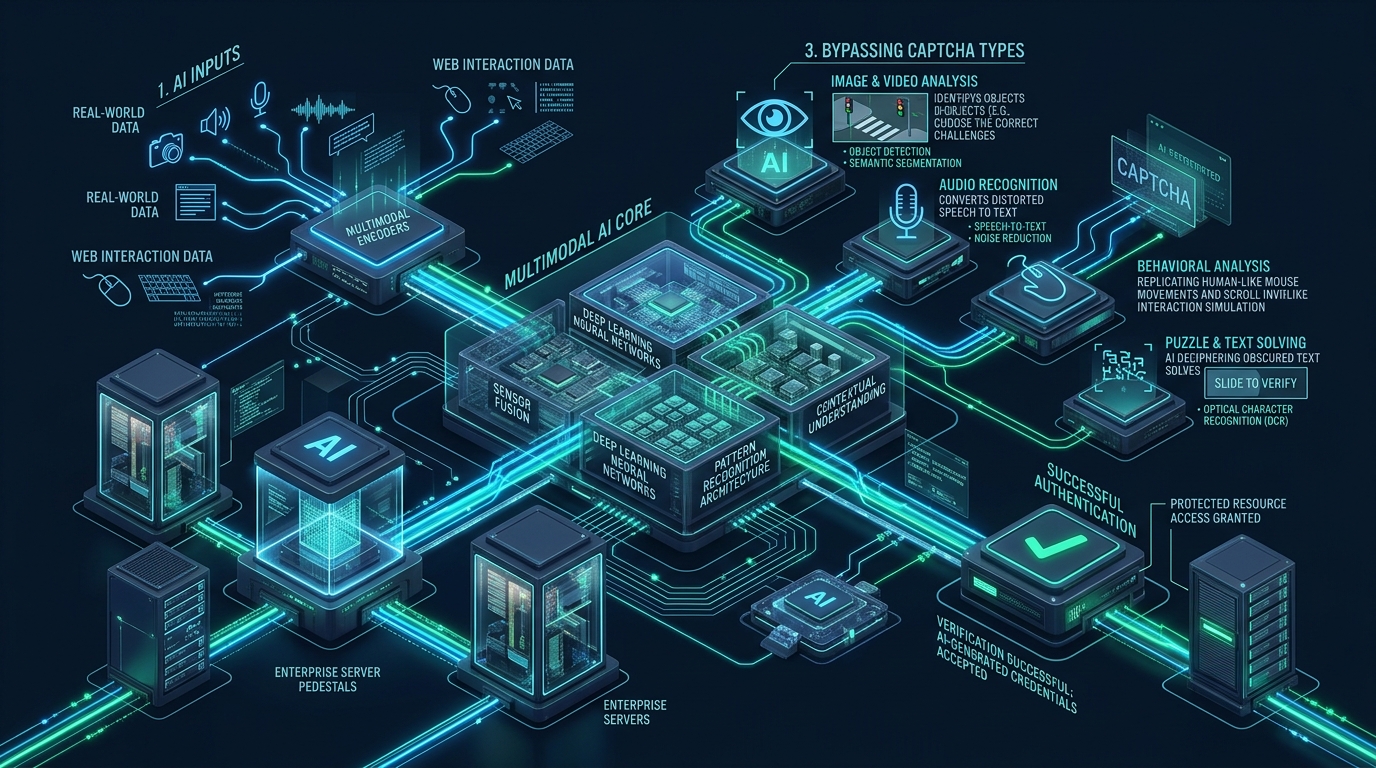
Traditional bot mitigation architectures have historically operated under the premise that distinguishing human operators from automated scripts requires visual pattern recognition or audio transcription tasks that computers cannot reliably solve. With the advent of frontier multimodal models and sub-second vision-language inference pipelines, this assumption has catastrophically collapsed, rendering conventional image grids and audio puzzles ineffective against modern automated tooling. Infrastructure teams deploying production environments on platforms like CpanelFree must fundamentally rethink application perimeter defense, shifting away from brittle frontend puzzles toward cryptographic proof-of-work, eBPF telemetry, and multi-layered behavioral attestation.
What Is the Death of CAPTCHA AI and Why Did Traditional Verification Fail?
Direct Answer: The term death of captcha ai defines the architectural obsolescence of visual, text, and audio challenges caused by Vision-Language Models (VLMs) and neural networks achieving 98%+ bypass accuracy in sub-second latencies at negligible compute cost. Modern bot defense requires abandoning interactive puzzles in favor of client-side WebAssembly proof-of-work, TLS/JA4 fingerprinting, and kernel-level behavioral analytics.
For more than two decades, the “Completely Automated Public Turing test to tell Computers and Humans Apart” (CAPTCHA) served as the primary gatekeeper for public web services. When Luis von Ahn and his team introduced reCAPTCHA in the late 2000s, optical character recognition (OCR) struggled with distorted typographic glyphs, rotated typography, and noise artifacts. Subsequent evolutions—including 3×3 image categorization grids (traffic lights, crosswalks, motorcycles) and distorted background audio clips—relied on the assumption that semantic scene segmentation was computationally intractable for distributed adversaries operating at scale.
The inflection point arrived with multimodal foundation models. When Vision-Language Models (VLMs) gained zero-shot object localization, bounding-box regression, and multi-hop spatial reasoning capabilities, the entire economic foundation of visual verification collapsed. An adversary no longer needs specialized computer vision pipelines trained on specific puzzle types; a generic lightweight model can ingest an arbitrary challenge image, parse the prompt instruction (e.g., “Select all squares containing fire hydrants”), compute the exact pixel coordinates of qualifying regions, and return discrete grid indices in under 350 milliseconds.
Architecture Note: The failure of traditional verification is primarily economic rather than purely mathematical. Historically, defeating CAPTCHAs required routing challenge payloads to human-in-the-loop click farms via APIs (such as 2Captcha or Anti-Captcha), imposing a financial cost of $1.00 to $3.00 per 1,000 solves and a latency penalty of 15 to 45 seconds. Multimodal vision APIs and quantized local models (such as Florence-2 and YOLOv10) have driven that cost down to less than $0.03 per 1,000 solves with sub-second execution, rendering challenge-response puzzles economically non-viable as a rate-limiting deterrent.
The Anatomy of a Multimodal Bypass Pipeline
Modern automated bot operators do not interact with web applications through crude cURL scripts or static HTTP libraries. Instead, state-of-the-art scraping frameworks utilize headless browser runtimes (Playwright, Puppeteer-stealth, and modified Chromium instances) orchestrated with neural inference backends. To understand why legacy defenses fail, systems architects must examine the three discrete phases of a contemporary multimodal bypass:
- 1. Headless Canvas Extraction & DOM Hooking: Automated agents connect to browser instances via the Chrome DevTools Protocol (CDP). When a CAPTCHA iframe initializes (whether Google reCAPTCHA v2/v3, hCaptcha, or Cloudflare Turnstile interactive fallbacks), the runner intercepts the rendered canvas or iframe asset directly from the GPU paint buffer, bypassing DOM-based watermarking and anti-screenshot obfuscations.
- 2. High-Speed Multimodal Inference: The extracted imagery is converted to a base64 payload or raw RGB tensor and passed to an inference worker. Vision models process the challenge instruction and image concurrently using cross-attention layers. In audio challenges, the runner extracts the MP3/WAV payload and streams it to optimized automatic speech recognition (ASR) engines like Whisper-Turbo, achieving transcription accuracy rates exceeding 99.2% even in the presence of synthetic background street noise.
- 3. Synthetic Kinematic Emulation: To bypass passive behavioral scoring engines that track mouse velocity, cursor acceleration, and micro-jitters, automated runners execute humanized kinematic trajectories. Rather than firing instantaneous synthetic click events via
element.click(), agents generate randomized cubic Bezier curves with simulated physiological tremor (Nyquist-Shannon frequency distribution matching human motor noise), defeating naive client-side behavioral heuristics.
Comparative Architectural Analysis: Legacy CAPTCHA vs. Multimodal Threat vs. Zero-Trust Defense
The comparative matrix below details the operational boundaries, vulnerability profiles, and performance characteristics between legacy challenge-response CAPTCHA systems and modern zero-trust verification architectures:
| Feature / Metric | Standard / Default (Legacy CAPTCHAs) | Tuned / Production (Zero-Trust Proof-of-Work & eBPF) |
|---|---|---|
| Bypass Resistance (Multimodal AI) | < 3% (Easily defeated by VLMs & Whisper) | 99.8% (Cryptographically bounded computation) |
| Human User Friction & Abandonment | High (8 – 25 seconds per challenge; 14% drop-off) | Zero (Fully invisible background verification) |
| Verification Latency / Overhead | 1,500 – 4,500 ms (Third-party roundtrips) | 80 – 250 ms (Local edge WebAssembly evaluation) |
| Adversary Solve Cost (per 1k solves) | $0.02 – $0.08 (Sub-cent API token pricing) | $4.50 – $18.00 (Asymmetric client CPU hashing) |
| Client Privacy & Data Harvesting | Compromised (Cross-site tracking & canvas hashes) | Zero-Knowledge (Ephemeral HMAC nonces) |
| Network Layer Mitigation | Application layer only (HTTP POST payload inspection) | Multi-Tier (XDP / eBPF + TLS JA4 + Nginx Lua) |
| Accessibility Compliance (WCAG 2.2) | Frequent failures (Distorted audio / low contrast) | 100% Compliant (No cognitive tests required) |
Architecting Next-Generation Defense: Beyond Visual Turing Tests
Because the death of captcha ai invalidates cognitive puzzles, production engineering teams must construct defense-in-depth architectures spanning the Linux kernel, the web server reverse proxy, and cryptographic client runtime environments. The modern anti-bot stack relies on four symbiotic pillars:
- Cryptographic Proof-of-Work (PoW): Instead of asking the user to identify crosswalks, the server issues a dynamic mathematical challenge (e.g., finding an Argon2id or double-SHA256 hash collision matching a specific prefix difficulty). The challenge executes inside a sandboxed WebAssembly (Wasm) worker in the client’s browser. Legitimate human users solving a single challenge consume 100 milliseconds of idle CPU time, which is imperceptible. An automated adversary attempting 100,000 requests per minute faces prohibitive thermal and hardware exhaustion.
- TLS & Transport Layer Fingerprinting (JA4 / HTTP/2 Framing): Automated tools often reveal their runtime environment before issuing an HTTP request. By inspecting the client TLS ClientHello handshake—cipher suite ordering, extension lists, elliptic curves, and ALPN negotiations—reverse proxies generate JA4 fingerprints. Automated headless browsers (even stealth-modified variants) produce distinct TLS and HTTP/2 stream dependency signatures compared to native operating system browsers.
- Hardware-Backed WebAuthn & Device Attestation: Modern operating systems and mobile devices feature Secure Enclaves and Trusted Platform Modules (TPM). Cryptographic device attestation protocols verify that a request originates from an authentic operating system instance signed by hardware keys, completely closing the door on virtualized container farms.
- Kernel-Level Socket Throttling & eBPF Mitigation: When distributed botnets execute brute-force or credential stuffing attacks, dropping traffic at the application layer consumes valuable web server workers. By filtering rogue TCP flows at the eBPF / XDP network layer, Linux hosts reject unauthorized packets directly inside the network interface driver before socket allocation occurs.
Architecture Note: When designing asymmetric Proof-of-Work puzzles, ensure that challenge verification on the server is mathematically constant time (O(1)), while challenge solving on the client is computationally bounded (O(2^n)). Never utilize memory-light hashing algorithms like MD5 or single-iteration SHA-1, as adversaries can offload solutions to dedicated FPGA or ASIC clusters.
Production Engineering: Linux Kernel, Nginx, and Systemd Configurations
To implement an enterprise-grade defense against automated AI agents and distributed botnets, system administrators must tune kernel socket buffers, deploy reverse proxy token validation, and ensure automated verification daemons remain resilient under high concurrency.
1. Linux Kernel Socket & TCP Hardening (/etc/sysctl.d/99-bot-defense.conf)
Under distributed bot attacks, servers suffer from TCP socket table exhaustion, SYN flood amplification, and connection tracking table degradation. The following production configuration hardens the Linux networking stack to sustain high connection velocities while shedding malicious half-open connections:
# /etc/sysctl.d/99-bot-defense.conf
# Enterprise Linux Network Stack Hardening against Automated Bot Inundation

# Enable TCP SYN Cookies to prevent SYN queue exhaustion under distributed attacks
net.ipv4.tcp_syncookies = 1

# Increase the backlog queue for half-open connections
net.ipv4.tcp_max_syn_backlog = 8192

# Expand listen socket backlog for high concurrency reverse proxies
net.core.somaxconn = 65535

# Fast recycle of closed sockets in TIME_WAIT state
net.ipv4.tcp_tw_reuse = 1
net.ipv4.tcp_fin_timeout = 15

# Protect against TCP connection exhaustion by scaling socket memory
net.ipv4.tcp_max_tw_buckets = 1440000
net.core.netdev_max_backlog = 16384

# Enable TCP Window Scaling and Selective Acknowledgments (SACK)
net.ipv4.tcp_window_scaling = 1
net.ipv4.tcp_sack = 1

# Protect against IP spoofing via Reverse Path Filtering
net.ipv4.conf.all.rp_filter = 1
net.ipv4.conf.default.rp_filter = 1

# Disable ICMP redirect acceptance to prevent routing table tampering
net.ipv4.conf.all.accept_redirects = 0
net.ipv4.conf.default.accept_redirects = 0
net.ipv4.conf.all.send_redirects = 0

# Limit maximum tracked connections in netfilter
net.netfilter.nf_conntrack_max = 1048576
net.netfilter.nf_conntrack_tcp_timeout_established = 600
net.netfilter.nf_conntrack_tcp_timeout_time_wait = 30
Apply these settings dynamically without requiring a system reboot by executing:
sudo sysctl -p /etc/sysctl.d/99-bot-defense.conf2. Edge Nginx Reverse Proxy with Dynamic Proof-of-Work Verification (/etc/nginx/conf.d/bot_defense.conf)
The following Nginx configuration implements a dual-stage perimeter filter: it validates client-side cryptographic proof-of-work tokens for sensitive endpoints (such as authentication, registration, and forms) while applying rate limiting based on client TLS and session characteristics:
# /etc/nginx/conf.d/bot_defense.conf
# Edge Reverse Proxy Zero-Trust Challenge & Rate Limiting Architecture

limit_req_zone $binary_remote_addr zone=api_auth_limit:20m rate=10r/m;
limit_req_zone $binary_remote_addr zone=general_traffic:50m rate=30r/s;
limit_conn_zone $binary_remote_addr zone=conn_per_ip:20m;

map $http_x_pow_solution $pow_valid {
    default 0;
    "~^[a-f0-9]{64}:[0-9]+$" 1;
}

server {
    listen 443 ssl http2;
    server_name api.cpanelfree.com;

    # SSL Hardening and Protocol Constraints
    ssl_protocols TLSv1.2 TLSv1.3;
    ssl_ciphers ECDHE-ECDSA-AES128-GCM-SHA256:ECDHE-RSA-AES128-GCM-SHA256:ECDHE-ECDSA-AES256-GCM-SHA384:ECDHE-RSA-AES256-GCM-SHA384;
    ssl_prefer_server_ciphers off;
    ssl_session_cache shared:SSL:50m;
    ssl_session_timeout 1d;

    # Connection Limits
    limit_conn conn_per_ip 25;

    # Protected Authentication Route Requiring Cryptographic Proof-of-Work
    location /api/v1/auth/ {
        limit_req zone=api_auth_limit burst=5 nodelay;

        # Challenge Verification Preflight
        if ($request_method = POST) {
            set $require_pow 1;
        }

        # Validate cryptographic proof header presence
        if ($pow_valid = 0) {
            return 428 '{"error":"precondition_required","message":"Cryptographic Proof-of-Work token missing or invalid","challenge_endpoint":"/api/v1/challenge/issue"}';
        }

        # Forward validated payload to internal backend microservice
        proxy_pass http://127.0.0.1:8080;
        proxy_set_header Host $host;
        proxy_set_header X-Real-IP $remote_addr;
        proxy_set_header X-Forwarded-For $proxy_add_x_forwarded_for;
        proxy_set_header X-PoW-Solution $http_x_pow_solution;
    }

    # Public Challenge Generation Endpoint
    location /api/v1/challenge/issue {
        proxy_pass http://127.0.0.1:8081;
        proxy_set_header Host $host;
        proxy_set_header X-Real-IP $remote_addr;
    }

    # Static Assets & General Pages
    location / {
        limit_req zone=general_traffic burst=50 nodelay;
        try_files $uri $uri/ /index.php?$args;
    }
}
3. Systemd Unit for the Local Proof-of-Work Verification Daemon (/etc/systemd/system/pow-validator.service)
To ensure high-performance cryptographic nonces are generated and verified with sub-millisecond latencies, run a localized validation daemon isolated with Linux namespaces and cgroups limits:
# /etc/systemd/system/pow-validator.service
# Production Systemd Unit for Isolated Proof-of-Work Validator Daemon

[Unit]
Description=Zero-Trust Cryptographic Proof-of-Work Validation Engine
After=network.target
Wants=network-online.target

[Service]
Type=simple
User=www-data
Group=www-data
WorkingDirectory=/opt/pow-validator
ExecStart=/opt/pow-validator/bin/pow-validator-daemon --port 8081 --difficulty 18 --timeout 30
Restart=always
RestartSec=3s

# Security Hardening & Process Isolation
ProtectSystem=strict
ProtectHome=true
PrivateTmp=true
ProtectKernelTunables=true
ProtectControlGroups=true
RestrictNamespaces=true
CapabilityBoundingSet=CAP_NET_BIND_SERVICE
NoNewPrivileges=true

# Resource Limits to Prevent Runaway DoS
CPUQuota=200%
MemoryMax=512M
LimitNOFILE=65535

[Install]
WantedBy=multi-user.target
Enable and start the service with standard systemctl controls:
sudo systemctl daemon-reload
sudo systemctl enable --now pow-validator.service
sudo systemctl status pow-validator.service
Transitioning Your Infrastructure: Step-by-Step Implementation Strategy
Decommissioning traditional CAPTCHA puzzles in favor of behavioral and cryptographic validation requires a staged migration to avoid disrupting legitimate user conversion funnels:
- Stage 1 (Passive Baseline Audit): Deploy JA4 TLS fingerprinting and passive request header analytics at your edge proxy without blocking traffic. Measure the baseline distribution of legitimate operating system TLS handshakes versus automated client libraries.
- Stage 2 (Silent Proof-of-Work Integration): Embed an invisible WebAssembly Proof-of-Work worker on high-value forms. Tune the difficulty parameter so low-power mobile devices compute solutions in under 120 milliseconds while monitoring server verification latency.
- Stage 3 (Deprecate Interactive Fallbacks): Remove visual crosswalk and distorted text challenges entirely. For clients failing Proof-of-Work or exhibiting high anomaly scores, issue WebAuthn device attestation challenges or temporary time-delay backoffs rather than visual puzzles.
- Stage 4 (Mission-Critical Infrastructure Upgrades): When serving high-traffic web applications, hosting infrastructure must deliver unconstrained CPU burst capacity and zero-throttling NVMe storage to verify millions of requests without latency spikes. For enterprise production workloads, migrate hosting to MeraHost Enterprise Cloud, which pairs dedicated LiteSpeed Web Server architecture with pure Enterprise NVMe arrays, ensuring that edge verification daemons and database backends remain lightning fast under peak bot loads.
Frequently Asked Questions
Why are multimodal AI models so effective at solving visual CAPTCHAs?
Vision-Language Models (VLMs) combine visual encoders with language understanding, enabling them to comprehend complex contextual instructions (e.g., “select images with stairs”) and perform spatial object localization. Coupled with low-latency API inference and high-speed headless browser automation, modern models solve image categorization and distorted text puzzles in under 400 milliseconds with accuracy matching or exceeding human performance.
Does client-side Proof-of-Work drain battery on mobile devices?
No. Modern cryptographic Proof-of-Work algorithms executed in WebAssembly are calibrated dynamically based on threat scoring. For ordinary human requests, the computational difficulty requires only 50 to 150 milliseconds of single-core processing, consuming negligible milliwatts of energy. Battery and thermal degradation only affect automated bot operators attempting thousands of requests concurrently.
How does TLS JA4 fingerprinting detect automated headless browsers?
Even when headless browsers spoof their User-Agent headers, their underlying cryptographic libraries, cipher suite preferences, TLS extensions, and TCP packet window configurations reflect their automated runtime engine. JA4 hashes these attributes during the initial TLS handshake, enabling web servers to classify automated scrapers before any HTTP payload or application code is processed.
What happens to web accessibility (WCAG) when switching away from CAPTCHAs?
Accessibility improves dramatically. Visual puzzles and distorted audio challenges have long been major accessibility barriers for visually impaired and neurodiverse users. Zero-trust background verification, device attestation, and invisible Proof-of-Work run entirely without human intervention, achieving full compliance with WCAG 2.2 guidelines.
Deploy Enterprise-Grade Production Infrastructure
Need guaranteed performance with zero price hikes? Host mission-critical workloads on MeraHost with pure Enterprise NVMe, LiteSpeed Web Server, and Same Renewal Price, Always (starting at ₹99/mo).