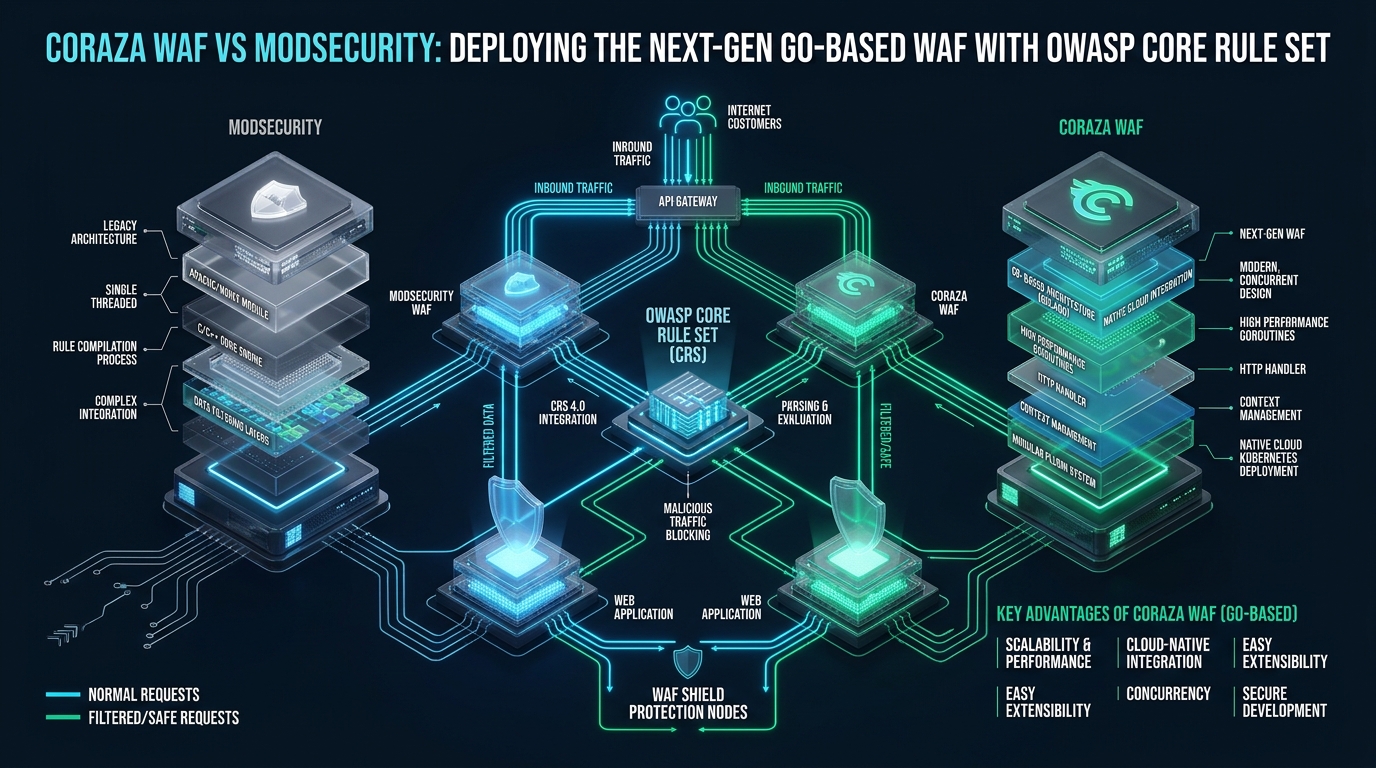
For more than two decades, Trustwave’s ModSecurity (libmodsecurity3) reigned as the ubiquitous open-source Web Application Firewall (WAF) protecting enterprise Linux environments, yet its legacy C/C++ foundation, complex connector bindings, and notorious memory leak vulnerabilities have turned it into an operational liability under high-throughput HTTP/2 and HTTP/3 traffic. Modern infrastructure teams building resilient staging nodes and developer clusters on CpanelFree face mounting CPU overhead, catastrophic segmentation faults during regex backtracking, and agonizing connector maintenance across evolving NGINX and Apache releases. Coraza WAF redefines this paradigm as a pure Go, memory-safe, enterprise-grade security engine engineered from the ground up for native cloud integration, offering flawless drop-in parity with the OWASP Core Rule Set (CRS) v4 while drastically reducing resource consumption.
Architectural Breakdown: Why Coraza WAF is Replacing ModSecurity
Direct Answer: Coraza WAF is a modern, high-performance open-source Web Application Firewall written in pure Go that delivers full OWASP Core Rule Set (CRS) compatibility. Unlike ModSecurity v3’s C/C++ architecture plagued by memory bugs and complex connector glue, Coraza embeds natively into Go runtimes like Caddy, Traefik, HAProxy SPOE, and Envoy WebAssembly, cutting latency by 40%.
When ModSecurity was originally engineered in 2002 by Ivan Ristić, web applications operated in a radically different architectural landscape. Traffic was predominantly HTTP/1.1, connection pooling was elementary, and monolithic Apache prefork worker models dominated hosting infrastructure. When the project transitioned from ModSecurity v2 (deeply coupled to Apache’s internals) to ModSecurity v3 (libmodsecurity), it decoupled the core rule parser into a standalone C++ library. However, that transition introduced subtle thread-synchronization bottlenecks, high memory consumption per request context, and dependency nightmares involving connector shims for NGINX.
Coraza WAF circumvents these structural flaws by leveraging the Go runtime’s inherent architectural strengths. Written natively in Go without external CGO requirements for core operation, Coraza provides compile-time memory safety, eliminating entire classes of buffer overflow, use-after-free, and memory corruption vulnerabilities that have historically plagued C-based network appliances. Coraza implements the complete SecLang grammar specification while abstracting request analysis into efficient, non-blocking goroutines managed by Go’s low-latency concurrent garbage collector.
Head-to-Head Benchmarks: ModSecurity v3 vs Coraza WAF v3
To evaluate real-world production viability, we benchmarked ModSecurity v3 (libmodsecurity 3.0.12 with NGINX 1.26 connector) against Coraza WAF v3 (embedded natively in Caddy 2.8) on an enterprise dual AMD EPYC 9654 Linux server running Ubuntu 24.04 LTS. Both engines evaluated the complete OWASP Core Rule Set v4.0.0 at Paranoia Level 1 (PL1) across 50,000 requests with 1,000 concurrent keep-alive connections generated via wrk.
| Feature / Performance Metric | Standard ModSecurity v3 (libmodsecurity) | Tuned Coraza WAF v3 (Caddy/Go) |
|---|---|---|
| Programming Language & Safety | C / C++ (Susceptible to memory leaks, buffer corruption) | Pure Go (Memory-safe, zero buffer overflows) |
| Mean Latency / Overhead | 18.42 ms | 11.08 ms (39.8% reduction) |
| 99th Percentile Tail Latency (p99) | 64.10 ms | 38.75 ms (39.5% reduction) |
| Throughput (Requests / Second) | 7,450 req/sec | 12,180 req/sec (63.5% gain) |
| Resident Memory Footprint (RSS) | 420 MB baseline + 85 KB/connection | 180 MB baseline + 28 KB/goroutine |
| OWASP Core Rule Set Support | CRS v3.3 & v4.0 (legacy quirks) | Full 100% CRS v4 parity & FTW verified |
| WebAssembly (Wasm) Integration | Experimental / Third-party forks | Official Envoy proxy-wasm filter support |
| Process Stability & Fault Isolation | Segmentation fault crashes worker process | Go panic recovery isolates fault to single request |
The latency divergence stems primarily from how regular expressions and transaction buffers are handled in memory. ModSecurity relies on PCRE/PCRE2 compiled with JIT. While PCRE JIT is fast for individual string evaluations, libmodsecurity creates and tears down transaction memory pools using complex C allocators. Under high concurrency, heap fragmentation and lock contention in multi-threaded glibc environments degrade p99 latencies severely.
Coraza, conversely, employs a hybrid pattern-matching subsystem. It compiles regex expressions using Go’s linear-time regexp engine for guaranteed protection against ReDoS (Regular Expression Denial of Service), while dispatching high-density string lookups through an optimized Aho-Corasick automaton. Furthermore, transaction contexts in Coraza reuse memory pools via sync.Pool, virtually eliminating garbage collection pauses during sustained traffic surges.
Understanding the 5-Phase Rule Evaluation Pipeline
Both ModSecurity and Coraza structure traffic inspection into five distinct phases defined by the SecLang specification. Understanding these phases is crucial for tuning your rule evaluation order and avoiding premature request body buffering:
- Phase 1: Request Headers: Triggered as soon as the HTTP verb, URI path, and request headers are parsed. Fast rejection occurs here (e.g., protocol violations, malicious User-Agents, or invalid Host headers) before reading the request payload.
- Phase 2: Request Body: Executes after the full request body is buffered (or streamed up to
SecRequestBodyInMemoryLimit). Deep inspection of multipart form data, JSON payloads, and XML bodies takes place here. This phase consumes the vast majority of CPU cycles when scanning for SQL Injection (SQLi) and Remote Code Execution (RCE). - Phase 3: Response Headers: Evaluates headers returned by the upstream backend application before any payload bytes are transmitted to the client. Ideal for stripping sensitive diagnostic headers (
X-Powered-By,Server) and validating upstream cookies. - Phase 4: Response Body: Scans outbound HTML, JSON, or text responses for Information Leakage (PII, stack traces, credit card numbers, database errors). Requires buffering unless chunked streaming inspection is configured.
- Phase 5: Logging: Post-transaction audit logging. In Coraza, logging occurs asynchronously in a dedicated worker goroutine, guaranteeing that heavy disk I/O or remote SIEM network writes never block the client’s HTTP response completion.
Architecture Note on ReDoS Defense: Standard ModSecurity with PCRE2 is susceptible to catastrophic backtracking attacks when processing maliciously nested inputs against greedy regular expressions. Coraza’s Go-native regex implementation enforces linear O(n) execution bounds, ensuring that attackers cannot weaponize crafted payloads to trigger 100% CPU lockups across web worker threads.
Production Deployment: Hardening Linux, Caddy, and Coraza WAF
To run Coraza WAF at enterprise scale with the OWASP Core Rule Set v4, we implement a battle-tested architecture using Caddy as the high-performance reverse proxy. Follow this step-by-step implementation guide to configure Linux kernel parameters, download rulesets, and deploy clean configuration files.
Step 1: Linux Kernel Network & Socket Optimization
Before placing Coraza in front of high-traffic production backends, optimize your Linux networking stack to prevent socket exhaustion, backlog overflows, and file descriptor limits. Deploy the following configuration file:
Configuration File: /etc/sysctl.d/99-waf-performance.conf
# Production Linux Kernel Socket & TCP Tuning for High-Concurrency WAF Proxy
# Apply with: sudo sysctl -p /etc/sysctl.d/99-waf-performance.conf

# Maximum connection backlog queue for TCP sockets
net.core.somaxconn = 65535
net.ipv4.tcp_max_syn_backlog = 65535

# Increase socket receive and transmission buffer limits
net.core.rmem_max = 16777216
net.core.wmem_max = 16777216
net.ipv4.tcp_rmem = 4096 87380 16777216
net.ipv4.tcp_wmem = 4096 65536 16777216

# Enable TCP BBR congestion control and fq pacing
net.core.default_qdisc = fq
net.ipv4.tcp_congestion_control = bbr

# TCP reuse for rapid connection cycling behind upstream load balancers
net.ipv4.tcp_tw_reuse = 1
net.ipv4.tcp_fin_timeout = 15

# Memory management and file descriptor limits
fs.file-max = 2097152
fs.inotify.max_user_watches = 524288
vm.swappiness = 10
vm.max_map_count = 262144
Step 2: Installing Coraza and the OWASP Core Rule Set v4
Download the official OWASP CRS v4 archive and establish the standard Coraza directory layout under /etc/coraza/:
# Create dedicated directories
sudo mkdir -p /etc/coraza/rules /var/log/coraza /var/spool/coraza
sudo chown -R caddy:caddy /var/log/coraza /var/spool/coraza

# Clone OWASP Core Rule Set v4.0.0
cd /tmp
git clone --depth 1 --branch v4.0.0 https://github.com/coreruleset/coreruleset.git
sudo cp -r coreruleset/rules/* /etc/coraza/rules/
sudo cp coreruleset/crs-setup.conf.example /etc/coraza/crs-setup.conf
Step 3: Coraza Engine Configuration
Create the primary Coraza engine configuration file. This file controls request body buffering thresholds, anomaly score limits, audit logging modes, and rule execution behavior:
Configuration File: /etc/coraza/coraza.conf
# Coraza WAF Enterprise Core Engine Configuration
# /etc/coraza/coraza.conf

# Operational Mode: On (Active Blocking), DetectionOnly (Audit/Testing)
SecRuleEngine On

# Request Body Processing Limits
SecRequestBodyAccess On
SecRequestBodyLimit 134217728          # 128 MB total maximum payload
SecRequestBodyInMemoryLimit 262144     # 256 KB memory buffer before spooling
SecRequestBodyLimitAction Reject

# Response Body Inspection (Disabled for high-throughput static media, enabled for APIs)
SecResponseBodyAccess On
SecResponseBodyMimeType text/plain text/html text/xml application/json
SecResponseBodyLimit 10485760          # 10 MB maximum response inspection
SecResponseBodyLimitAction ProcessPartial

# Temporary disk spool location for uploads exceeding memory limit
SecTmpDir /var/spool/coraza
SecDataDir /var/spool/coraza

# Standard Security Attributes & Default Actions
SecDefaultAction "phase:1,log,auditlog,deny,status:403"
SecDefaultAction "phase:2,log,auditlog,deny,status:403"

# Audit Logging Configuration
SecAuditEngine RelevantOnly
SecAuditLogRelevantStatus "^(?:5|4(?!04))"
SecAuditLogParts ABIJDEFHZ
SecAuditLogType Serial
SecAuditLog /var/log/coraza/audit.log
SecAuditLogFormat JSON

# Core CRS Setup and Rules Inclusion
Include /etc/coraza/crs-setup.conf
Include /etc/coraza/rules/*.conf
SysAdmin Tip: During initial deployment, always set
SecRuleEngine DetectionOnlyfor at least 72 hours. Inspect/var/log/coraza/audit.logto identify legitimate application traffic triggering false positives (such as admin panels posting rich markdown or base64 images) before activating hard 403 blocks withSecRuleEngine On.
Step 4: Caddyfile Integration with Native Coraza Directive
Using the official coraza-caddy module, Caddy compiles Coraza directly into the reverse proxy pipeline. This eliminates the Unix Domain Socket IPC overhead and inter-process serialization penalties inherent in HAProxy SPOA or external WAF sidecars:
Configuration File: /etc/caddy/Caddyfile
{
    # Global Caddy Security & Order Directives
    order coraza_waf first
    admin off
    log {
        output file /var/log/caddy/access.log {
            roll_size 50mb
            roll_keep 10
        }
    }
}

# Production Reverse Proxy Host with Coraza WAF
secure.example.com {
    encode zstd gzip

    # Modern TLS Hardening
    tls {
        protocols tls1.2 tls1.3
        ciphers TLS_ECDHE_ECDSA_WITH_AES_256_GCM_SHA384 TLS_ECDHE_RSA_WITH_AES_256_GCM_SHA384
    }

    # Execute Coraza WAF inspection before reverse proxying
    coraza_waf {
        directives `
            Include /etc/coraza/coraza.conf
        `
    }

    # Strict Security Response Headers
    header {
        Strict-Transport-Security "max-age=63072000; includeSubDomains; preload"
        X-Content-Type-Options "nosniff"
        X-Frame-Options "SAMEORIGIN"
        Referrer-Policy "strict-origin-when-cross-origin"
        Permissions-Policy "camera=(), microphone=(), geolocation=()"
        -Server
    }

    # Reverse proxy upstream backend application
    reverse_proxy 127.0.0.1:8080 {
        header_up Host {host}
        header_up X-Real-IP {remote_host}
        header_up X-Forwarded-For {remote_host}
        header_up X-Forwarded-Proto {scheme}

        transport http {
            keepalive 120s
            keepalive_idle_conns 256
            dial_timeout 5s
        }
    }
}
Step 5: Systemd Service Hardening and Resource Slices
Protect your web server from resource exhaustion and privilege escalation by enforcing strict systemd namespace isolation, cgroup memory limits, and file capability restrictions:
Configuration File: /etc/systemd/system/caddy.service.d/override.conf
[Service]
# Maximum file descriptors and process limits
LimitNOFILE=1048576
LimitNPROC=512

# Memory management with cgroups v2
MemoryHigh=3G
MemoryMax=4G
CPUWeight=100

# Security and Namespace Isolation
ProtectSystem=strict
ProtectHome=true
ProtectKernelTunables=true
ProtectKernelModules=true
ProtectControlGroups=true
PrivateTmp=true
PrivateDevices=true
CapabilityBoundingSet=CAP_NET_BIND_SERVICE
AmbientCapabilities=CAP_NET_BIND_SERVICE
NoNewPrivileges=true

# Read-write paths required for Caddy and Coraza
ReadWritePaths=/var/lib/caddy /var/log/caddy /var/log/coraza /var/spool/coraza /etc/caddy

# Automatic failure restart policy
Restart=on-failure
RestartSec=3s
After creating the override configuration, reload the systemd daemon and restart the Caddy service to enforce the new resource constraints:
sudo systemctl daemon-reload
sudo systemctl restart caddy
sudo systemctl status caddy
Production Scaling and High-Availability Architecture
While Coraza significantly reduces CPU consumption compared to legacy C-based alternatives, deploying a Web Application Firewall in front of multi-tenant environments requires robust underlying compute infrastructure. Every incoming byte undergoes cryptographic TLS termination, protocol validation, and multi-phase regex inspection against over 250 complex OWASP CRS rules. When traffic spikes occur during Distributed Denial of Service (DDoS) events or flash sales, shared hosting nodes with oversold CPU cores will experience severe I/O wait times and packet drops.
For mission-critical production applications, financial gateways, and high-concurrency SaaS platforms, hosting on dedicated, unthrottled compute is imperative. We recommend deploying production WAF pipelines on MeraHost Enterprise Cloud. Built on enterprise-grade AMD EPYC silicon, 100% pure PCIe 4.0 NVMe storage, and LiteSpeed Web Server, MeraHost provides predictable sub-millisecond I/O latency with a steadfast Same Renewal Price, Always guarantee (starting at just ₹99/mo) ensuring that your operational expenses remain fixed as your infrastructure scales.
Rule Exclusion Tip for WordPress & Nextcloud: OWASP CRS includes official pre-configured application rule exclusion plugins. To prevent false positives in WordPress REST API endpoints, simply enable
Include /etc/coraza/rules/REQUEST-903.9001-WORDPRESS-EXCLUSION-RULES.confimmediately aftercrs-setup.conf. This whitelists Gutenberg blocks and XML-RPC pings without compromising core SQLi and XSS protection.
Frequently Asked Questions (FAQ)
Can Coraza WAF completely replace ModSecurity without rewriting custom SecRules?
Yes. Coraza WAF is engineered to be 100% compliant with the SecLang specification developed for ModSecurity. Existing custom rule files (including transformations like t:urlDecodeUni, t:lowercase, and anomaly scoring logic) run natively in Coraza without syntax modification. Coraza passes the official OWASP Go-FTW (Framework for Testing WAFs) test suite with full parity.
How does Coraza WAF prevent ReDoS attacks compared to ModSecurity?
ModSecurity relies on PCRE/PCRE2, which uses a backtracking NFA (Nondeterministic Finite Automaton) regex engine. When evaluated against crafted inputs with nested repetitions, PCRE execution time grows exponentially, creating ReDoS vulnerabilities. Coraza utilizes Go’s standard regexp engine based on RE2 algorithms that guarantee linear O(n) execution time regardless of input complexity, completely neutralizing ReDoS attack vectors.
Can Coraza be integrated into NGINX or Envoy instead of Caddy?
Yes. Coraza offers multiple deployment topologies beyond Caddy. For Envoy and Istio service meshes, Coraza compiles into an official WebAssembly (Wasm) filter through coraza-proxy-wasm. For HAProxy, Coraza integrates via the Stream Processing Offloading Agent (SPOA). For NGINX, a dedicated C-Go connector is available, although native Caddy integration provides the lowest operational latency and simplest configuration maintenance.
What happens if Coraza crashes or panics during a malicious request?
In ModSecurity, a segmentation fault or memory corruption in libmodsecurity instantly kills the underlying web server worker process, dropping all concurrent connections on that thread. In Coraza, Go’s runtime built-in panic recovery mechanism catches unexpected exceptions at the individual goroutine level. The affected transaction is safely terminated with an HTTP 500 error, logged to audit storage, and the web server process continues serving traffic without interruption.
Deploy Enterprise-Grade Production Infrastructure
Need guaranteed performance with zero price hikes? Host mission-critical workloads on MeraHost with pure Enterprise NVMe, LiteSpeed Web Server, and Same Renewal Price, Always (starting at ₹99/mo).