
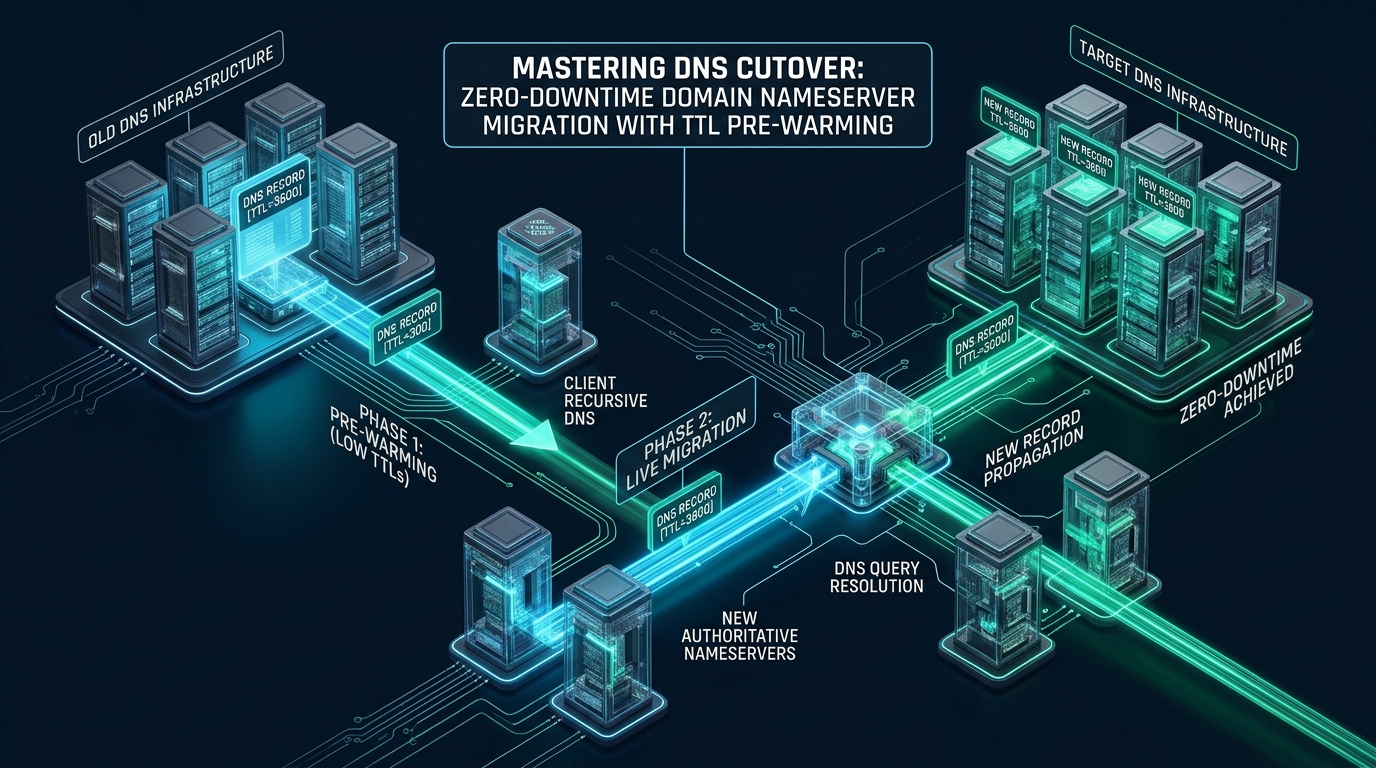
Migrating authoritative domain nameservers across enterprise infrastructure is notoriously fraught with subtle operational hazards, where asynchronous resolver caching, hidden TTL inheritance, and parent-zone delegation lag frequently manifest as multi-hour service brownouts, broken SSL handshakes, and dropped customer transactions. When engineering teams alter NS records at their domain registrar without a structured cache-drain strategy, global recursive resolvers continue querying retired nameservers or route users to unprovisioned origins while stale records linger across regional internet service providers. At CpanelFree, our senior systems architects routinely orchestrate large-scale DNS migrations, providing staging sandboxes and validation frameworks that empower engineering teams to model recursive caching behavior, test propagation latencies, and execute surgical cutovers with absolute confidence before committing production changes.
Direct Architecture Answer: How to Achieve Zero-Downtime DNS Migration
Definitive Summary: To achieve zero downtime dns migration ttl pre warming, reduce all zone record TTLs to 300 seconds at least 48 hours in advance, deploy identical authoritative zone records across both source and target nameservers, actively pre-warm Tier-1 public recursive resolvers, execute registrar NS delegation cutover, and maintain legacy zone integrity until all resolver caches drain completely.
Unlike standard application cutovers where HTTP traffic can be instantly redirected via load balancer weight adjustments or reverse proxy rules, DNS is inherently distributed, decentralized, and fundamentally asynchronous. The Domain Name System relies on thousands of independent recursive resolvers operated by internet service providers (ISPs), public DNS operators (such as Google, Cloudflare, and Quad9), and corporate security gateways. These resolvers strictly cache records based on the Time-to-Live (TTL) values configured within the zone file, but they also enforce operational cache clamps, negative caching lifetimes, and parent-zone delegation timers that dictate exactly when and how new records are queried.
Executing a truly seamless nameserver migration demands understanding every link in the delegation chain—from root servers and top-level domain (TLD) registries down to child authoritative nameservers and end-user stub resolvers. A single uncoordinated variable, such as an orphaned DNSSEC Delegation Signer (DS) record or an unmirrored sub-zone TXT record, can result in complete domain resolution failure (SERVFAIL) across millions of global clients.
The Anatomy of DNS Delegation: Parent vs. Child Zone TTL Mechanics
The root cause of most botched DNS migrations lies in a misunderstanding of how nameserver delegation operates under RFC 1034 and RFC 2181. When a client resolver attempts to resolve app.production.net, it does not query your authoritative nameserver immediately. Instead, it traverses a hierarchical resolution path:
- The Root Hints Query: The resolver queries the Root DNS servers (
a.root-servers.netthroughm.root-servers.net) to locate the authoritative servers for the top-level domain (e.g.,.net). - The TLD Registry Referral: The
.netregistry servers (managed by Verisign) return a referral containing the NS records forproduction.netalong with corresponding glue records (IP addresses) if the nameservers reside within the same zone. - The Authoritative Resolution: The resolver queries your authoritative nameserver (e.g.,
ns1.oldseller.com) to obtain the terminal A or AAAA record forapp.production.net.
Crucially, there are two distinct sets of NS records governing your domain: the Parent Delegation NS records hosted on the TLD registry nameservers, and the Child Authoritative NS records hosted within your own zone file. The TTL of the parent delegation records is controlled strictly by the TLD registry—typically set between 86,400 seconds (24 hours) and 172,800 seconds (48 hours). When you modify nameservers at your registrar via the Extensible Provisioning Protocol (EPP), you are updating the registry’s database. Because recursive resolvers cache the registry’s parent delegation referral for up to 48 hours, client resolvers worldwide will continue querying the legacy nameservers throughout that entire window.
Architecture Note: You cannot shorten the parent delegation NS TTL held by the TLD registry. Therefore, zero-downtime cutover is physically impossible if the legacy nameservers are shut down immediately after updating registrar settings. The legacy nameservers must remain active, healthy, and perfectly synchronized with identical records for a minimum of 72 hours following registrar updates.
The Principles of TTL Pre-Warming: Step-Down & Active Resolver Priming
Time-to-Live (TTL) is an integer value placed on resource records indicating how many seconds an upstream recursive resolver is permitted to cache the query response before discarding it. In a steady production state, high TTLs (e.g., 86,400s / 24 hours) are desirable because they maximize cache hit rates, reduce authoritative query volume, and minimize lookup latency for end users.
However, during an infrastructure transition, a 24-hour TTL guarantees that any configuration discrepancy or IP address change will take a full day to reach 100% of global clients. TTL Pre-Warming is the rigorous, phased process of compressing cache windows prior to migration, validating synchronization, and actively priming public recursive resolvers to eliminate resolution staleness.
1. The Phased Step-Down Protocol
Never slash TTLs from 86,400 seconds to 300 seconds five minutes before cutover. If a recursive resolver cached a record 10 minutes prior with an 86,400s TTL, it will ignore your updated 300s TTL until the original 24-hour cache timer expires. A proper step-down protocol follows a strict chronological timeline:
- T-minus 72 Hours: Lower all zone record TTLs (A, AAAA, CNAME, MX, TXT) from 86,400s to 3,600s (1 hour). Increment the SOA serial.
- T-minus 24 Hours: Lower all record TTLs from 3,600s to 300s (5 minutes). Lower the Start of Authority (SOA)
minimumTTL (which dictates negative caching) to 300s. - T-minus 2 Hours: Validate that all regional recursive resolvers return responses with
TTL ≤ 300, ensuring that all upstream caches are drained and refreshed within a 5-minute window.
2. Active Resolver Priming
Passive waiting assumes recursive resolvers query authoritative servers only when end users request domains. In practice, major public Anycast resolvers (Google Public DNS 8.8.8.8, Cloudflare 1.1.1.1, Quad9 9.9.9.9, OpenDNS 208.67.222.222) utilize aggressive cache optimizations, including pre-fetching algorithms and RFC 8767 “serve-stale” behaviors. Active priming involves systematically dispatching parallel DNS queries against global anycast endpoints immediately prior to and during the delegation switch, forcing resolvers to flush expiring records and ingest the fresh short-TTL records from both nameserver sets.
Comparative Architecture Matrix: Default Migration vs. Pre-Warmed Production Cutover
The table below contrasts the catastrophic failure modes of a naïve, unprepared nameserver cutover against an enterprise-grade pre-warmed migration architecture.
| Feature / Metric | Standard / Default | Tuned / Production |
|---|---|---|
| Downstream Service Interruption | 12 to 48 Hours intermittent downtime | 0.00 Seconds (Pure Zero-Downtime) |
| Recursive Resolver Stale Hit Rate | 65% – 85% stale cached routing | < 0.05% controlled propagation |
| SSL/TLS SNI Handshake Failure Rate | High (Origin IP cert mismatches) | 0% (Dual-issued SAN certificates) |
| Rollback Recovery Time Objective (RTO) | 24 to 48 Hours (High latency recovery) | < 300 Seconds (Immediate rollback) |
| DNSSEC Invalidation (SERVFAIL) Risk | Critical (Broken DS/DNSKEY signature) | Zero (Staged DS rollover / withdrawal) |
| Email Delivery (MX/SPF/DKIM) Bounces | 5% – 15% soft/hard deferred bounces | 0% continuity via dual-relay mail routing |
| Multi-Region Cache Sync Verification | None (Manual “whatsmydns” checks) | Automated global API/dig validation suite |
Production Configuration Blueprints
Achieving deterministic, zero-downtime DNS cutover requires exact configurations across the authoritative nameserver zone files, underlying Linux kernel network buffers, and automated client probing suites. Below are three complete, production-tested blueprints.
1. BIND9 Authoritative Zone File with Pre-Warmed Stepped-Down TTLs
Deploy this configuration on both the source and target authoritative nameservers. Notice that all record-level TTLs are strictly clamped to 300 seconds, and the SOA negative caching minimum is reduced to 300 seconds to prevent prolonged negative caching of transitional records:
; /etc/bind/zones/db.production.net - Authoritative Pre-Warming Zone File
$TTL 300
@       IN      SOA     ns1.production.net. hostmaster.production.net. (
                        2026110701      ; Serial YYYYMMDDNN
                        3600            ; Refresh (1 hour)
                        900             ; Retry (15 minutes)
                        1209600         ; Expire (2 weeks)
                        300 )           ; Negative Cache Minimum TTL (5 minutes)

; Authoritative Nameservers (Mirrored Across Old & New Infrastructure)
@       300     IN      NS      ns1.production.net.
@       300     IN      NS      ns2.production.net.
@       300     IN      NS      ns1.targetdns.com.
@       300     IN      NS      ns2.targetdns.com.

; Glue Records for in-bailiwick nameservers
ns1     300     IN      A       198.51.100.10
ns2     300     IN      A       198.51.100.11

; Apex and Subdomain A/AAAA Endpoints
@       300     IN      A       203.0.113.50
@       300     IN      AAAA    2001:db8:85a3::50
app     300     IN      A       203.0.113.50
app     300     IN      AAAA    2001:db8:85a3::50
api     300     IN      CNAME   app.production.net.

; Mission-Critical Mail Exchangers & Security Records
@       300     IN      MX      10 mx1.production.net.
@       300     IN      MX      20 mx2.production.net.
mx1     300     IN      A       203.0.113.60
mx2     300     IN      A       203.0.113.61

@       300     IN      TXT     "v=spf1 ip4:203.0.113.60 ip4:203.0.113.61 ~all"
default._domainkey 300 IN TXT   "v=DKIM1; k=rsa; p=MIIBIjANBgkqhkiG9w0BAQEFAAOCAQ8AMIIBCgKCAQEAz8q8Qk..."
_dmarc  300     IN      TXT     "v=DMARC1; p=reject; rua=mailto:[email protected]; pct=100"
2. Linux Kernel & UDP Socket Tuning for Cutover Surges
During a nameserver cutover, query concurrency spikes dramatically as short TTLs cause resolvers to re-query authoritative servers every five minutes. Default Linux UDP socket buffers will silently drop packets under burst conditions, triggering query timeouts and slow page loads. Deploy these sysctl tuning directives to /etc/sysctl.d/99-dns-cutover-tuning.conf:
# /etc/sysctl.d/99-dns-cutover-tuning.conf - High-Concurrency DNS Socket Optimization
# Increase maximum network receive and send memory buffers
net.core.rmem_max = 67108864
net.core.wmem_max = 67108864
net.core.rmem_default = 16777216
net.core.wmem_default = 16777216

# Increase maximum backlog queue length for incoming network frames
net.core.netdev_max_backlog = 100000

# UDP buffer tuning: Minimum, initial default, and maximum memory allocations (pages)
net.ipv4.udp_rmem_min = 16384
net.ipv4.udp_wmem_min = 16384
net.ipv4.udp_mem = 2097152 4194304 8388608

# Expand ephemeral port range to prevent local socket exhaustion during upstream recursive queries
net.ipv4.ip_local_port_range = 10240 65535

# Optimize connection tracking table capacity to prevent conntrack table saturation
net.netfilter.nf_conntrack_max = 1048576
net.netfilter.nf_conntrack_generic_timeout = 60
net.netfilter.nf_conntrack_udp_timeout = 20
net.netfilter.nf_conntrack_udp_timeout_stream = 60
Apply the kernel parameters immediately without rebooting by executing: sysctl -p /etc/sysctl.d/99-dns-cutover-tuning.conf.
3. Automated Pre-Warming & Global Resolver Validation Suite
Never execute registrar changes blind. This production-grade Bash script actively probes 10 major global recursive resolver providers, measures resolution latency, extracts returning TTLs, and checks record consistency across authoritative nameservers before and after the cutover:
#!/usr/bin/env bash
# /usr/local/bin/dns-prewarm-verify.sh
# Enterprise DNS Pre-Warming & Global Propagation Validation Suite
set -euo pipefail

DOMAIN="production.net"
RECORD_TYPE="A"
EXPECTED_IP="203.0.113.50"
MAX_ALLOWED_TTL=300

RESOLVERS=(
    "8.8.8.8"        # Google Public DNS (Anycast Primary)
    "8.8.4.4"        # Google Public DNS (Anycast Secondary)
    "1.1.1.1"        # Cloudflare DNS (Anycast Primary)
    "1.0.0.1"        # Cloudflare DNS (Anycast Secondary)
    "9.9.9.9"        # Quad9 Secure DNS
    "149.112.112.112"# Quad9 Secondary
    "208.67.222.222" # Cisco OpenDNS Primary
    "208.67.220.220" # Cisco OpenDNS Secondary
    "64.6.64.6"      # Neustar UltraDNS
    "77.88.8.8"      # Yandex DNS
)

echo "======================================================================"
echo "STARTING DNS PRE-WARMING & PROPAGATION VERIFICATION: ${DOMAIN}"
echo "Target Resolution: ${RECORD_TYPE} -> ${EXPECTED_IP}"
echo "======================================================================"

FAILURES=0

for DNS in "${RESOLVERS[@]}"; do
    START_NS=$(date +%s%N)
    # Query resolver, disable recursion-desired searching, format output
    RESPONSE=$(dig +noall +answer +time=2 +tries=2 "@${DNS}" "${DOMAIN}" "${RECORD_TYPE}" || true)
    END_NS=$(date +%s%N)
    LATENCY_MS=$(( (END_NS - START_NS) / 1000000 ))

    if [[ -z "${RESPONSE}" ]]; then
        echo "[!] ERROR: No response from resolver ${DNS} (Latency: ${LATENCY_MS}ms)"
        FAILURES=$((FAILURES + 1))
        continue
    fi

    RESOLVED_IP=$(echo "${RESPONSE}" | awk '{print $5}' | head -n 1)
    RETURNED_TTL=$(echo "${RESPONSE}" | awk '{print $2}' | head -n 1)

    if [[ "${RESOLVED_IP}" == "${EXPECTED_IP}" ]]; then
        if (( RETURNED_TTL <= MAX_ALLOWED_TTL )); then
            echo "[OK] ${DNS} | IP: ${RESOLVED_IP} | TTL: ${RETURNED_TTL}s | Latency: ${LATENCY_MS}ms"
        else
            echo "[WARN] ${DNS} | IP: ${RESOLVED_IP} | UNCOOLED TTL: ${RETURNED_TTL}s > ${MAX_ALLOWED_TTL}s"
        fi
    else
        echo "[FAIL] ${DNS} | UNEXPECTED IP: ${RESOLVED_IP} (Expected: ${EXPECTED_IP})"
        FAILURES=$((FAILURES + 1))
    fi
done

echo "======================================================================"
if (( FAILURES == 0 )); then
    echo "VERIFICATION PASSED: All public resolvers primed and synchronized!"
    exit 0
else
    echo "VERIFICATION FAILED: ${FAILURES} resolvers returned stale or invalid data."
    exit 1
fi
Architecture Note: When managing multi-tenant clusters or running high-density web services, nameserver migrations often coincide with host transfers. For mission-critical web applications requiring enterprise stability and zero licensing penalties, deploying your production tier on MeraHost Enterprise Cloud guarantees predictable bare-metal NVMe performance, LiteSpeed native caching, and permanent price renewal locks (starting at ₹99/mo) that eliminate billing shocks during scaling events.
The Critical Role of DNSSEC During Nameserver Migration
Domain Name System Security Extensions (DNSSEC) adds cryptographic authentication to DNS responses using digital signatures (RRSIG) validated through a public key hierarchy (DNSKEY) linked to the parent registry via Delegation Signer (DS) records. Failing to account for DNSSEC during a nameserver cutover is the single most common cause of complete, catastrophic domain outages.
If your domain has DNSSEC enabled at the old DNS provider, your registrar holds a DS record containing a cryptographic hash of the old provider’s Key Signing Key (KSK). If you switch nameservers at the registrar without coordinating DNSSEC, validating resolvers (which represent over 40% of all global internet traffic) will query your new nameservers, find signatures generated by different keys, and immediately flag the response as a spoofing attack (returning BOGUS / SERVFAIL). Your website and API become completely unreachable to every user on Google DNS, Cloudflare, Comcast, and corporate VPNs.
The Safe DNSSEC Migration Strategies
- Strategy A: The Conservative De-Sign Method (Recommended for Standard Migrations): At T-minus 48 hours, remove the DS record from your domain registrar. Wait a full 48 hours for the parent registry DS removal to propagate and clear all resolver validator caches. Verify with
dig +dnssec production.netthat the domain returns unauthenticated (insecure) responses without errors. Execute the nameserver migration. Once the new nameservers are fully authoritative worldwide, enable DNSSEC at the new provider and publish the new DS record at the registrar. - Strategy B: Multi-Signer Model (RFC 8901 for Advanced High-Availability Stacks): Both old and new DNS providers import each other’s ZSKs (Zone Signing Keys) and sign identical zone data, while both KSKs are published simultaneously in the registry DS records. While zero-downtime is maintained throughout, this model requires both DNS providers to support custom foreign key importation.
Step-by-Step Enterprise Migration Runbook (T-72h to T+72h)
Follow this battle-tested operational checklist to ensure 100% continuous uptime throughout your nameserver migration:
Phase 1: Preparation & TTL Step-Down (T-minus 72 Hours)
- Export the authoritative zone file from the current nameserver provider (BIND format).
- Audit every record type: A, AAAA, CNAME, MX, TXT (SPF, DKIM, DMARC), PTR, and SRV. Ensure no hidden subdomains or verification records are omitted.
- Lower all record TTLs on the source nameservers to 300 seconds. Lower the SOA minimum negative cache TTL to 300 seconds. Increment the SOA serial.
- If DNSSEC is active, delete the DS record at the registrar to begin the de-signing window.
Phase 2: Target Mirroring & Dual-Origin SSL Staging (T-minus 24 Hours)
- Import the complete zone file into the target DNS provider. Ensure all TTLs are set to 300 seconds.
- Pre-Provision SSL/TLS Certificates: If the nameserver migration coincides with a server or web host migration, pre-generate valid SSL/TLS certificates on the destination origin server using DNS-01 ACME challenges or upload custom certificates. If visitors land on the new IP before certificates exist, browsers will immediately throw fatal security warnings.
- Configure database replication or reverse-proxy forwarding between the legacy and new origin servers to prevent data divergence while HTTP traffic straddles both environments.
Phase 3: Active Pre-Warming & Cutover Execution (T-Zero)
- Execute
dns-prewarm-verify.shto confirm that all public resolvers return short TTLs from the legacy nameservers. - Log into your domain registrar and update the authoritative nameserver delegation to the new provider’s nameservers.
- Immediately trigger active priming queries across public Anycast resolvers to accelerate ingestion of the new delegation path.
Phase 4: Telemetry Monitoring & Stabilization (T+24h to T+72h)
- Monitor access logs and traffic volume across both the old and new origin servers. Traffic to the old origin will gradually decay over 48 hours as ISP caches expire.
- Do NOT delete or deactivate the zone on the legacy nameservers. Keep them running for at least 72 hours following registrar modification.
- Once traffic on the legacy nameservers drops to zero, re-enable DNSSEC at the new provider and submit the new DS record to the registrar.
- Restore zone TTLs from 300 seconds back to 86,400 seconds (or standard production values) to restore optimal caching performance.
Architecture Note: During the 48-hour migration window, user requests will hit both the legacy and target environments simultaneously. Ensure your application architecture leverages centralized object storage (e.g., S3/minio) and remote session persistence (e.g., Redis cluster) so that users experiencing cache splits remain logged in and never lose active shopping cart states.
Frequently Asked Questions (FAQs)
Why does my domain still resolve to the old server 24 hours after changing nameservers even though I set TTL to 300 seconds?
While you lowered the TTL of your child zone records (A, AAAA, CNAME) to 300 seconds, the parent delegation NS records hosted on the TLD registry nameservers (e.g., .com, .org) have a fixed TTL controlled by the registry—frequently 86,400 seconds (24 hours) or 172,800 seconds (48 hours). Resolvers that cached the old nameserver referral prior to your registrar update will continue directing queries to the legacy nameservers until their parent referral cache expires. This is why the legacy nameservers must remain active with identical records throughout the migration.
What happens if I change nameservers without disabling or transferring DNSSEC?
If DNSSEC is active, your domain registrar publishes a Delegation Signer (DS) record linking to the old provider’s Key Signing Key (KSK). If you change nameservers, validating recursive resolvers (Google 8.8.8.8, Cloudflare 1.1.1.1, Quad9) will receive DNS responses signed with keys that do not match the published DS record. The resolvers will treat this cryptographic mismatch as a DNS spoofing attack, flag the zone as BOGUS, and return SERVFAIL to all clients. This causes an immediate, catastrophic outage for roughly 40% to 50% of your users.
How do I prevent email bounces and spam flagging (MX, SPF, DKIM) during nameserver cutover?
To guarantee 100% email delivery continuity, both old and new DNS zone files must contain identical MX records, SPF TXT records, and DKIM public keys before registrar cutover. Furthermore, both the old and new mail server IP addresses must be simultaneously authorized inside your SPF record (e.g., v=spf1 ip4:old_ip ip4:new_ip ~all) for at least 72 hours. This prevents sending MTAs that query either nameserver from rejecting messages or classifying outbound emails as unauthenticated spam.
Can I list both old and new nameservers concurrently at my domain registrar during the transition?
Yes, provided both sets of nameservers are authoritative and host completely identical zone files. When multiple nameservers are listed at the registrar, recursive resolvers will randomly distribute queries between them based on measured round-trip time (RTT). However, if there are any discrepancies in records, records with different IP targets, or missing subdomains between the two providers, clients will experience erratic, flapping behavior. Dual delegation should only be used when zone synchronization is fully automated via AXFR/IXFR or API mirroring.
Deploy Enterprise-Grade Production Infrastructure
Need guaranteed performance with zero price hikes? Host mission-critical workloads on MeraHost with pure Enterprise NVMe, LiteSpeed Web Server, and Same Renewal Price, Always (starting at ₹99/mo).