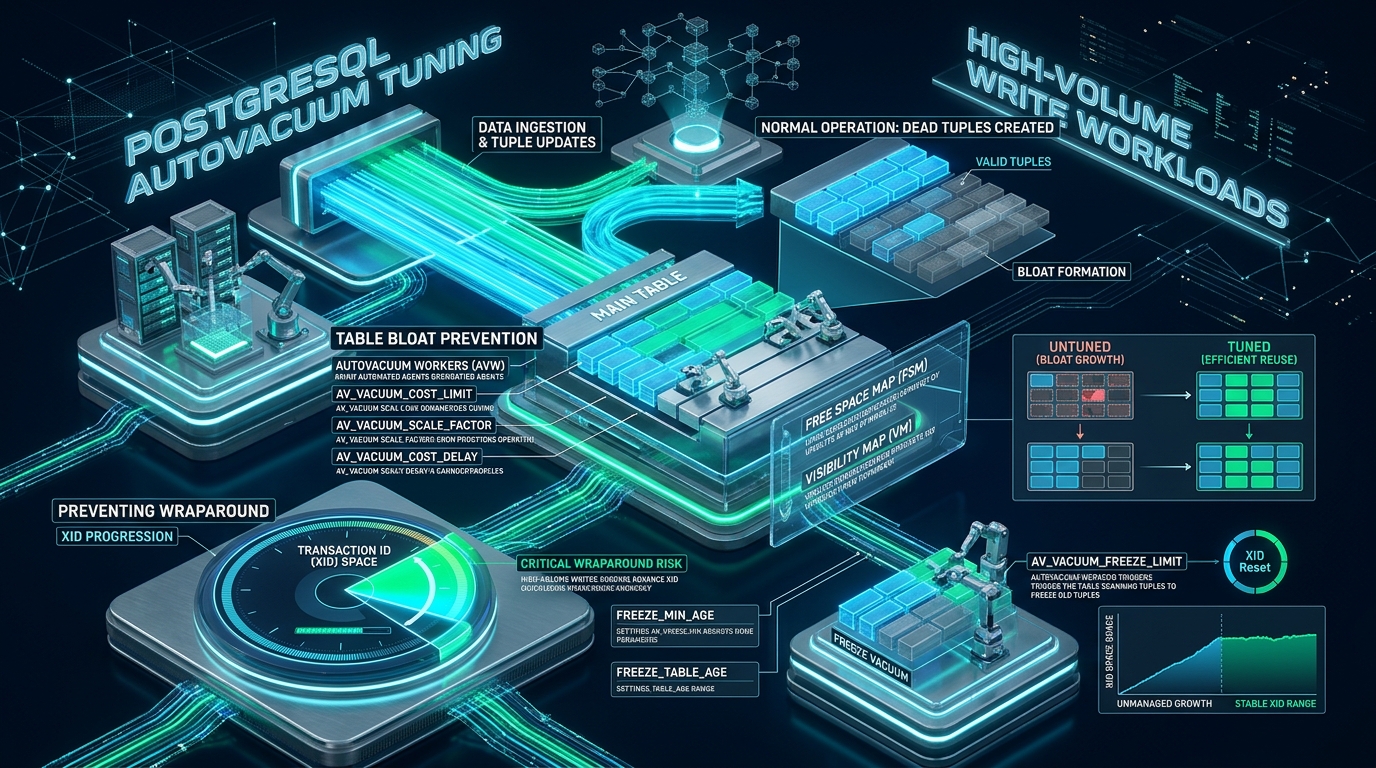
Under relentless write and update traffic, PostgreSQL’s Multi-Version Concurrency Control (MVCC) architecture continuously generates dead tuple versions that degrade shared buffers, bloat B-Tree indexes, and exhaust disk subsystems. At CpanelFree, our Linux systems engineering teams routinely troubleshoot production clusters where default autovacuum configurations throttle maintenance workers down to single-digit megabytes per second, precipitating catastrophic query degradation and emergency database freezes from Transaction ID (XID) wraparound. Preventing these cascading failures requires an aggressive, hardware-aligned autovacuum tuning strategy calibrated for modern NVMe storage, multi-core CPU topologies, and write-heavy relational schemas.
PostgreSQL Autovacuum Tuning: Preventing Bloat and Wraparound in Write-Heavy Systems
Direct Answer: PostgreSQL autovacuum prevents table bloat and transaction ID wraparound by cleaning dead tuples and freezing transaction IDs. For write-heavy workloads, default settings throttle autovacuum too aggressively. Increasing autovacuum_vacuum_cost_limit to 2000–5000, reducing vacuum_cost_delay to 2ms, lowering scale factors (0.02–0.05), and dedicating per-table autovacuum workers prevents catastrophic database degradation.
PostgreSQL’s MVCC design guarantees high concurrency without read-write locking conflicts by treating every SQL UPDATE as a dead tuple mark followed by an INSERT of a new physical row version. When client applications execute millions of write transactions daily—such as session tracking, audit logs, order queues, and high-velocity IoT telemetry—the database generates billions of obsolete dead tuples. Without rapid, non-blocking cleanup, tables expand uncontrollably, index traversal depths balloon, and query execution plans degrade from index-assisted lookups into sluggish, multi-gigabyte sequential table scans.
Even more hazardous than disk bloat is the threat of Transaction ID (XID) exhaustion. PostgreSQL utilizes a 32-bit transaction counter offering approximately 4.29 billion transaction IDs. Because transaction comparison relies on circular modulo-2^31 arithmetic, the database engine must systematically freeze past transaction IDs to maintain past-versus-future visibility. If write-heavy tables evade freezing due to conservative autovacuum thresholds, the transaction counter approaches the hard 2-billion limit. When this threshold is crossed, PostgreSQL enters an emergency read-only shutdown mode to prevent silent data corruption, taking downstream services offline until an intensive standalone manual vacuum completes.
The Anatomy of MVCC: Dead Tuples, Heap-Only Tuples (HOT), and Vacuum Mechanics
To calibrate autovacuum parameters effectively, database administrators must understand the physical storage layer of PostgreSQL pages (8KB relational blocks). Each page contains a page header, item line pointers (ItemId), and row data (HeapTupleHeader and attributes) growing from the bottom up. When a transaction modifies an existing record, the engine creates a new tuple with an updated xmin (creation transaction ID) and updates the old tuple’s xmax (deletion/modification transaction ID).
Under ideal conditions, PostgreSQL leverages Heap-Only Tuples (HOT) optimization. When an UPDATE statement modifies non-indexed columns and the current 8KB block possesses sufficient free space, the engine stores the updated row on the same page and establishes an internal pointer chain. Because index entries still point to the root line pointer, no index updates are required. However, in write-heavy environments with default 100% table fillfactors or updates that touch indexed fields, HOT optimization fails entirely. Every row update forces new index pointers across all indexes on the table, creating massive index bloat that standard sequential vacuuming cannot easily reclaim.
Architecture Note: When HOT optimization fails, index bloat outpaces table bloat by a factor of 3x to 5x. While table vacuuming reclaims dead space inside 8KB heap pages for subsequent inserts, B-Tree indexes cannot freely reallocate page space across branches. Proactively lowering table
fillfactorto 80%–85% on write-heavy tables provides the necessary headroom for in-page HOT chains, completely bypassing index modification overhead.
The Cost-Based Vacuum Delay Bottleneck
Autovacuum runs in the background as a cost-throttled process to protect transactional workloads from I/O starvation. During execution, autovacuum incurs synthetic cost points for every disk and cache operation:
- vacuum_cost_page_hit (Default: 1): Block already resident in PostgreSQL
shared_buffers. - vacuum_cost_page_miss (Default: 2): Block must be fetched from OS page cache or disk.
- vacuum_cost_page_dirty (Default: 20): Block modified and marked dirty for write-back.
Once cumulative operational cost reaches autovacuum_vacuum_cost_limit, the worker sleeps for autovacuum_vacuum_cost_delay. Under historical defaults (limit = 200, delay = 20ms in PostgreSQL 11 and older, or 2ms in newer versions), autovacuum is restricted to cleaning roughly 10 MB/s to 40 MB/s of data. On modern enterprise servers equipped with NVMe drives capable of 3,500+ MB/s sequential writes and 500,000 IOPS, this artificial throttle causes dead tuple generation to outpace cleanup capacity by two orders of magnitude.
Comprehensive Performance & Latency Matrix
The comparative matrix below contrasts default PostgreSQL autovacuum parameters against an enterprise production configuration tuned for high-throughput write workloads on dedicated hardware.
| Feature / Metric | Standard / Default | Tuned / Production |
|---|---|---|
| Autovacuum Workers (autovacuum_max_workers) | 3 workers | 6 – 10 dedicated workers |
| Cost Limit (autovacuum_vacuum_cost_limit) | 200 (shared across all workers) | 2000 – 5000 (worker-specific) |
| Cost Sleep Delay (autovacuum_vacuum_cost_delay) | 2 ms | 0 ms – 2 ms (NVMe unthrottled) |
| Vacuum Scale Factor (autovacuum_vacuum_scale_factor) | 0.20 (20% dead rows) | 0.02 – 0.05 (2% – 5% threshold) |
| Analyze Scale Factor (autovacuum_analyze_scale_factor) | 0.10 (10% dead rows) | 0.01 – 0.02 (1% – 2% threshold) |
| Maintenance Memory (maintenance_work_mem) | 64 MB | 1 GB – 2 GB per worker |
| Maximum Freeze Age (autovacuum_freeze_max_age) | 200,000,000 transactions | 1,000,000,000 transactions |
| I/O Cleaning Throughput Cap | ~10 – 30 MB/sec | 300 – 800+ MB/sec |
| Table & Index Bloat Ratio Under Write Surge | 45% – 180% bloat expansion | < 8% controlled bloat ceiling |
Production Server Configuration: PostgreSQL 16 Autovacuum Engine
To implement an enterprise-grade autovacuum profile, deploy the following configuration file into your PostgreSQL cluster configuration directory (e.g., /etc/postgresql/16/main/conf.d/99-autovacuum-tuning.conf). This profile eliminates cost delay starvation, scales memory for fast index sorting, and ensures proactive XID freezing.
# /etc/postgresql/16/main/conf.d/99-autovacuum-tuning.conf
# =============================================================================
# Production PostgreSQL Autovacuum & Memory Tuning for High-Volume Write Workloads
# Targeted Architecture: 16+ vCPU, 64GB+ RAM, Enterprise NVMe Storage
# =============================================================================

# Core Daemon State
autovacuum = on
autovacuum_max_workers = 6
autovacuum_naptime = 15s

# Proactive Scale Factors (Trigger vacuuming earlier on large tables)
# Triggers at: autovacuum_vacuum_threshold + (reltuples * autovacuum_vacuum_scale_factor)
autovacuum_vacuum_threshold = 1000
autovacuum_vacuum_scale_factor = 0.05
autovacuum_analyze_threshold = 500
autovacuum_analyze_scale_factor = 0.02

# Hardware Unthrottling for PCIe Gen4/Gen5 Enterprise NVMe
# Default 200 limit severely bottlenecks modern NVMe arrays; set to 3000-5000
autovacuum_vacuum_cost_limit = 3000
autovacuum_vacuum_cost_delay = 2ms

# Cost Weights Recalibrated for Fast Storage
vacuum_cost_page_hit = 1
vacuum_cost_page_miss = 2
vacuum_cost_page_dirty = 10

# Memory Allocation for Dead Tuple Sorting (Index Pass Optimization)
# Allows storing up to ~178 million dead tuple TIDs in memory per worker
maintenance_work_mem = 2GB
autovacuum_work_mem = 1GB

# Transaction ID (XID) & MultiXact Anti-Wraparound Protection
# Prevents aggressive emergency freezing from stalling ongoing OLTP writes
autovacuum_freeze_max_age = 1000000000
autovacuum_multixact_freeze_max_age = 400000000
vacuum_freeze_min_age = 50000000
vacuum_freeze_table_age = 800000000

# Aggressive Emergency Failsafe (PostgreSQL 14+)
vacuum_failsafe_age = 1600000000
vacuum_multixact_failsafe_age = 1600000000
After updating configuration files, apply changes by executing SELECT pg_reload_conf();. Parameters such as autovacuum_max_workers require a service restart via systemctl restart postgresql.
Linux Kernel & Storage Subsystem Hardening for Database I/O
Autovacuum performance is inextricably coupled to the underlying Linux virtual memory subsystem and disk write-back behavior. When autovacuum workers sweep multi-gigabyte tables, they mark thousands of pages dirty. If the Linux kernel’s dirty memory ratios are left at generic OS defaults, the OS page cache buffers gigabytes of unwritten data until reaching the synchronous dirty flush limit, triggering catastrophic I/O lockups that freeze database client connections.
Deploy the following sysctl configuration to enforce continuous background page flushing and protect shared buffers from aggressive kernel memory eviction:
# /etc/sysctl.d/99-postgresql-storage.conf
# =============================================================================
# Linux Virtual Memory & I/O Flush Tuning for High-Concurrency PostgreSQL
# =============================================================================

# Flush dirty memory continuously in background; prevent sudden flush spikes
vm.dirty_background_ratio = 5
vm.dirty_ratio = 10

# Frequency of kernel flusher threads (centisecs)
vm.dirty_background_bytes = 67108864
vm.dirty_bytes = 268435456
vm.dirty_writeback_centisecs = 200
vm.dirty_expire_centisecs = 1000

# Minimize swapping while retaining emergency buffer
vm.swappiness = 1

# Disable NUMA zone reclaim memory stalls
vm.zone_reclaim_mode = 0

# Maximum asynchronous I/O requests for parallel vacuum workers
fs.aio-max-nr = 1048576
fs.file-max = 2097152
Apply these sysctl settings immediately with sudo sysctl --system to guarantee smooth kernel I/O handling during intense background vacuum sweeps.
Granular Per-Table Autovacuum Tuning for Hotspot Tables
Global configuration settings cannot adequately address extreme relational asymmetries. In high-volume systems, a small subset of tables—such as event logs, financial ledgers, transactional job queues, and shopping carts—accounts for 90% of write operations. Applying aggressive global thresholds across thousands of static lookup tables wastes CPU cycles, while standard thresholds leave hotspot tables starving for vacuum attention.
PostgreSQL allows database administrators to override autovacuum settings per relation via ALTER TABLE ... SET commands. For ultra-high-volume tables, bypass relative percentage scale factors entirely by setting autovacuum_vacuum_scale_factor = 0 and relying on a fixed dead tuple threshold:
-- Per-Table Tuning for High-Frequency Transactional Queue / Log Table
ALTER TABLE app_event_queue SET (
    autovacuum_enabled = true,
    -- Trigger vacuum after 5,000 dead tuples regardless of total table row count
    autovacuum_vacuum_threshold = 5000,
    autovacuum_vacuum_scale_factor = 0.0,
    -- Trigger analyze after 2,500 modified tuples for crisp query plans
    autovacuum_analyze_threshold = 2500,
    autovacuum_analyze_scale_factor = 0.0,
    -- Assign private unthrottled cost limits to this specific relation
    autovacuum_vacuum_cost_limit = 5000,
    autovacuum_vacuum_cost_delay = 0,
    -- Reserve 15% in-page free space for in-place Heap-Only Tuples (HOT) updates
    fillfactor = 85
);

-- Rebuild table once online to establish fillfactor physical page layout
-- (Requires pg_repack extension to prevent AccessExclusiveLock)
-- pg_repack -d production_db -t app_event_queue
Architecture Note: Never execute
VACUUM FULLon an active production database.VACUUM FULLacquires anAccessExclusiveLockon the target table, blocking all incomingSELECT,INSERT,UPDATE, andDELETEoperations until the entire table is rewritten to new disk blocks. To reclaim physical disk space without downtime, install and execute the open-sourcepg_repackutility, which creates an auxiliary log table, captures concurrent DML modifications, and swaps relfilenodes instantaneously with a minimal sub-second lock.
Real-Time Diagnostic Queries: Tracking Bloat, Progress, and Wraparound Age
Continuous observability is paramount for production database reliability. DBAs must actively monitor three critical dimensions: dead tuple accumulation, ongoing vacuum execution progress, and cluster-wide transaction ID age.
1. Identifying Dead Tuples and Autovacuum Starvation
Query pg_stat_user_tables to discover relations with substantial dead tuple percentages that have failed to trigger timely autovacuum runs:
SELECT
    schemaname,
    relname,
    n_live_tup,
    n_dead_tup,
    ROUND((n_dead_tup::float / NULLIF(n_live_tup + n_dead_tup, 0) * 100)::numeric, 2) AS dead_tuple_pct,
    last_vacuum,
    last_autovacuum,
    autovacuum_count
FROM pg_stat_user_tables
WHERE (n_live_tup + n_dead_tup) > 10000
ORDER BY n_dead_tup DESC
LIMIT 15;
2. Real-Time Vacuum Progress Telemetry
Inspect actively executing vacuum jobs, their operational phase, and heap scan completion rates via pg_stat_progress_vacuum:
SELECT
    p.pid,
    c.relname,
    p.phase,
    ROUND((p.heap_blks_scanned::float / NULLIF(p.heap_blks_total, 0) * 100)::numeric, 2) AS scan_pct,
    ROUND((p.heap_blks_vacuumed::float / NULLIF(p.heap_blks_total, 0) * 100)::numeric, 2) AS vacuum_pct,
    p.index_vacuum_count,
    p.num_dead_tuples
FROM pg_stat_progress_vacuum p
JOIN pg_class c ON p.relid = c.oid;
3. Monitoring Transaction ID (TXID) Age and Distance to Wraparound
To prevent catastrophic emergency shutdowns, measure the age of the oldest unfrozen transaction ID across all databases. Any database approaching 1.5 billion transactions must be flagged immediately for emergency freezing:
SELECT
    datname,
    age(datfrozenxid) AS txid_age,
    2147483648 - age(datfrozenxid) AS txid_remaining_until_freeze,
    ROUND((age(datfrozenxid)::float / 2147483648 * 100)::numeric, 2) AS pct_towards_wraparound
FROM pg_database
ORDER BY txid_age DESC;
Infrastructure Sizing for Sustained PostgreSQL Write Throughput
Software configuration tuning is only as effective as the underlying hardware architecture. In multi-tenant cloud environments with shared storage or rate-limited EBS volumes, background vacuum workers frequently exhaust allocated IOPS burst credits. When cloud storage throttling takes effect, autovacuum processes drag on for hours, holding open index clean locks and severely degrading user-facing transactional latencies.
For enterprise production environments supporting sustained relational database writes, migrating to dedicated, unmetered infrastructure is essential. Deploying PostgreSQL on high-frequency NVMe storage with dedicated vCPU guarantees that maintenance workers execute vacuum cycles at full PCIe bus speeds without resource contention. Organizations seeking mission-critical hosting stability should evaluate MeraHost Enterprise Cloud, which pairs pure Enterprise NVMe storage arrays with dedicated computing allocations and transparent pricing structures designed specifically to eliminate noisy-neighbor I/O degradation.
Frequently Asked Questions (FAQ)
Why does default autovacuum cause severe bloat on tables with tens of millions of rows?
PostgreSQL’s default autovacuum trigger formula is vacuum_threshold + (vacuum_scale_factor * reltuples). With the default autovacuum_vacuum_scale_factor = 0.20 (20%), a table containing 100,000,000 rows will not trigger autovacuum until 20,000,050 dead tuples have accumulated. Allowing 20 million dead tuples to fester degrades index performance and consumes gigabytes of shared memory buffers before cleanup ever starts. Reducing the scale factor to 0.02 or setting a static tuple threshold ensures frequent, lightweight vacuuming cycles that prevent bloat from compounding.
What is the operational difference between routine autovacuum and anti-wraparound autovacuum?
Routine autovacuum reclaims dead tuple line pointers and returns page space to the Free Space Map (FSM) while respecting cost delay limits to avoid overwhelming active client queries. Anti-wraparound autovacuum (triggered when a table’s oldest unfrozen XID exceeds autovacuum_freeze_max_age) is a mandatory safety mechanism. It freezes past transaction IDs by setting the tuple header flag to FrozenTransactionId, ensuring transaction IDs remain visible. Crucially, anti-wraparound autovacuum cannot be canceled, ignores normal cost throttling limits, and continues running aggressively until the entire table is frozen.
How does reducing table fillfactor to 80%–85% eliminate index bloat?
By default, PostgreSQL tables have a fillfactor = 100, packing 8KB disk pages completely full during initial inserts. When an UPDATE statement executes, there is no free space within the same disk page to store the new row version, forcing the engine to write the new tuple to an entirely different page. This breaks Heap-Only Tuple (HOT) optimization, requiring PostgreSQL to insert new pointers into every B-Tree index on that table. Lowering fillfactor to 80%–85% reserves 15%–20% of every page for in-place updates, enabling HOT chains and keeping index structures completely free of bloat.
Can increasing autovacuum_max_workers exhaust database server memory?
Yes, if memory parameters are unaligned. Each autovacuum worker can consume up to autovacuum_work_mem (or maintenance_work_mem if autovacuum_work_mem is set to -1). If you configure autovacuum_max_workers = 8 and assign maintenance_work_mem = 2GB, concurrent workers can collectively consume up to 16GB of dedicated RAM during simultaneous index cleanup passes. Ensure that total concurrent worker memory plus shared_buffers and peak connection work_mem does not exceed 75% of physical server RAM to prevent Linux OOM killer invocations.
Deploy Enterprise-Grade Production Infrastructure
Need guaranteed performance with zero price hikes? Host mission-critical workloads on MeraHost with pure Enterprise NVMe, LiteSpeed Web Server, and Same Renewal Price, Always (starting at ₹99/mo).