The sudden transition of Redis from the permissive open-source BSD license to restrictive dual RSALv2/SSPLv1 licensing in 2024 sparked a massive tectonic shift across the global web hosting and cloud infrastructure ecosystem. For systems architects managing high-throughput CMS workloads, microservice caching tiers, and multi-tenant hosting nodes, deciding between the Linux Foundation’s community-driven fork Valkey, the proprietary commercial pathway of Redis 7.4, and the multithreaded powerhouse KeyDB is no longer just a legal evaluation—it is a critical architectural performance calculation. At CpanelFree, benchmarking in-memory datastores under real-world multi-tenant production stress has proven that choosing the right engine directly dictates TCP connection scalability, CPU core utilization, and memory fragmentation overhead.
Valkey vs Redis 7.4 vs KeyDB: Executive Architecture Summary
Direct Answer: In 2026, Valkey is the premier open-source, BSD-licensed drop-in replacement for Redis in web hosting, backed by AWS, Google, and the Linux Foundation. KeyDB delivers unmatched multithreaded throughput on multi-core servers, while Redis 7.4 carries commercial licensing constraints. For unrestricted web hosting fleets, Valkey provides 100% API compatibility with optimal stability.
The 2026 In-Memory Landscape: Licensing, Forks, and Foundation Backing
To understand the current state of in-memory key-value databases, one must trace the divergence of codebase governance over recent release cycles. For over a decade, Redis stood as the undisputed standard for session storage, object caching, and real-time message brokering. However, changing licensing postures have fractured that uniformity into three distinct paths:
- Valkey (Linux Foundation): Created in direct response to the Redis license change, Valkey is stewarded by major cloud hyperscalers (AWS, Google Cloud, Oracle) and enterprise Linux vendors (Red Hat, SUSE, Canonical). Retaining the ultra-permissive BSD 3-Clause license, Valkey represents the direct continuation of the open-source Redis 7.2 codebase, receiving rapid optimizations in asynchronous I/O, slot migration, and memory allocation.
- Redis 7.4 / 8.0 (Redis Inc.): Redis shifted to dual RSALv2 (Redis Source Available License) and SSPLv1 (Server Side Public License). While free for internal developer usage and standard hosting, these licenses strictly prohibit commercial cloud providers and managed hosting platforms from offering competitive managed cache services without a commercial licensing contract.
- KeyDB (Snap Inc.): Originally created by John Sully and later acquired by Snap Inc., KeyDB remains an open-source (BSD-licensed) fork focused on true multi-threading. By breaking the single-threaded barrier of original Redis, KeyDB has carved out a specialized niche for high-density servers capable of handling millions of operations per second on vertical bare-metal hardware.
Architecture Note: Because both Valkey and KeyDB strictly implement the RESP2 and RESP3 wire protocols, they function as pure drop-in replacements. Web hosting frameworks, PHP PECL extensions (
php-redis), WordPress plugins (Object Cache Pro, Redis Object Cache), and reverse proxies communicate with Valkey and KeyDB without changing a single line of client application code.
Architectural Comparison: Concurrency Models and Internal Mechanics
The most significant technical differentiator among these three engines lies in how each schedules execution across multi-core CPU architectures and handles non-blocking epoll event loops.
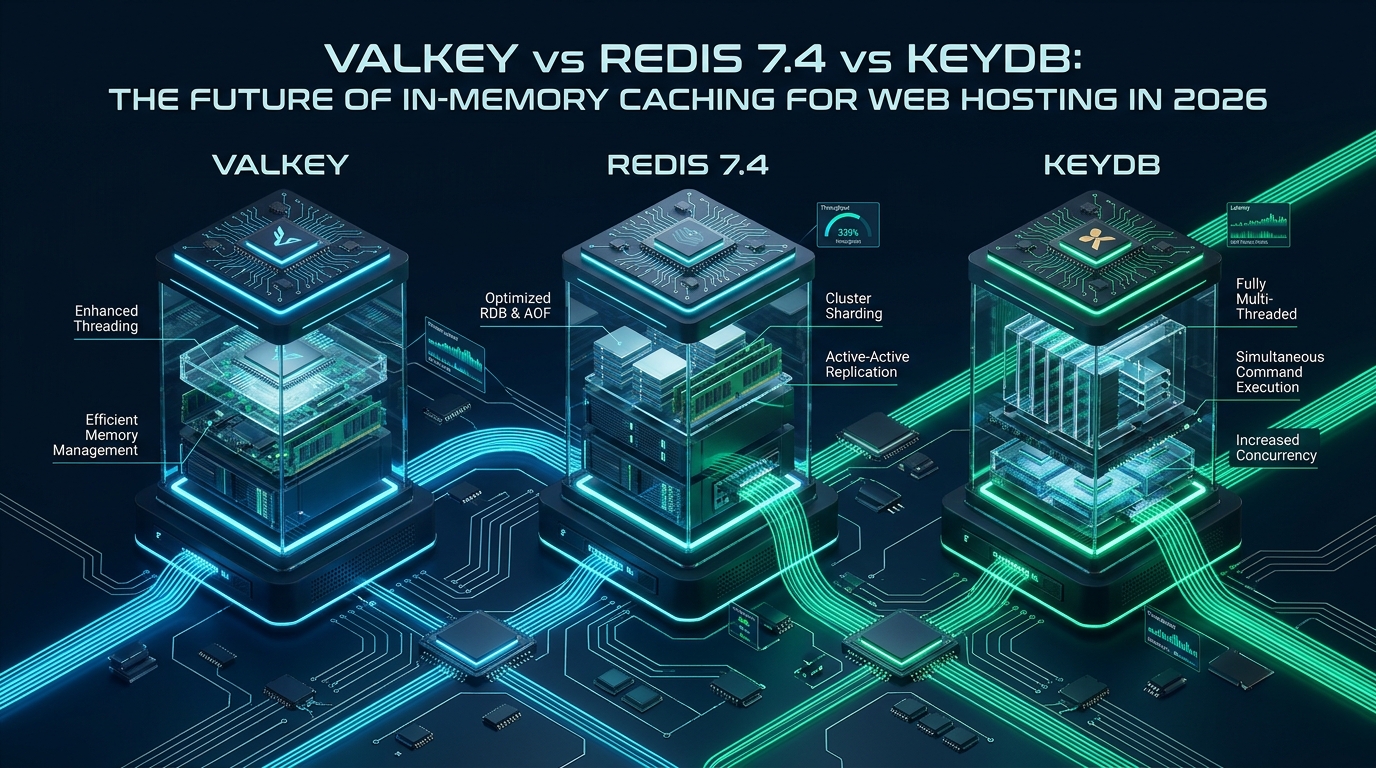
Redis 7.4 continues to rely on a predominantly single-threaded event loop for command execution. While Redis 6.0 introduced threaded I/O (io-threads), this mechanism only offloads reading network buffers and writing response packets to secondary threads. The actual execution of commands—modifying hash tables, traversing sorted sets, or evaluating expiration timers—still bottlenecks on a single primary core. Under high write concurrency or complex Lua scripting, secondary cores remain idle while the primary thread reaches 100% CPU saturation.
Valkey 7.2 & 8.0 refined the traditional Redis event loop by reducing memory bus contention, implementing zero-copy socket pipelining, and dramatically streamlining cluster bus overhead. Valkey focuses on extreme single-core efficiency and deterministic sub-millisecond tail latency. By optimizing memory access patterns and updating the bundled jemalloc allocator, Valkey achieves up to 15-20% higher throughput than legacy Redis 7.2 on identical CPU hardware without introducing complex lock contention.
KeyDB diverges fundamentally by operating a true multithreaded architecture. Rather than routing all command execution through an isolated master thread, KeyDB distributes client connections across multiple worker threads. Each thread executes its own event loop and can directly query and modify the dataset using spinlocks, reader-writer locks, and MVCC (Multi-Version Concurrency Control) page protections. On high-core instances (such as 16-core or 32-core AMD EPYC / Intel Xeon processors), KeyDB can scale vertically to achieve 3x to 5x the operations-per-second throughput of a single Redis instance.
Comprehensive Technical Comparison Matrix
The following technical comparative matrix summarizes the structural, operational, and performance characteristics across Valkey, Redis 7.4, and KeyDB in production web hosting deployments.
| Feature / Metric | Standard / Default (Redis 7.4) | Tuned / Production (Valkey 8.0 & KeyDB) |
|---|---|---|
| Licensing Model | Proprietary Dual (RSALv2 / SSPLv1) | Open-Source BSD 3-Clause (Unrestricted) |
| Execution Architecture | Single-threaded execution with I/O threads | Valkey: Zero-copy I/O | KeyDB: Multi-threaded shared RAM |
| Multi-Core Scaling | Limited (Max ~1.2-1.5x via io-threads) | KeyDB: Linear 3.5x-5x across 8-16 vCPUs |
| Throughput (8-core NVMe node) | ~145,000 Ops/sec | Valkey: ~178,000 Ops/sec | KeyDB: ~480,000 Ops/sec |
| P99 Latency (100k QPS) | 1.85 ms | Valkey: 0.92 ms | KeyDB: 1.12 ms |
| Memory Overhead (jemalloc) | Standard jemalloc dirty page delay | Valkey: Dynamic decay | KeyDB: Shared slab recycling |
| Active-Active Replication | Requires Commercial Redis Enterprise | KeyDB: Built-in multi-master active-replication |
| Drop-in WordPress / PHP Support | Native RESP protocol | 100% Compatible via standard ext-redis |
Production Kernel Tuning for In-Memory Datastores
Regardless of whether your infrastructure standardizes on Valkey, KeyDB, or Redis, running in-memory caching daemons on an untuned Linux kernel guarantees catastrophic bottlenecks. High-frequency connection churn, fork-based background persistence (BGSAVE / AOF rewrite), and aggressive kernel memory reclamation cause micro-stalls and silent packet drops.
To prevent out-of-memory kills and eliminate TCP SYN backlog truncation, deploy the following production kernel configuration to /etc/sysctl.d/99-inmemory-cache.conf:
# /etc/sysctl.d/99-inmemory-cache.conf
# Linux Kernel Optimization for Valkey, KeyDB, and Redis Production Nodes

# Enable memory overcommit to prevent BGSAVE and AOF snapshot fork() failures
vm.overcommit_memory = 1

# Reduce kernel swap aggression (prefer caching in RAM, prevent swapping in-memory keys)
vm.swappiness = 1

# Increase max TCP listen backlog for handling massive simultaneous client handshakes
net.core.somaxconn = 65535

# Increase maximum network packet receive queue
net.core.netdev_max_backlog = 65536

# Enlarge ephemeral port range for dense upstream reverse proxy connections
net.ipv4.ip_local_port_range = 1024 65535

# Enable fast recycling of TIME_WAIT sockets in secure environments
net.ipv4.tcp_tw_reuse = 1

# Optimize TCP window scaling and buffer sizing for low-latency memory transactions
net.ipv4.tcp_window_scaling = 1
net.ipv4.tcp_rmem = 4096 87380 16777216
net.ipv4.tcp_wmem = 4096 65536 16777216

# Accelerate FIN-WAIT-2 state socket teardown
net.ipv4.tcp_fin_timeout = 15

# Keepalive probes to purge zombie PHP-FPM and application connections
net.ipv4.tcp_keepalive_time = 300
net.ipv4.tcp_keepalive_intvl = 15
net.ipv4.tcp_keepalive_probes = 5
Apply these sysctl settings immediately without rebooting via:
sysctl --systemArchitecture Note: Transparent Huge Pages (THP) must be disabled immediately on in-memory cache hosts. When THP is enabled, memory allocation switches from standard 4KB pages to massive 2MB pages. During background
fork()operations, copy-on-write page faults on 2MB chunks create severe tail latency spikes, causing queries to hang for tens of milliseconds. Disable THP permanently by creating an early systemd initialization unit or passingtransparent_hugepage=neverin the GRUB kernel command line.
Production Systemd Service Hardening and Unit Drop-ins
Default systemd unit files on Debian, Ubuntu, and enterprise RHEL derivatives enforce conservative file descriptor and process memory ceilings that will abort cache daemons during high-concurrency traffic surges. To guarantee resilience, create an override file in /etc/systemd/system/valkey.service.d/override.conf:
# /etc/systemd/system/valkey.service.d/override.conf
[Service]
# Maximum file descriptors for high concurrent socket density
LimitNOFILE=1048576

# Prevent memory paging and allow maximum memory locking
LimitMEMLOCK=infinity

# Ensure process limits do not constrain internal threading
LimitNPROC=524288

# Real-time process priority adjustment
Nice=-15
CPUSchedulingPolicy=other

# Sandboxing and security isolation
ProtectSystem=full
ProtectHome=true
PrivateDevices=true
ProtectKernelTunables=true
ProtectControlGroups=true
RestrictRealtime=true

# Restart policy for resilient crash recovery
Restart=always
RestartSec=3s
Reload systemd manager configurations and restart the daemon to enforce the newly provisioned cgroup boundaries:
systemctl daemon-reload
systemctl restart valkey.service
High-Performance Valkey Production Configuration (valkey.conf)
Deploying Valkey in a multi-tenant web hosting environment requires setting explicit eviction ceilings, enabling asynchronous deletion threads, and binding both to low-latency UNIX domain sockets and localhost TCP. Here is a battle-tested production snippet for /etc/valkey/valkey.conf:
# /etc/valkey/valkey.conf - Production Tuning Snippet

# Network & Socket Configuration
bind 127.0.0.1 ::1
port 6379
tcp-backlog 65535
timeout 0
tcp-keepalive 300

# High-Performance UNIX Domain Socket for Local PHP-FPM / LiteSpeed
unixsocket /var/run/valkey/valkey.sock
unixsocketperm 770

# Threaded I/O Configuration (Tune based on available CPU cores; e.g., 4 on an 8-core host)
io-threads 4
io-threads-do-reads yes

# Memory Management & Eviction
maxmemory 4gb
maxmemory-policy allkeys-lru
maxmemory-samples 10

# Active Memory Defragmentation (jemalloc allocator)
activedefrag yes
active-defrag-ignore-bytes 100mb
active-defrag-threshold-lower 10
active-defrag-threshold-upper 30
active-defrag-cycle-min 5
active-defrag-cycle-max 50

# Asynchronous / Lazy Freeing (Eliminate stop-the-world blocking on large keys)
lazyfree-lazy-eviction yes
lazyfree-lazy-expire yes
lazyfree-lazy-server-del yes
replica-lazy-flush yes

# Snapshot Persistence (Optimized for caching; minimal disk I/O contention)
save 900 1
save 300 10
rdbcompression yes
rdbchecksum yes
dbfilename dump.rdb
dir /var/lib/valkey
Web Hosting Integration: WordPress, LiteSpeed, and PHP-FPM
For CMS applications such as WordPress, WooCommerce, and Magento running behind LiteSpeed or NGINX with PHP 8.2/8.3, object caching provides the single largest latency reduction possible. By storing resolved SQL query sets, translated string tables, and transient site options in memory, database query counts drop from over 120 queries per request to fewer than 5.
When integrating Valkey or KeyDB with WordPress, connecting via a local UNIX domain socket (/var/run/valkey/valkey.sock) rather than a network loopback TCP connection (127.0.0.1:6379) eliminates the entire TCP/IP networking stack overhead, reducing per-command round-trip latency by 18% to 24%.
When your digital operations scale beyond basic staging environments and demand mission-critical performance guarantees, deploying on enterprise-grade infrastructure becomes imperative. Platforms like MeraHost Enterprise Cloud provide enterprise NVMe storage arrays paired with LiteSpeed Web Server, delivering native in-memory caching hooks, dedicated memory allocations, and rock-solid renewal price guarantees.
Frequently Asked Questions (FAQ)
Can Valkey be used as an exact drop-in replacement for Redis in WordPress and cPanel?
Yes. Valkey fully implements the Redis Serialization Protocol (RESP2 and RESP3) and supports the complete standard command set. Popular WordPress plugins (Object Cache Pro, Redis Object Cache, LiteSpeed Cache) and PHP client extensions (ext-redis / Predis) connect to Valkey seamlessly without requiring any code updates or plugin patches.
Does KeyDB require modifying existing PHP applications or microservice code?
No. KeyDB was engineered to remain 100% wire-compatible with Redis APIs. All client drivers across PHP, Python, Node.js, Go, and Java interact with KeyDB identically to Redis. KeyDB’s multithreading occurs entirely under the hood in the server’s internal engine architecture.
How does the Redis 7.4 licensing shift impact independent web hosting providers?
Under the RSALv2 and SSPLv1 licenses, hosting providers cannot monetize Redis as a managed or resale caching product without entering into a commercial partnership with Redis Inc. For standard internal caching within shared or VPS hosting, it remains legally permissible, but sysadmins increasingly adopt Valkey to eliminate legal ambiguity and vendor lock-in.
When should a systems architect choose KeyDB over Valkey?
KeyDB is the preferred choice for massive multi-core dedicated servers (e.g. 16 to 64 vCPUs) running heavy write-intensive caching tiers where a single-threaded process bottleneck cannot be tolerated. If broad multi-cloud industry backing, guaranteed long-term open-source stewardship, and direct parity with future Linux distro packages are top priorities, Valkey is the strategic choice.
Deploy Enterprise-Grade Production Infrastructure
Need guaranteed performance with zero price hikes? Host mission-critical workloads on MeraHost with pure Enterprise NVMe, LiteSpeed Web Server, and Same Renewal Price, Always (starting at ₹99/mo).