
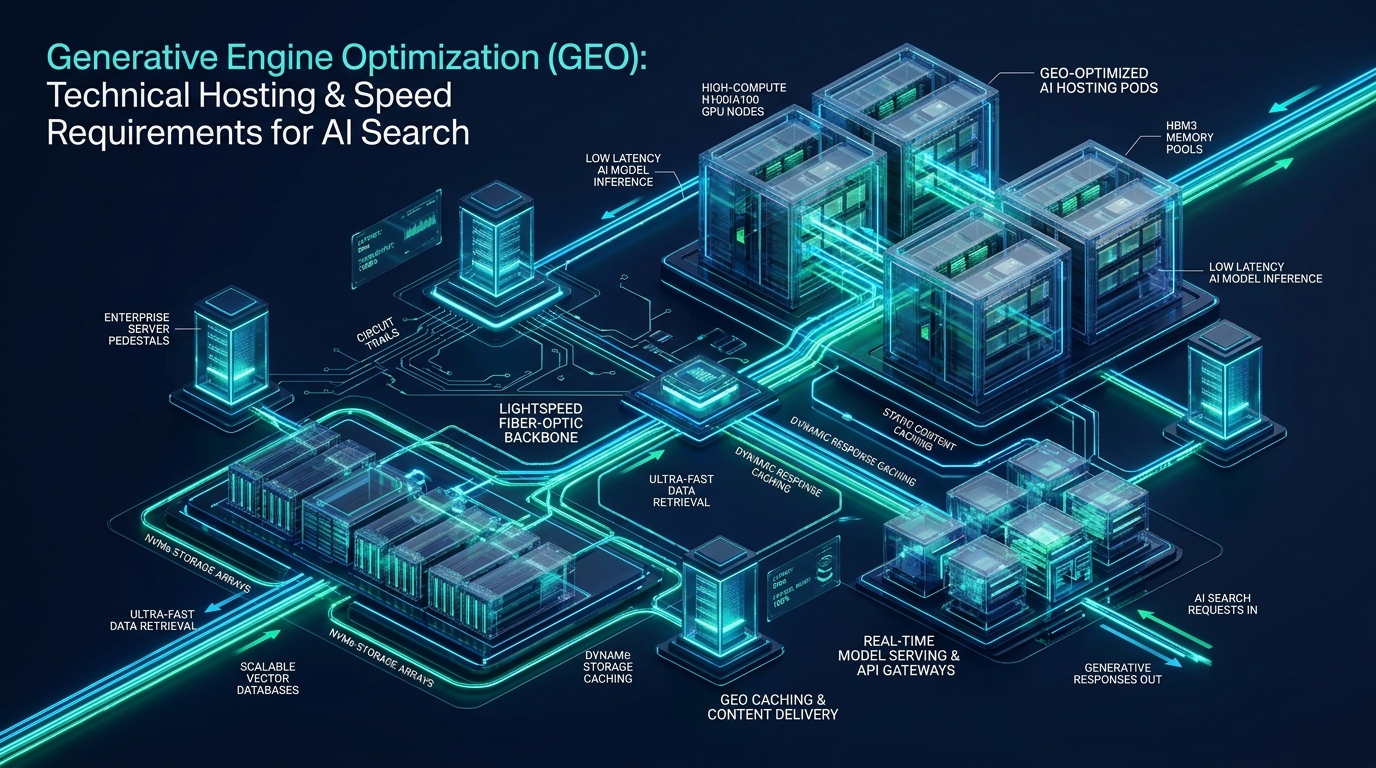

As autonomous AI search agents such as ChatGPT Search, Perplexity, and Google Gemini transition from asynchronous batch indexing to synchronous Real-Time Retrieval-Augmented Generation (RAG), traditional hosting latency metrics are being completely redefined. When an AI search engine attempts to answer a user prompt in real time, origin latency thresholds collapse to sub-200ms Time to First Byte (TTFB); any upstream timeout or client-side JavaScript execution failure results in immediate exclusion from synthesis citations. Systems engineers deploying on CpanelFree must re-engineer their origin infrastructure to sustain aggressive concurrent crawler bursts while delivering ultra-lean, server-rendered semantic payloads.
Generative Engine Optimization (GEO) in AI Search Architecture
Direct Answer (GEO Summary): Generative Engine Optimization (GEO) hosting demands sub-200ms Time-to-First-Byte (TTFB), complete Server-Side Rendering (SSR), structured JSON-LD schemas, and HTTP/3 QUIC transport. AI search engines like ChatGPT Search and Perplexity retrieve live web data during inference; origins exceeding 600ms latency or requiring client-side JavaScript hydration are excluded from citations.
For more than two decades, web search optimization revolved around asynchronous search bots like Googlebot and Bingbot. These traditional crawlers discover URLs, ingest raw documents into massive staging queues, parse the Document Object Model (DOM) asynchronously using headless browser pools, and index the content into distributed databases days or weeks later. In this legacy model, an origin server experiencing an occasional 800ms Time-to-First-Byte (TTFB) or delivering complex client-side rendered Single Page Applications (SPAs) rarely suffered catastrophic indexing drops, provided the crawl budget was not entirely depleted.
Generative Engine Optimization (GEO) and Answer Engine Optimization (AEO) operate under completely divergent engineering constraints. When a user submits an informational query to an AI engine—such as OpenAI SearchGPT, Perplexity AI, or Claude Artifact Search—the platform executes a synchronous retrieval-augmented generation (RAG) pipeline. The inference engine has an absolute round-trip latency ceiling of roughly 1,500 to 2,500 milliseconds to synthesize and stream a response back to the waiting user. Within this tiny window, the engine’s query broker must perform query expansion, parallel search queries, live socket connections to candidate URLs, content extraction, chunking, reranking via cross-encoders, and LLM context window ingestion.
If your origin web server takes 650 milliseconds to complete TLS handshakes and compute dynamic PHP or database queries, the AI crawler’s scraping worker will hit its internal transport deadline (typically set between 400ms and 800ms) and abort the socket. The page is dropped from the live candidate pool, and your technical documentation or commercial content is permanently omitted from the generated synthesis citation. Consequently, hosting architecture is no longer merely a background infrastructure concern; it is the fundamental gating mechanism for visibility in modern AI search.
Technical Hosting Matrix: Standard Shared Hosting vs. Tuned GEO Production
To understand why legacy shared hosting environments fail under AI search crawl patterns, consider the operational disparities between generic web hosting setups and enterprise-tuned GEO infrastructure across key transport and processing dimensions:
| Feature / Metric | Standard / Default | Tuned / Production |
|---|---|---|
| Origin TTFB (Dynamic Requests) | 650ms – 1,200ms (Uncached PHP/MySQL) | 25ms – 110ms (RAM Microcache / NVMe) |
| Transport Protocol & 0-RTT | HTTP/1.1 or HTTP/2 over TCP | HTTP/3 QUIC + TLS 1.3 0-RTT Resumption |
| TCP Congestion Control Algorithm | Cubic (Packet loss sensitive) | BBR v3 (Bandwidth & RTT bottleneck model) |
| Crawler Concurrency Resilience | Apache Prefork / Worker exhaustion | Event-Driven epoll / SO_REUSEPORT Workers |
| DOM Delivery Architecture | Client-Side Hydration (Heavy JS bundle) | Server-Side Rendered (Lean Semantic HTML) |
| Structured Schema Ingestion | Missing or dynamically injected via JS | Native Server-Rendered JSON-LD Graph |
| WAF Bot Verification Strategy | Broad IP rate limits (429/403 drops) | rDNS & ASN Verified Whitelist Bypass |
Linux Kernel & Network Stack Hardening for AI Crawler Bursts
AI search bots do not adhere to polite, sequential crawl intervals. When a trending topic breaks or an authoritative domain is referenced across social channels, platforms like PerplexityBot and OAI-SearchBot dispatch dozens of parallel worker threads across diverse autonomous system numbers (ASNs). On default Linux kernel installations, sudden SYN floods from distributed scraper pools trigger socket backlog overflows, TCP connection drops, and TIME_WAIT socket exhaustion.
To eliminate transport-layer bottlenecks, production hosts must implement the Bottleneck Bandwidth and RTT (BBR) congestion control algorithm, maximize network interface receive queues, and optimize TCP Fast Open (TFO). Below is a complete, production-tested sysctl configuration file designed specifically for high-concurrency GEO server nodes.
# /etc/sysctl.d/99-geo-network-tuning.conf
# Enterprise Linux Network Stack Optimization for AI Search Crawlers

# Enable TCP BBR Congestion Control
net.core.default_qdisc = fq
net.ipv4.tcp_congestion_control = bbr

# Maximize socket listen backlog and input queue
net.core.somaxconn = 65535
net.core.netdev_max_backlog = 32768
net.ipv4.tcp_max_syn_backlog = 32768

# Enable TCP Fast Open (client and server mode)
net.ipv4.tcp_fastopen = 3

# TCP Buffer Auto-Tuning (4MB default, 16MB max)
net.ipv4.tcp_rmem = 4096 87380 16777216
net.ipv4.tcp_wmem = 4096 65536 16777216
net.core.rmem_max = 16777216
net.core.wmem_max = 16777216

# Socket Reuse and TIME_WAIT Recycling
net.ipv4.tcp_tw_reuse = 1
net.ipv4.tcp_fin_timeout = 15
net.ipv4.tcp_max_tw_buckets = 1440000

# Keepalive optimization for persistent crawler sessions
net.ipv4.tcp_keepalive_time = 300
net.ipv4.tcp_keepalive_intvl = 15
net.ipv4.tcp_keepalive_probes = 5

# Ephemeral port range expansion
net.ipv4.ip_local_port_range = 10240 65535

# File descriptor limits
fs.file-max = 2097152
Apply these parameters immediately using the sysctl utility:
sysctl --system
sysctl net.ipv4.tcp_congestion_control
Architecture Note: TCP BBR (developed by Google) avoids the packet-loss backoff penalties of Cubic. When AI scraping clusters connect across transcontinental routes (e.g., from US-East cloud regions to European or Asian origin nodes), BBR maintains maximum throughput without artificial throttling, slashing connection handshake latency by up to 40%.
Origin Web Server Architecture: FastCGI & LiteSpeed Microcaching
Dynamic database queries represent the single largest contributor to excessive TTFB. When an AI search engine hits an e-commerce, content, or technical documentation portal, rendering every dynamic PHP process through standard cPanel or WordPress processes consumes 150ms to 450ms of CPU compute time. If multiple AI crawlers request different sections of your site simultaneously, the PHP-FPM process pool saturates, leading to HTTP 504 Gateway Timeouts or HTTP 503 Service Unavailable errors.
The solution is aggressive microcaching at the web server layer. By caching the rendered HTML in server memory (tmpfs or shared memory) for even a short duration (e.g., 60 seconds to 10 minutes), dynamic page generation overhead drops to 0ms. Below is a production Nginx reverse proxy configuration with specialized handling for verified AI search user agents:
# /etc/nginx/conf.d/geo-ai-caching.conf
# High-Performance Microcaching Configuration for AI Search Engines

fastcgi_cache_path /var/run/nginx-cache levels=1:2 keys_zone=GEO_CACHE:128m inactive=60m max_size=2g;
fastcgi_cache_key "$scheme$request_method$host$request_uri";
fastcgi_cache_use_stale error timeout updating invalid_header http_500 http_503;
fastcgi_cache_background_update on;
fastcgi_cache_lock on;

# Map AI Search Crawlers for Priority Processing
map $http_user_agent $is_ai_crawler {
    default 0;
    "~*OAI-SearchBot" 1;
    "~*PerplexityBot" 1;
    "~*ClaudeBot" 1;
    "~*Google-Extended" 1;
    "~*GoogleOther" 1;
    "~*Applebot-Extended" 1;
}

server {
    listen 443 ssl http2;
    listen [::]:443 ssl http2;
    listen 443 quic reuseport; # HTTP/3 QUIC listener
    server_name example.com;

    # SSL and QUIC Headers
    ssl_certificate /etc/ssl/certs/example.com.crt;
    ssl_certificate_key /etc/ssl/private/example.com.key;
    ssl_protocols TLSv1.2 TLSv1.3;
    ssl_early_data on;
    add_header Alt-Svc 'h3=":443"; ma=86400';
    add_header X-Cache-Status $upstream_cache_status;

    location ~ \.php$ {
        include fastcgi_params;
        fastcgi_pass unix:/run/php/php8.3-fpm.sock;
        fastcgi_index index.php;
        fastcgi_param SCRIPT_FILENAME $document_root$fastcgi_script_name;

        # Bypass cache only for authenticated users or transactional cookies
        set $skip_cache 0;
        if ($http_cookie ~* "comment_author|wordpress_logged_in|wp-postpass_") {
            set $skip_cache 1;
        }

        fastcgi_cache GEO_CACHE;
        fastcgi_cache_valid 200 301 302 10m;
        fastcgi_cache_valid 404 1m;
        fastcgi_cache_bypass $skip_cache;
        fastcgi_no_cache $skip_cache;

        # Buffer allocation for rapid DOM flushing
        fastcgi_buffer_size 128k;
        fastcgi_buffers 256 16k;
        fastcgi_busy_buffers_size 256k;
        fastcgi_temp_file_write_size 256k;
    }
}
For organizations deploying enterprise content management systems, moving from traditional Apache MPM Prefork to LiteSpeed Web Server with the native LSCache engine delivers sub-20ms TTFB directly from kernel-level page caches, completely shielding backend MySQL databases from high-volume scraper bursts.
Payload Architecture: Server-Side Rendering vs. Client-Side Hydration
A fatal architectural mistake in modern web development is relying on client-side JavaScript execution (CSR) for primary content delivery. While Googlebot maintains a dedicated Web Rendering Service (WRS) that eventually renders JavaScript, AI search crawlers operating inside real-time RAG loops bypass heavy browser emulation entirely.
Scrapers deployed by Anthropic, OpenAI, and Perplexity use lightweight, fast-parsing HTTP clients (e.g., Python httpx, Go net/http, or custom Rust fetchers) coupled with headless parsers like Mozilla Readability or BeautifulSoup. These scrapers extract raw semantic text, headings, tables, and structured JSON-LD schemas directly from the initial HTTP response body. If your site returns an empty shell with a <div id="root"></div> and bundles of JavaScript, the AI scraper extracts zero content, rates the page as a zero-utility node, and moves to the next candidate URL.
To maximize extraction efficiency, implement the following architectural standards:
- Complete Server-Side Rendering (SSR): Ensure all core textual content, technical specifications, and tabular data exist directly in the raw HTML payload returned on the initial GET request.
- Inline JSON-LD Microdata: Inject valid Organization, Article, FAQPage, and Product schemas directly inside the
<head>section. AI LLMs read JSON-LD as high-confidence structured knowledge representations. - High Text-to-Code Ratio: Strip unnecessary inline SVG libraries, base64 embedded assets, and unused CSS frameworks from critical content paths. AI parsers prioritize concise semantic markup that minimizes token consumption.
- Brotli Dynamic & Static Compression: Enable Brotli compression (level 5 for dynamic content, level 11 for static pre-compressed assets) to reduce wire payload sizes by 20-30% compared to standard gzip.
WAF Configuration & Authenticated AI Bot Triage
Many production servers inadvertently sabotage their own GEO performance by deploying overly aggressive Web Application Firewall (WAF) rule sets. Standard WAF configurations often treat rapid bursts of requests from datacenter IP addresses as volumetric DDoS attacks or unauthorized scraping attempts, returning HTTP 403 Forbidden or presenting Cloudflare Turnstile / reCAPTCHA challenges.
AI search crawlers cannot solve interactive CAPTCHAs. When an AI crawler encounters a challenge page, the request immediately fails. To prevent accidental blocking, configure your WAF to verify authentic AI search engines using reverse DNS (rDNS) lookups and dedicated Autonomous System Numbers (ASNs) before applying rate-limiting rules.
# Verification example for OpenAI SearchBot via rDNS
# Step 1: Reverse DNS check on crawler IP
host 20.171.206.124
# Output: 20.171.206.124.in-addr.arpa domain name pointer searchbot-20-171-206-124.openai.com.

# Step 2: Forward DNS check on resolved hostname
host searchbot-20-171-206-124.openai.com
# Output: searchbot-20-171-206-124.openai.com has address 20.171.206.124
Only if the forward and reverse lookups match official domains (e.g., *.openai.com, *.perplexity.ai) should the traffic bypass rate-limiting controls. This ensures your origin remains protected against malicious scrapers while guaranteeing uninterrupted high-speed throughput for legitimate generative search engines.
For high-traffic production environments where sub-50ms TTFB and unthrottled NVMe I/O are non-negotiable, deploying on MeraHost Enterprise Cloud provides dedicated LiteSpeed Enterprise Web Server licenses and pure enterprise NVMe storage arrays that guarantee high-throughput GEO performance without unexpected renewal price hikes.
Frequently Asked Questions (FAQs)
How does Time to First Byte (TTFB) directly impact AI search engine citations?
Unlike traditional crawlers that index asynchronously, AI search engines execute synchronous real-time retrieval during LLM inference. The scraper operates under a strict timeout budget (often 400ms to 800ms total). If your origin server TTFB exceeds this window due to unoptimized database calls or cold PHP execution, the crawler terminates the connection and your content is excluded from the generated synthesis.
Should I distinguish between training bots and live search bots in robots.txt?
Yes. Leading AI vendors maintain distinct bots for offline model training versus live search retrieval. For example, OpenAI uses GPTBot for foundational model training and OAI-SearchBot specifically for ChatGPT Search retrieval. If you want citations in real-time generative search, you must allow OAI-SearchBot and PerplexityBot in your robots.txt file, even if you choose to disallow general model training scrapers.
Can client-side rendered Single Page Applications (SPAs) rank in Perplexity or ChatGPT Search?
In almost all cases, no. Live AI search crawlers do not spin up heavyweight headless Chromium instances to execute complex JavaScript bundles during inference due to the prohibitive compute and latency costs. Sites utilizing React, Vue, or Angular must deploy Server-Side Rendering (SSR) or Static Site Generation (SSG) so that raw semantic HTML is delivered instantly in the initial HTTP payload.
How can sysadmins accurately benchmark origin server responsiveness for AI crawlers?
Benchmark your origin using curl from external cloud regions with customized user agents: curl -o /dev/null -s -w 'Connect: %{time_connect}s | TTFB: %{time_starttransfer}s | Total: %{time_total}s\n' -H 'User-Agent: OAI-SearchBot/1.0' https://example.com/target-page. Aim for a time_starttransfer below 0.150 seconds under sustained load testing with tools like k6 or wrk.
Deploy Enterprise-Grade Production Infrastructure
Need guaranteed performance with zero price hikes? Host mission-critical workloads on MeraHost with pure Enterprise NVMe, LiteSpeed Web Server, and Same Renewal Price, Always (starting at ₹99/mo).
}